
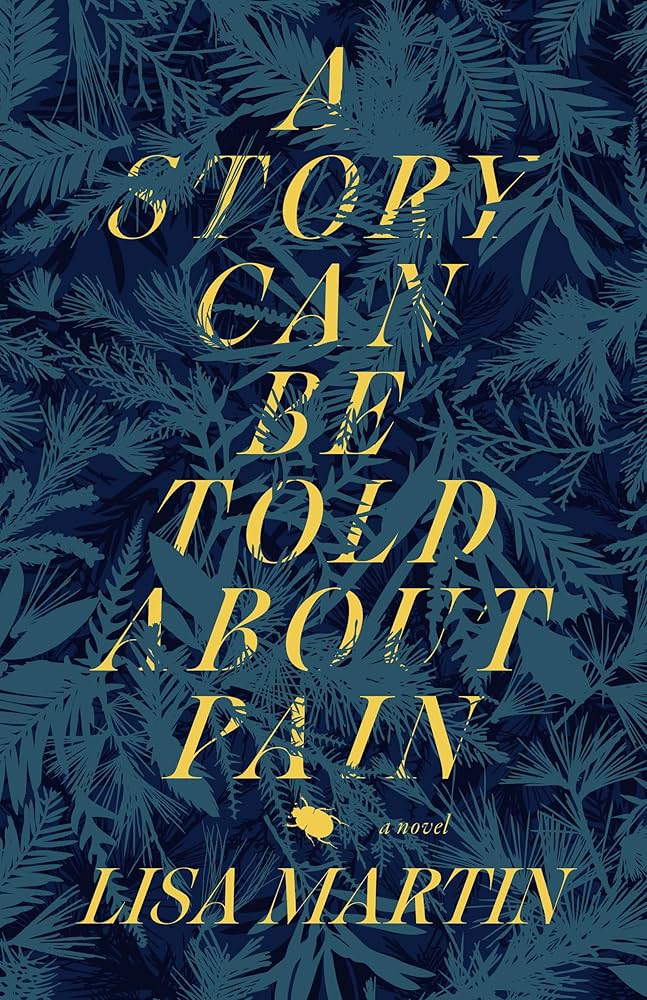
A Story Can be Told about Pain
Lisa Martin
NeWest Press
Publication Date: May 1, 2025
The atmosphere of an abandoned psychiatric hospital brings its own kind of haunting, that draw from fractured memory, ruin and also forgotten history. For Lisa, encountering photographs of these derelict spaces, where, “leaf litter on the floors” and “paint peeling off the walls in layers…looked like lichen,” led to what she describes as the “unified gestalt” for her debut novel, A Story Can be Told About Pain. From our years as PhD students in the Department of English at the University of Alberta, both of us struggling to find form and structure for our respective research projects, I have watched Martin move from her foundation of lyrical poetry towards this unwieldy task of prose. She grounds what could have been a fugacious anecdote about a family’s legacy of suicide into her own “spiritual autobiography” creating a novel that functions as a container for both historical trauma and personal survival. In my interview with her, we discuss the aesthetics of abandonment and dereliction, the blending resonance of grief and the radical ethical obligation of a novelist to witness pain without being consumed by it.
JV: What originally inspired you to take on the massive subject of the trauma caused by World War II? Given the vast scope of literature on that era, was there a specific piece of history, a photograph, or an untold story you encountered during your research that became the necessary catalyst for this novel and compelled you to write it now?
LM: The catalyst that is most clear to me is that I knew someone whose sister had married a German guy, and one day my friend mentioned that her German brother-in-law’s grandparents had all died by suicide—all four of them (!). This fact was so staggering to me that it opened up questions for me about the legacies of guilt we bear, the ways that cultural guilt and trauma get handed down in families. And my grandmother’s closest sister had been a nurse overseas during the second world war, stationed in England and then in Germany. And I had interviewed her extensively about her life before she died, with a little microphone attachment stuck into an old Ipod, before I had any inkling I’d write this novel, just out of interest in her and her life and her stories. So I felt I had some way in, some material I could work with.
JV: The sense of place is often critical in a novel dealing with trauma. Beyond the historical backdrop of World War II, what significance did you find in choosing your primary setting, such as the hospital grounds or the community where the characters reside? How did the atmosphere of that physical location contribute to or confine the characters’ ability to heal?
LM: I came to the setting first, actually, before I had anything resembling a story. I had been looking online at photographs of abandoned psychiatric hospitals—all of these derelict buildings that were somehow both totally ruined and also incredibly beautiful in the ways they were falling to ruin. Leaf litter on the floors. Paint peeling off the walls in layers, so it looked like lichen. I was incredibly interested in thinking about what the appeal is of derelict spaces. That was a question I couldn’t exhaust for myself at the time, no matter how much I turned it around in my mind: what is it about dereliction that is so compelling? And you need a question like that for a novel. I need a question like that.
Anyway, in the comments section of this website with photos of abandoned psychiatric hospitals, I read a comment by a teenager: “I partied there.” And I thought to myself, in a kind of unified gestalt of an idea, two things simultaneously: 1) “That’s not really partying”—i.e. a teenager getting shitfaced in a ruined asylum is something a bit darker than that—and 2) I know something about that kind of mistake, the mistake of thinking you’re “partying” when you’re not actually having a good time at all, on any level, when you might even be having the worst time of your life. And so all of a sudden I had a character with this kind of troubled relationship to a ruined space, a character with ruin inside them as well as outside of them, and the fire was lit.
So this novel, to me, is inconceivable without that primary setting. And I liked the idea of a supportive housing complex that backs onto the space of the ruined asylum because it introduces this kind of liminal space that a lot of people live in—adjacent to ruin, if not quite fully in it, yet. But the threat is there. The edge is there. I know something about that, too. So the book gave me a way to take up a lot of things that I know and have embodied at one point or another in my life. And it gave me a way to think about all of these things that I had, as the poet Seamus Heaney puts it, “stored up as I grew.” I was 26 when I began. And I set myself this incredibly massive task. It was totally unwieldy. But somehow I did come to wield it. Through stubbornness, mostly. And because I didn’t lose interest.
JV: Each of your previous forms –poetry and non-fiction — demands a distinct relationship with truth and the author’s voice. The poet speaks through lyric truth, the journalist through verifiable truth. As you construct a fictional world, how do you reconcile these different approaches to ‘truth’ in your novel, and what did you have to consciously silence or amplify in your own writerly voice to allow the pure invention of the novelist to emerge?
LM: This is an interesting question to try to think through. I think the novel forced me to work out as deep a psychological truth as I could access for each of my characters. By this I mean that I needed to try to understand not just who they were but how they had become who they were, and why—the mechanism of that. And then I needed to try to find a narrative truth—by which I think I mean something like a series of actions or plot points that would unfold from out of who the characters were, rather than from some kind of stage directing by me. And it took a long time listening to the world I had created and the characters I had placed in that world—like a safecracker listening, maybe—for things to tumble into place.
But across all these forms, a kind of extreme commitment to listening—straining to hear and then to articulate things accurately enough, with enough precision—feels central to what truth is, what we (or I) mean by that word. I’m not sure that I am conscious of having needed to silence or amplify anything in particular in my writerly voice. But I did need to endure. To abide with it all for a long time when it simply wasn’t working. And to keep trying to hear what it needed.
JV: It’s hard not to see the poet in you in this book, the observation, the details, the reflections, all are resonances of loss and faith found in your third poetry collection, Believing is Not the Same as Being Saved. My question comes from these extensive moments of exposition and reflection in the novel: How did you navigate balancing the demands of novelistic plot and momentum with those deeply contemplative, almost lyrical passages, which feel so distinctly linked to the concerns of your poetry?
LM: To some extent, I just tried to write the kind of book I like to read. I like novels with digressions and discursive or even expository passages as long as they are meaningfully connected to the story and feel purposeful and warranted. I don’t think I actually have any true digressions or discursive or expository passages. But I gave myself a lot of rope, a lot of leeway, to do what I felt I needed to do to give the novel the kind of philosophical and existential heft I wanted it to have. And hopefully a reader will agree with me that those risks have paid off. I’m sure some readers will not agree, and that is ok. A book can’t—shouldn’t—be for everyone.
I did have a steely intention from the beginning not to write a “poet’s novel”—by which I meant a novel that flouts the conventions of the novel and tries to compensate for its lack of plot with description and lyrical prose or by claiming to be “experimental.” I intended to respect the form I was working in and I think I got there, even if—in the end—the novel is a poet’s novel, actually, after all. But (I think) it is a poet’s novel in the sense that it bears the trace of having been written by a poet, rather than because it isn’t a conventional narrative. I believe I succeeded in writing something that deeply respects–and works actually fairly conservatively within–the conventions of the literary novel.
JV: The research supporting this book is extensive, and the structure is fascinating. The narrative is framed by a first-person prologue and epilogue in Shiloh’s voice, which invites us into the lives and pains of characters like Raymond, Dave, and Madeline. What creative opportunities did you find in alternating between Shiloh’s intimate first-person voice and the third-person perspectives focused on the ensemble’s collective experience of pain?
LM: I had an instinct from the beginning that I needed to move back and forth between first person and third person, and in fact an early draft brought in Shiloh’s first person voice quite a bit more throughout the third part of the novel. My initial idea was that trauma keeps us at a distance from our own stories but that as we integrate the story and become able to tell it, the connection to the self becomes stronger (so we can move from telling the story at a distance, in the third person, to embodying our own first-person perspective). That’s an oversimplification. But I had the sense that the movement between first and third person had something interesting to do with representing post-traumatic experience. A trusted reader told me that the oscillation between first and third person in that early draft was confusing and recommended making the first person narration a simple frame for the book instead. That was a good suggestion. The book is better for it. And I think the original idea still comes through in its way.
JV: I’m fascinated by the connection you draw between emotional and physical pain. This is powerfully embodied by Raymond, whose near-suicide is a physicalized release of unexpressed anguish, and by the self-destructive acts of Shiloh and the others (their truancy, drug use, and violence in the hospital grounds). First, does the novel suggest that unacknowledged internal pain will always find a physical or external form of expression? Second, what do these self-destructive acts reveal about the necessity of having profound, internal pain witnessed or shared?
LM: I don’t know if I would say “always…a physical or external form,” but I do think that unacknowledged internal pain will find ways to express itself—and that the ways it expresses itself are likely to be destructive as long as we remain unwilling—or unable—to acknowledge (and turn toward, instead of away from) the pain we’re in.
JV: Your work consistently navigates the terrain of shared trauma and the burden of the witness. The struggle of Shiloh and her mother, for instance, highlights how personal grief is compounded by seeing the pain of someone you deeply love. In transferring your real-life experiences of loss to fiction, what is the weight of portraying this ‘double grief’—the pain of loss itself, coupled with the pain of watching a loved one suffer—and what does that act of profound empathy reveal about the nature of human connection?
LM: This is a complex question and I don’t know if I can answer it fully. For a child, trauma is trauma because no one—no parent or other safe adult—was able to intervene to protect or shield the child—to contain, in other words, the overwhelming experience, to keep them safe. So everything that comes after that core experience—whether it is one’s own suffering or the pain of another—lands on top of that originary experience of trauma. Pain—even vicarious emotional pain—is not just pain now but pain then. That’s just how brains work. Profound empathy is powerful partly because it shatters alienation. (Does trauma always have an aspect of alienation, of being alone with our pain? I don’t know. But profound empathy crashes through all that.) But it’s not such a long walk in truly difficult circumstances from “profound empathy” to “vicarious trauma”—or even to feeling triggered. So we have to be careful with ourselves and each other when it comes to pain.
I am not a clinician, and I in no way intend all this to pass as an authoritative description of trauma. This is just my own way of making sense of all of it. But: I have come to understand trauma as harmonic—something that resonates throughout our lives—sometimes subtler and less pronounced, sometimes louder and more insistent, more plainly connected to the original crisis. And the more it is possible to contain the original experience that couldn’t be contained at the time (a coherent story is one such container; a therapist is another), the less overwhelming the harmonic echoes of traumatic pain may eventually become in our lives, but it takes much practice and intention and repetition. Re-training the brain and nervous system, essentially. But healing can occur. And post-traumatic growth can be profound.
JV: Your novel provides two compelling paths for coping with trauma: the active mending demonstrated by Madeline, who cares for broken plants and people, and the willful withdrawal of Eva, who ‘does not want to be found.’ This contrast is striking. Does the novelist have an ethical obligation to narrate pain toward a possibility of healing, or is there space for the kind of defiant, untended, and un-narrated suffering embodied by a character who simply ‘does not want to be found’?
LM: I tried to write Eva’s character with a real respect for how absolutely overwhelming psychic pain can be. Her right to not be found feels central to me, and I think Joy, the nurse, embodies that radical respect for her. As for the novelist’s obligation, I do think at least the kind of novelist I want to be does have a duty of care toward the reader. Does that mean all pain has to be narrated toward a possibility of healing? I don’t think so. I believe some pain is terminal. But I have a deep belief in the possibilities of healing. Not the kind of healing advertised in my evangelical Christian childhood—as a miracle from above—but something incredibly ordinary and natural, like a burn that heals, even if it scars terribly, like the new pink skin that can grow where there was a brutal, infected wound. Ordinary healing comes from us, ourselves, just from who we are and what we are already made of. And from the kindness we show to ourselves. And from relationships that are safe and that respect and support us. We can and do survive astonishing things as human beings.
The novel is deeply interested in pain, as I am in real life. Could pain be a form of intelligence on the situation? Could we practice turning toward it, instead of away, when that feels safe? Could we listen to it, get closer to it, let it confide in us what it knows? Could we do more than just survive? Could our pain one day diminish? What would that take? What would that look like?
JV: There’s a subtle but strong current of faith running through the novel. The name for instance, Shiloh is particularly interesting, given its meaning of ‘peace’ and its biblical weight. Did you deliberately choose the name Shiloh to function as a symbolic undercurrent, contrasting her internal world of trauma with the name’s promise of tranquility or peace?
LM: I chose that name long enough ago that I was worried when Brad Pitt and Angelina Jolie called their baby Shiloh that people might think I got the idea from them, haha. So it’s been with me a long time now. I did choose it because of its religious associations and the emotional register I felt it offered.
JV: I know this is a sensitive topic, but given the recurrence of loss and pain in your work—and the recurring theme of seeking tenderness of self as a path to ‘healing’—I have to ask: Where do you see the connection between experiencing grief and loss in your own life and processing those themes through the world of fiction? Does writing about pain help you negotiate how much of it you remember as you evolve?
LM: At the time I began writing the novel, I knew there were whole swathes of my life—of trauma—I hadn’t gotten to or touched yet in writing the two books of poems I had already published, which were largely about the deaths of my parents and religious trauma from the years my dad was ill. I hadn’t gotten to adolescence yet or to my own (or my mother’s) mental health yet. And even though the novel isn’t autobiographical at a plot level—none of these characters is a direct stand-in for me or for my experience—it is a kind of spiritual autobiography, taken as a whole. The characters, taken together, helped me to work out some of the central losses and experiences of traumatic pain in my own life.
I read somewhere that, in the lab, “earned secure attachment” can be measured by the ability to tell a coherent story about an incoherent or chaotic (i.e. traumatic) primary experience of attachment. Working on this book was the methodology I used—along with therapy, to be clear—to walk myself to that place of being able to tell a coherent story about my own life. It took a long time, but I was able to get there. The novel was so hard to write partly because I had set myself such a difficult problem. The novel is in no literal way a story about my life. But being able to tell a fictional story that got at the emotional truth of my real life in some way was a critical first step—or accompanying step—for me in being able to tell myself the true story of my own chaotic experiences. For a long time, writing was how I tried to understand what I remembered. Now I understand and remember quite fluently. It’s remarkable, really, when I think of how fractured my memory used to be.
JV: The novel’s title, A Story can be told about Pain, is deeply evocative and comes directly from the text. How do you feel this phrase encapsulates the novel’s central theme of pain, trauma, and the search for tenderness?
LM: That’s a good question. I had this sentence as an anchor from early on. Sometimes when I didn’t know anymore what I was trying to do, I would just write down again, “A story can be told about pain.” So it was something I had a hold of intuitively as a reminder to myself. If I try to think about what I think it meant to me back then—distinct from how I think about that line or the title now—I think I meant something like: “It’s possible to make a coherent story even out of pain that was overwhelming at the time. It might be hard. It might have to be done by stitching together different perspectives. But I have an instinct that it can be done and I’m going to stay with it until I do. The story can be told.” So it was, at its core, an affirmation. It was always crucial to me not to bludgeon the reader with pain. I wanted to tell a story that did justice to my subject matter but it was important to me that it was a good story—a good container—and not too dark or gratuitously heavy a story. I wanted to write a story about pain that still held out the possibility of consolation.
JV: Now that you have successfully published this novel, which we know was years in the making, what’s next? Are you already at work on a new novel, and given the arduous journey of the last one, do you anticipate the process will be fundamentally easier or more difficult now that you have crossed the finish line?
LM: I have to think whenever I—if I ever—write another novel, it will be easier on some level because I now know what a novel is from the inside, instead of only from the outside. I would approach the whole thing very differently going into it a second time. I would be much more concerned about structure from the beginning, for example, instead of having to—as Daphne Marlatt said to me when I worked with her on this novel (at the Banff Centre’s Writing Studio)—“thrash around in the structure” for years. But I’m not “working on” anything yet. I am working. Reading, writing, thinking deeply, taking notes, making myself voice memos—hovering over the face of the deep. This is the work that is by far the most important, for me, for my process—everyone’s different. I’m working my way in. Without this ground work, I’ve got nothing. And I am very intent on not rushing this part of the process.
Bio
Lisa Martin is the author of two full-length collections of poetry, One Crow Sorrow (Brindle & Glass, 2008) and Believing is Not the Same as Being Saved (University of Alberta Press, 2017). Her creative work has won a National Magazine Award for Personal Journalism and the Writers’ Guild of Alberta’s Stephan G. Stephansson Award for Poetry. Her second collection of poems was a finalist for the Robert Kroetsch City of Edmonton Book Prize. The anthology of literary essays she co-edited, How to Expect What You’re Not Expecting, won an International Independent Publisher’s Award (IPPY) in 2015. She has also collaborated on major projects with both the Edmonton Opera and Ballet Edmonton. A Story Can Be Told About Pain (NeWest Press) which forms the basis of this interview, became her first entry into fiction.
INTERVIEWER
Jumoke Verissimo is a poet and novelist living in Toronto, Canada. She is the author of two well-received poetry collections, i am memory and The Birth of Illusion, both published in Nigeria and nominated for various awards, including the Nigeria Prize for Literature. Her debut novel, A Small Silence, received critical acclaim and was nominated for the Edinburgh Festival Book Award and the RSL Ondaatje Prize and won the Aidoo-Synder Book Prize. Her latest book, Circumtrauma, is published by Coach House Books, Canada.