
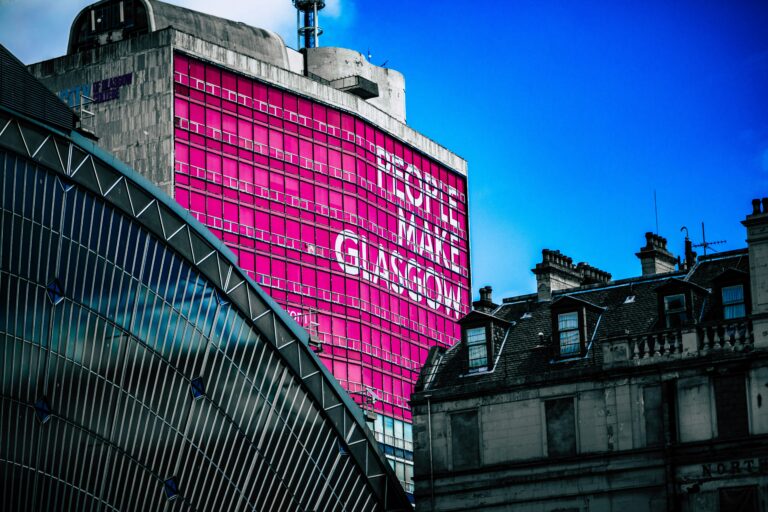
The Met Tower is an eyesore. Rising over George Square in Glasgow, Scotland, the fourteen-storey modernist building has sat unused since 2016, despite multiple attempts at both renovation and demolition. The tower is a giant concrete block, standing upright like a sideways shoebox. Formerly hosting Glasgow City College, it has long since been abandoned for a new campus down the road. The façade has bleached from years under the sun. Dirty, broken windows and a look of ruin contrast with the more dignified buildings in the area, like the historical Glasgow City Commons and the James Weir building. The Met Tower is a Glasgow landmark, not only because of its 60-year presence in the city, but because of the design that covers its south side. The interior of the windows is plastered over with electric-pink plastic and inscribed with “People Make Glasgow” in blocky white font. The design was unveiled in 2014 in anticipation of the Commonwealth Games, held in Glasgow that year. With the plastic peeling from the inside, the pink faded to a dull salmon, and the white letters barely visible from afar, the Met Tower has become a blemish amongst the city’s more elegant architecture. However, its message has remained for over a decade.
I arrived in Glasgow on a misty January afternoon in 2023. I had chosen Scotland for my academic exchange. I came not only because of my heritage (my dad’s side of the family can trace its lineage back to the MacRae clan and Eilean Donan Castle), but also because of its history. I spent my teen years poring over biographies of Mary, Queen of Scots and learning about the hundreds of castles that dotted the Highlands. I was drawn to Glasgow’s thousand-year-old cathedral, historic parks, and beautiful Victorian buildings. I felt that I had something to learn about my heritage, and maybe myself, by going there.
I soon learned that it was not exactly the romantic city I saw in TikTok edits and promotional pictures. Desperate to find a place to live, any place, I signed a lease on a flat in the city centre just days before Christmas. The cabbie dropped my dad and me off in front of the mid-sized apartment building, a burnt orange colour, sandwiched between a 4-star hotel and a pub that boasted of being the oldest in Glasgow. In front of the building’s entrance was an old telephone booth, crooked and covered in graffiti. Its phone was long disconnected, yet surprisingly had not been removed from the booth. A fire engine, sirens blaring, raced down the street. The air smelled faintly of fried food, wet pavement, and cigarette smoke. To the south was the River Clyde, little more than a creek in this part of the city; to the north was Four Corners, the hub of the city centre and an area which Reddit warned tourists to avoid.
My building manager, Douglas, was a born-and-bred Glaswegian. He showed us up a set of creaky, carpeted stairs to my new flat, a small studio facing the street. Douglas was a constant presence around the building throughout the five months I lived there, always greeting me with a smile and striking up a conversation when I passed by the office on the main floor. His accent was hard to decipher, but I soon figured out that he was almost always talking about either the weather or the Rangers football team, of which he was an avid fan. In April, after hearing that I was hosting an Easter party with some friends, Douglas gifted me twelve cases of stubby Heineken beers to share with them. In his own way, he made me feel welcome.
Dad stayed with me for a week after first arriving in Scotland, helping me clean my flat and buying me some extra furniture. In between, we tried to explore the city, though we only made it to the Hop-On Hop-Off bus and a few pubs in the area. Across the street from my flat was the Imperial Pub, later dubbed an “old man pub” by my friends. Populated by people in their middle or old age, the pub is decorated with stained glass and TV screens playing nothing but Scottish rugby. Dad and I found a spot at the bar next to a man in his late 30s. The man, clearly in his cups, heard our accents and struck up a conversation. He told us his name was John and asked where we were from. When we told him Canada, he perked up and shared his life story, including at the end that his wife didn’t know he was at the pub. “Welcome to Glasgow,” he slurred.
The first month in Scotland was hard. The incessant rain, chilling the bones, collected in puddles on the gum-filled, cracked sidewalks, splashing onto pedestrians when a lorry passed. I spent many an evening huddled by the heater, hands outstretched in front of the tiny vents like a Dickensian orphan in front of a coal stove. Whether it was the weather or my loneliness in a foreign country, I sank into a deep depression, my thoughts mirroring the persistently grey skies. The Glasgow I read about in books, and the one I imagined through all my online research, seemed like a distant, foggy memory.
However, I made myself get out of bed. I had to attend classes, buy groceries, and search the mall for a coat better suited for the rain than my waterlogged parka. I would become a part of the city. Slowly, I began to explore the streets; if not intentionally, then because of necessity.
Glasgow was born out of industry. The old shipyards and textile factories stand like remnants of an old empire amongst modern concrete and glass buildings, the rain never quite washing away the layer of smog covering their walls. Much of the city centre’s Victorian architecture has remained, though its level of upkeep varies across the area. While Buchanan Street’s old mansions have turned into ritzy boutiques and restaurants, High Street’s shops are largely abandoned. Most people pass by the historic buildings without much notice, perhaps only observing the age of the bricks when they stop in the recessed doorways for a cigarette. At times, I stopped and felt all the history seeping away, flowing off rain-slick walls and down past the feet of tourists.
While Canadian smokers have largely switched to vaping, many Glaswegians have retained their cigarettes. Clouds of grey smoke waft out onto the sidewalk into the faces of passersby, the smell inescapable in the city centre. I found it necessary to buy a scarf to cover my hair so it wouldn’t stink after simply walking to school. Some streets have a more distinctive stench, a combination of garbage and urine that urges you to walk quickly to escape the miasma. On certain days throughout the month, the Tennants Brewery emits a malty odour that permeates the city until the rain comes to wash the smell away.
I would happen upon Tennants one day while searching for the Ladywell, a capped water fountain that predates the city. I found the Ladywell at the east end of the Glasgow Necropolis after weaving my way through cracked headstones and wandering down a winding path that slopes down a hill. The Victorian wellhead is covered with coins, trinkets, and rosaries left in tribute to the fountain’s namesake, the Virgin Mary. Directly across the fountain, where Roman soldiers supposedly stopped for a drink long ago, is the Tennants Brewery, its silver tanks and tubes towering like Goliath over David.
Four Corners eventually became home for me. Argyle Street cuts through Union and Jamaica Streets like a knife, separating the two streets just east of Central Station. The titular corners are marked by a Kentucky Fried Chicken, Pizza Hut, McDonald’s, and (much to my delight) Tim Hortons, all of which are Frankenstein-like amalgams of modern and Victorian architecture. Nightclubs, pubs, bethouses, vape shops, and a bingo hall pad out the surrounding area. Though the area is nowhere near as dangerous as online travel writers claimed, security is often present inside establishments, apparently to keep teenagers in Adidas tracksuits from becoming too rowdy. The homeless population is particularly dense around the intersection, with men and women alike holding out empty cups for a pound or two and calling out, “God bless you,” whether you obliged or not. Four Corners is a hybrid space, one filled with familiar shops and venues, while hiding its older, cultural side, a contradictory pairing that I felt connected to.
Argyle Street winds its way horizontally through the city, its section just west of Four Corners covered by Heinlenman’s Umbrella, a whimsical term for the railway overpass at Central Station. The name came from the Highlanders who relocated to Glasgow after the disastrous Highland Clearances. They would meet under the bridge to share news and gossip, the train tracks providing shelter from the rain. Today, the underside of the bridge is home to gold traders, a soup kitchen, and a greasy chippy. It’s also a relatively hidden spot for relieving yourself as you walk home from the nightclubs in the wee hours of the morning.
Heading east, Argyle turns into Trongate, one of the oldest streets of the city. Like in the rest of the city, the Victorian architecture has been modernized to house a collection of expensive restaurants, clothing stores, and theatres. Hidden on the corner next to a graffiti-filled alleyway that stinks of urine is the Britannia Panopticon, the oldest surviving music hall in Scotland. On the day I found it, I was the only visitor. Its current owner, Judith, and a friend of hers named Mary entertained me with stories of Glasgow, offering the enthusiasm of people who deeply know and love their city. I sat with rapt attention as they told me about the tunnels that are rumoured to crisscross the City Centre, including one home to a bagpipe-playing ghost (later, the two women made me promise I wouldn’t go looking for the tunnels; they could clearly see I was a natural explorer).
The chilly theatre was filled with ghosts of its own as I imagined the figures Judith told me about. In its prime, comedy, burlesque, theatre, freak shows, and even a zoo once called the theatre home. I was shown old cigarette boxes, buttons popped off of men’s trousers, and advertisements found beneath the floorboards of the gallery when Judith purchased the property, now held in glass cases along the perimeter of the theatre. The balcony, I was told, was often so packed with spectators that no one could leave to use the washroom. Instead, they would relieve themselves where they stood, saturating the wood with so much moisture that the theatre became impossible to burn, allowing it to escape the fate of many other music halls in the UK. To this day, the panopticon has a faint smell of ammonia.
Further down Trongate, the road changes names once again to Gallowgate, home to the Barras Market. A lifelong resident of Waterloo, Ontario, I anticipated the market to be something akin to the St. Jacob’s Market, filled with vegetables, meat, jams, quilts, and furniture. But the Barras market, like the rest of Glasgow, defies expectations. A cross between an antique shop and a garage sale, the market features dozens of vendors selling all kinds of objects, oddities, and plain old junk. Homemade jewelry, World War II bullet casings, plates commemorating Charles and Diana’s wedding, cowboy boots, calendars from the ’90s, knitted goods, buttons, china cabinet trinkets, and dolls old and new are just some of the oddities/items I found there. During my first trip to the market, I was acutely aware of the eyes that followed me as I walked between the stalls. It was as if the vendors could smell that I wasn’t a regular.
Back east, Trongate branches north into High Street, a remnant of Medieval Glasgow in its layout, though not in its Victorian architecture. The once bustling main street of old, filled with restaurants, shops, and administrative offices, was largely empty by 2023, a result of the COVID-19 pandemic. When I later returned to Glasgow a year after my exchange, the area had picked up a bit, with fewer abandoned buildings, but time will tell if it will regain its former glory.
One shop that stubbornly refuses to close is a little occult emporium nestled between a secondhand store and a cafe. I happened upon it one day while exploring High Street, intrigued by the crystals exhibited in the window. The shop is run by a middle-aged woman with curly grey hair who sits behind a table filled with various crystals, books, and jewelry. I wandered through the store, touching amethysts hung on long silver chains and marvelling at how many tarot decks a single shelf could hold. The woman watched me with keen interest. Eventually, I approached her to buy a book of Scottish mythology, and upon hearing my accent, she asked where I was from. “Canada,” I said, and, like John from the Imperial, her eyes brightened. “What made you visit Scotland?” she asked. I told her about my academic exchange and that I had chosen Scotland because it was where my ancestors were from.
She smiled warmly. “Welcome home.”