
Weeks from now, when the office is slow, or when the doctor’s door is closed and all she can hear is the muffled crying of a patient, she will still be thinking of him. She will be thinking of the moment her sandals fell off as she straddled his hips in the back of his car, how he grabbed onto her bare feet like handlebars. How, for the first time in her life, she became aware of the heels of her feet, as the rough, cracked, dry skin experienced its initial contact with human touch. She will think of her dry feet and follow that thread where it takes her—back to her childhood, playing in Nanny’s bathroom cabinet, collapsing into giggles over a small jar of product unhumorously called “foot butter.”
This is how she will pass her days, and eventually her life: opening the nesting dolls that live in her head, trailing them as far as they will allow her to go. Turtles, as they say, all the way down.
***
She works the front desk at a therapist’s office. She won’t tell anyone this, but it’s the sort of job she’s wanted since she was a little girl playing with Nanny’s dead rotary phone, picking up and speaking giddily to no one. She knows it’s a job she’s supposed to be embarrassed to have, just a little something to hold her over while she looks for her real job, which of course will be something much better. It is a secret even to herself that she doesn’t want something better, that this is it for her, that her career satisfaction will peak and plateau behind the receptionist’s desk at Dr. Gordon’s practice.
Sometimes a well-meaning person tells her she’s capable of “more,” and she accepts the compliment bashfully with lowered eyes, as she’s supposed to. But it all just makes her think of when her father would come home with his pockets bursting with scratchers. He’d toss her a quarter and together they’d pass the better part of an afternoon creating small piles of dust and sorting the tickets into winners and losers. It gave her great practice with her numbers, and he almost always let her keep the quarter.
The best part was listening to him talk about what they would do with the money when they hit the jackpot. “You, me, and Nanny are gonna practically live at Sandals Jamaica,” he said. He enchanted her with talk of white sand, piña coladas. Any sentence she began with “And can I have…” he answered with “Yes.” A Barbie Dreamhouse, a Shetland pony. A Cinderella dress with real glass slippers. She scratched until her fingers ached; the time dissolved into nothing with the aid of her and her father’s imaginations, as well as the conviction that they were working toward a common goal, something concrete and possible.
When the last ticket had been completely scratched off, the last number read aloud, they counted their winnings. It was never enough to break even from the total cost of all the tickets, but it was sometimes enough to take the two of them out for ice cream, as long as she promised not to tell her grandmother that she’d spoiled her dinner. Those were good days, excellent days; they did win a little something, after all, and next time it could be more.
Once, as they sat eating their ice cream, she asked him: “Will you be sad if we never win?”
He shut his eyes and gently shook his head. “Not as sad as I would be if I never tried,” he said.
From their picnic table outside the ice cream shop, he gestured with a sweeping arm to the rest of the world, the pedestrians on the sidewalk, the passing cars. “Any one of these schmucks could win,” he said, “but most of them are so sure they won’t that they think it’s stupid to buy a ticket. And so they don’t. If they don’t win, it’s their fault. But if we don’t win, we’ll at least know we gave it the best shot we could. We’ll lose with integrity.” He had been staring above her head as he spoke, but at this final word he returned his gaze to the little girl in front of him, her hands sticky with melted ice cream. “Do you know what that word means? Integrity?”
She shook her head.
“It’s sort of like being clean,” he said. “Clean and unbroken and solid. Honest and pure. That’s how we’ll lose, if we do. We’ll lose knowing we didn’t play dirty, and we tried our best. That’s what will keep me from being too sad about it.”
It was the smartest thing she’d ever heard.
As she got a little older, he started taking her to see the horses race, and she watched them with a reverence that bordered on fear, wondering how a living creature could move that fast, kick up that much dust. Their bodies looked like they should have been weighed down by all that muscle, and somehow they soared through the air as light as a bumblebee. Pounding the earth with their hooves, hair blowing through the wind, hair as pretty as a girl’s.
She stopped going to the races with him after she saw him crumple to the ground and sob into his hands, roaring and hitting himself in the head. He kept going back after that, but she didn’t want to anymore. She knew how great a loss it must have been to bring her father, a man so unafraid of losing, to his knees. A loss so great she felt it settle over her body like a fine layer of grime, dirtying everything in its wake.
***
So she took the job when it was offered to her and holds it close to her with steadfast devotion. Dullness is security, she knows, a shield against life’s upsets. She will never be hurt so long as she’s answering the phones at Dr. Gordon’s office.
Every morning she wakes up while the sky is still dark. No matter what time she fell asleep the previous night, her eyes blink open before the sun. She lies very still in her bed as her surroundings slowly fill with the cool blue light of the day, and she thinks quietly to herself. The subjects of her thoughts shift from day to day. She envisions her thinking as chipping away at a large block of marble, getting rid of all that is not the sculpture underneath. If she thinks enough, with patience and consistency, she will shed all thoughts that are useless or unhelpful and be left with the grand epiphany that, all the while, has been waiting for her below the surface.
When the sun is up she gets out of bed and makes a cup of coffee with four heaping spoonfuls of sugar and so much cream that the color nearly matches the eggshell white of the walls. As she dresses and puts her makeup on, she makes a face at herself in the mirror. She scrunches up her nose and sticks her tongue deep into the crevice of her left cheek. It is a reflexive gesture, one she hadn’t been aware of until someone pointed it out. In college, her friend Ben saw her looking at her reflection and said: “Why do you always make that expression when you look in the mirror?”
“What expression?” she’d asked, and he contorted his own face to show her what she looked like. How strange it looked on someone else. It didn’t square with how natural it felt to do.
At the time, she had been flattered that Ben had noticed something so quiet and private about her. She’d been in love with Ben, who would later turn out to be gay, and she had taken this small pearl of attention as evidence that he might be in love with her, too. It only made her want to keep making the face, even though she knew she didn’t have a good reason for it. It was the only way she could stand to look at herself, and still is. She hates her resting face, all slack-jawed and relaxed; it makes her appear dead. The twisting of her features reminds her that her body is full of muscles that still work; she is an object in motion that remains in motion.
When she’s done getting ready she gently opens her door and creeps down the hallway past Nanny’s room. The whir of her CPAP machine bleeds through her closed door.
“I never hear you in the mornings,” Nanny told her once, proudly; “You’re quiet as a mouse. It’s like you’re not even there.”
***
When she sees Adam for the first time, she is so startled by his appearance that she immediately becomes hyperaware of her own. Her field of vision becomes superimposed with the image of herself beside him. She tamps down her hair clumsily with an open palm and chews her bottom lip. Her entire body buzzes with awareness of every detail—how her skin stretches over the bones in her face, the coloration of each individual tooth.
She knows he will approach the reception desk and open his mouth and speak to her, and she will have to respond. He is stepping towards her; it’ll be any second now. In the narrowing window of time she has left, she frantically tries to sort his features out one by one. He has dark, deep-set eyes and waves of thick black hair, just long enough to flick upwards at the nape of his neck. It looks like he put gel in it, or else it’s natural grease. A five-o’clock shadow darkens the bottom half of his face; a pair of tortoiseshell glasses frames the top half.
By all accounts he is ordinary-looking, but he has absorbed every lumen of fluorescent light in the room. He has become the foreground. As he walks from the doorway towards her, a film camera centers on him, following on a truck parallel to his motion. Finally, his face inches away from the transparent plastic barrier she sits behind, he stops.
“Hi,” he says. “I’m Adam. I’m here for my twelve-thirty appointment.”
Before she can stop it, her tongue juts into the inside of her cheek.
***
Now that she thinks of it, how is her friend Ben from college? How are any of her friends from college? Did she really have them, once? Her life used to be filled with faces and names. Ben, Phoebe, Elena, Sam. These are the sounds of a foreign language to her now. A clean break is the only way to do it, Nanny always says, just cut and run. She cannot tolerate a waiting period. Why make a fool of herself prolonging the inevitable? Why make half-hearted attempts at plans, get-togethers, parties, when they all knew what was coming? A clean break, that’s the only way to do it. Losing with integrity.
That is to say, she sees her life about as clearly as you see your reflection in a puddle after you’ve already stepped in it. She wobbles and ripples. How could anyone get a hold of her that way? That’s why this was never going to be a love story.
***
“Is this your first time here?”
“Yes.”
With what feels like a robotic arm, moving independently from her brain, she hands him a clipboard and a pen. “I just need you to fill out this form,” she says. “You can have a seat. I’ll let Dr. Gordon know you’re here.”
She looks up at him from her office chair as he scans the form with a thick and furrowed brow. Suddenly he flicks his eyes upward and meets her stare. Mortified to have been caught, she scrambles to look at anything else. There’s no point. Her gaze bounces back off the edges of her peripheral vision, like the DVD logo on an idle screen, and finds him once again.
He gets up from his seat and slides the clipboard under the barrier.
“Thank you,” she says. “The doctor will be with you shortly.”
He nods, smiles an ordinary smile. Probably nobody has ever commented on the way he positions his face.
It feels like a betrayal to look at his chart, but she has no choice; in order to document his presence at his appointment she has to look. His birthday is eight months to the day before her own, and this piece of information feels as intimate and vulnerable to her as a hatchling bird raw and naked in her hands. Insurance information, email address, emergency contact. She hovers her mouse over the button that says “Admit Patient,” and when she clicks it, she feels she has irrevocably thrust him into her world; he is an entry in the glowing database of her life.
***
He starts coming back to the office every week at the same time, and every time he returns, she has to click that button again, “Admit Patient.” Gradually his chart becomes populated with Dr. Gordon’s notes from each previous session, some long and some short, some in laymen’s terms and others peppered with medical language. Diagnoses: Major depressive disorder; alcohol abuse, uncomplicated. Client reports feelings of anhedonia. Client discussed strained relationship with mother; damaged and strained relationships in general. Client relayed previous struggles with substance abuse. Client demonstrates a strong sense of self-awareness. Client affirms he does not currently experience suicidal ideation. Client reports desire to abandon everyone he knows and start all over.
He has no name, his physical form dissolves; he becomes a concept, purely linguistic, strung together with words rather than DNA. It seems to her that there are two of him—the homunculus made of ones and zeros that blinks on her desktop screen, and the gorgeous amalgam of flesh and hair that walks up to her desk and smiles at her. And yet they are both him, they both constitute the fabric of his existence.
Dr. Gordon tells all his patients that they’re in a safe space, they can be totally and recklessly honest, they can say anything, because nobody will know what they say outside of those walls. Well, there she is, nobody. A quiet interloper, a third party stealing your data.
***
The third time he comes in, he playfully drums his fingers on the plastic partition like a child tapping on a fish tank. When she laughs she can tell he is satisfied to have elicited it, pleased that she has upheld her end of the interaction. The fourth time he comes in he asks for her name, and the fifth time he uses it, walking past her desk on his way out the door: “Have a good weekend, Callie.” The sixth time he comes in, he winks at her—onest to God, he really does. And before she falls asleep that night she manages to ride the crest of an orgasm thinking solely about that singular contraction of his eyelid. Seven, eight, nine weeks of her life drip away, measured in early Friday afternoons, a cumulative ten minutes spent in his presence. Anticipation and hope crashing in her stomach as violently as nausea, a lurch in her lungs every time the door opens. She feels so sick she thinks he might have impregnated her without so much as touching her; there’s something growing inside her, draining her body of its resources, making her glow.
By the time he makes his tenth appearance, the seasons have begun to change outside without her noticing. She has thoughtlessly begun to sweep crisp brown leaves off her windshield every morning. That day, that tenth week, he approaches her desk and asks to borrow a Post-It note and a pen, which she provides with neither a word nor a second thought. He takes it in with him to Dr. Gordon’s office when his session begins. When he comes out an hour later, he hands it back to her.
“Have a good weekend, Callie,” he says before gliding out of her field of vision.
On the Post-It he has written a string of numbers. Not just any numbers, not just more data to serve as proof of his existence, but a phone number, with a scrawled message: “Call me.”
***
Before she goes to bed that night, she pokes her head into Nanny’s room. Nanny is propped up in bed scrawling on her yellow legal pad, lit only by the small warm lamp on her bedside table. She is practicing her clocks. She read somewhere once that an early symptom of dementia is the inability to draw a clock from memory, and so, out of an abundance of caution, she draws at least ten a day. She has filled up a dozen notebooks with drawings of clocks, all reading the same time, ten past eleven.
“Hi, sweetheart,” Nanny says. “You heading to bed?”
“Yeah,” she says. “I just wanted to tell you something. I’m going on a date tomorrow night.”
Nanny’s mouth falls open. “You’re kidding.”
“I’m not.”
“Well, who is he?”
“A guy I met at work. He gave me his phone number, and he wants to take me out.”
“Wow, wow, wow,” Nanny chuckles. “Well. I am thrilled to hear it. You deserve a little fun.”
“Thank you.”
“Don’t stay out too late. But if you do, don’t wake me up when you come in.”
“I won’t.”
“So, what’s he like?” Nanny asks, and the question dangles in the air. They leave it there for a moment, listening to the cicadas chirp outside.
Finally, she answers: “You mean, what’s wrong with him?” And they laugh and laugh, because that is, of course, what she meant.
And of course she already knows what’s wrong with him, she has encyclopedic knowledge of all his anguish, the things that keep him up at night. Does he know, she wonders? Does it matter? There’s plenty wrong with her, too; the only difference between them is that she’s been given a briefing, and, in turn, the ability to take a calculated risk. He, on the other hand, is going in blind, the poor thing.
***
The sun has almost set by the time he pulls into her driveway in what appears to be a brand new car. She blinks rapidly, her lids coated in chalky eyeshadow, and adjusts her skirt which all of a sudden feels quite short. He flashes his brights as a means of saying hello; her insides turn to hot lava at the gesture.
“Hi,” he says as she steps into the passenger seat. The interior is just as fresh and clean as the exterior. “You look pretty.”
“Thanks,” she says, bashful. It would be strange to call him pretty in return, despite the truth of the thing, so instead, she says: “Nice car.”
“Thanks,” he replies. “Turns out when you threaten to kill yourself your mom feels pretty bad and buys you stuff.”
“Wow, I’ll have to try that sometime,” she jokes.
“Seriously, you should,” he nods. “This thing has seat warmers and everything.”
The restaurant is dimly lit and loud. The menus are sheets of printer paper attached to thick wooden clipboards. He is devastatingly handsome as he pores over the list of thirty-dollar craft burgers; his hair falls in his face just so, and he flicks it away with the effortlessness of a cat swishing its tail.
“How long have you been working at the office?” he asks.
“A little over a year.”
“Do you like it?”
“I love it.”
“Really,” he replies, cocking his head. “Huh. I wouldn’t have thought that.”
“Why not?”
“I mean, what do you love about it?”
She pauses to think. He is testing her, she can tell; it is a question of legitimacy rather than opinion. What is there to love about it, he’s asking. Rather than defend herself, she tells him the truth. “I like being a cog in a machine,” she says. “Like, nobody notices that I’m there, but they would notice if I was gone.”
“You don’t like to be noticed?” he asks.
“Well,” she says, “I like that you noticed me.”
He grins; her stomach lurches. “I liked that you noticed me noticing you.” He sips his water. “I get what you mean, though. There’s a lot of power in being invisible.”
He doesn’t understand that power means nothing to her, that she surrenders it as quickly as it comes, that she’s surrendering it right at this very moment.
“I think that’s what drew me to you,” he continues. “You’re so quiet, but so approachable. I feel like I could tell you anything.”
“Well,” she says, “you can.”
So he does. There’s no need to rehash the conversation because you and she both already know everything he is going to say. The consequence of hearing something for the first time is that you may never hear it for the first time again. What’s more—the ebb and flow of conversation between two unknowable people is not so easily reproduced. They both want to be stricken from each other’s records, and so they are.
What you do need to know is this: His pain has made him myopic, unable to make contact with the pain of others lest it distract from his own. It doesn’t matter to him whether or not she understands him; he resists all understanding. He jerks away from every story she tries to tell him like he’s just touched a hot pan.
***
When he tells her he is sober, when she responds that she understands, when he answers back that of course she can’t really understand, she surrenders to the urge to tell and tell and tell in an effort to prove to him that she can.
The earliest memory she can recall, sitting on Nanny’s lap in footy pajamas in a church basement for her father’s first anniversary meeting. “Admitted to God, to ourselves, and to another human being the exact nature of our wrongs.” Seeing him cry, stoic silent tears, standing at the front of the room and pointing at her: “I’m so proud to have my mother and my little girl here to see me celebrate this. Wave hello to everybody, my good girl.” And she did, she waved, young enough for this to be the first time she conceptualized herself outside of herself, having a label, “my little girl.” Nanny bounced her on her knee encouragingly.
Later memories of sprouting up tall and curvy at fourteen, receiving a birthday gift from her father, a fake ID. “You’ll be the only one in your class who has one,” he’d said, all puffed up and proud. “You’re gonna be the cool kid from now on. You and me can even throw parties at the house, if you want.” Using it to buy him cases of PBR from the corner store whenever he sent her out. Anyone could take one look at the thing and know it was phony, it was peeling at the edges for God’s sake, but they let her get away with it anyway; they must have known it wasn’t for her. She did it to keep him quiet, to keep him from asking Nanny to do it; better for a daughter to kill her father than a mother to kill her son, if you had to choose between the two.
Sometimes, she tells him, when she was very little, she played cashier and her father let her use his sobriety chips as currency. She was mesmerized by the flat bits of plastic, their glittering jewel tones, sapphires and rubies and emeralds. They looked just like the chocolate coins wrapped in foil that the Jewish kids would bring to school during Hanukkah. She salivated as she fought the urge to put them in her mouth—she’d made that mistake once before. Her father had rushed over and stuck his hand right in to yank it out; it all happened so fast she nearly bit him.
“Bad girl!” He’d yelled, because up until that point he’d only had experience disciplining dogs. “We don’t eat those!”
She wept wildly and blubbered an apology and tried to explain how similar the chip had looked to candy, but it didn’t come out right. “I thought I could eat it” was all she managed to cry out, over and over again. It was the first time she could recall noticing a gap between what she wanted to say and the words she actually produced.
“I’m sorry I raised my voice,” her father said to her later. “I didn’t mean to scare you. I was afraid you’d choke.”
But even at that age she knew that wasn’t all it was, that these colorful toys really meant something to him. It was special, she knew, that he allowed her to play with them at all, that he mimed driving up beside her and placed them in her hand dutifully as she said, “Welcome to McDonald’s, would you like a Happy Meal?”
She was so close to him that she couldn’t get a good look. And so she crashed into him like a bird flying into a sliding glass door. So clear, why shouldn’t it be air?
In another life she was that bird. In another, she was the worm it plucked out of the dirt. In another still she was a stone on the beach worn smooth by the tide. She was a pirate, a prisoner, a king. She was whatever you want her to have been, because through it all she’s been soft clay in the hands of whoever held her, no matter whether those hands were rough or gentle.
There came a day when her father forgot to take the chips back when she was done playing, and he never went looking for them. They lost their luster in her eyes almost immediately after that; they became an obsolete currency. She stored them in her jewelry box with its spinning ballerina and twinkling music, and every once in a while she took them out just to examine them, to hold them up to the light and run her finger over the raised plastic words. TO THINE OWN SELF BE TRUE.
***
And as she tells this story she can see his eyes grow lazy with the look of a person who deeply believes he’s heard it all before, he’s seen it all, no stone left unturned. She translates her life into a series of sounds and watches as they slide over him like a cool breeze. Just words.
“So what happened to him?” What happened, what comes next, get to the end already.
“He died. Cirrhosis.”
“Wow,” he says, “I’m sorry,” and he really is; the idea of death has grounded him somehow, tethered him to the girl across the table in a new way.
“It’s okay.”
“Well, it isn’t,” he says, “but I know what you mean.”
“Can I ask you a question?” he asks shortly after the waiter brings the check.
“Yeah.”
“I just want to know, like, what exactly you’re looking for?”
She has no answer. It’s a good thing, then, that he doesn’t wait for a response.
“There’s something you should know about me,” he continues. “I think you’re beautiful, and lovely, but I’m not really built for relationships or anything like that. I mean, like, I’m sort of messed up in that way. I know I’m messed up. It’s because of everything we talked about.”
“Right. Okay.”
“I’ve hurt a lot of people and I’d really like to stop doing that. I don’t want to hurt you. So if this is only for tonight, are you going to be okay with that? If not, we can just call it right now.”
“No, no. It’s fine.”
“I need you to be a hundred percent sure,” he says. “I never want to hurt anyone again.”
“Really, I won’t be hurt.”
“Even if we never see each other again?”
“Yes.”
“Really?”
“Really.”
He smiles at her like you might smile at a baby playing peek-a-boo, a combination of feigned surprise and genuine entertainment. “Okay,” he says. “I’m really glad you feel that way. I just can’t really handle the feeling of letting someone down right now.”
And with that comment she feels herself becoming part of a category, the newest member of the group of people—women, likely—that have been let down by him. He wants her to know that there have been others before her and that there will be others after. It reminds her of a line from some book she read a long time ago, something about a simple girl whose life was a “rosary of hours,” beads shimmering one after the other, cobbling together some sort of existence. She takes her place on his string and it feels good to be there, it feels good to be one of many. Like a cell in a human body, like a notch in a belt. How simple.
***
Later, in the backseat of his car, he asks: “Is this your first time?” And maybe she should be insulted, but she isn’t.
“No,” she lies.
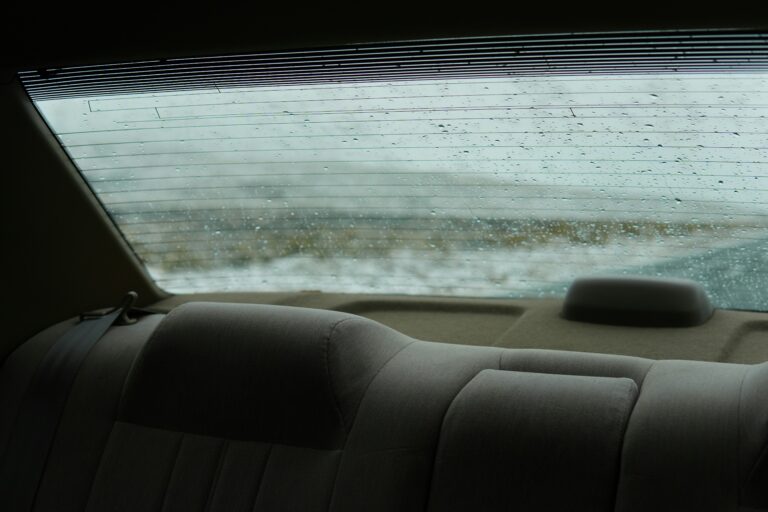
She cries out as she feels her body fill up with him—searing pain, a burn so hot that it finally circles back around to feeling cool again as they rock back and forth on the leather seats. The ache ebbs, it starts to hurt in a good way, like when she tears the hangnails off her thumbs. That’s when he grabs on to the backs of her heels, and all her past and future comes spinning out from somewhere deep within her, thread unwinding from a spool.
***
What is her life like? What does it matter? There’s no need to talk about her anymore.
She’s happy. Are you?
She watches as his taillights are swallowed whole by the darkness of the road. He turns the corner and he’s gone. Her father’s voice, not her own, is the one that rings in her head. Poor schmuck.