
The world blurs without warning. You’re strumming the introductory chords to “Heart of Gold” when the street scene—sidewalk, shopfronts, pedestrians, traffic—loses its edges in the wetness pooling in your eyes. You’ve become accustomed to your body’s random reminders of the symbiosis that it shares with your mind; without missing a strum, you blink, and two tears race each other down your gaunt cheeks, slip from the blades of your jaw, and plunge to the concrete in front of your feet. Your vision remains warped with refraction, but there are no more tears to blink away—just a familiar sheen bending everything that happens to drift across your gaze.
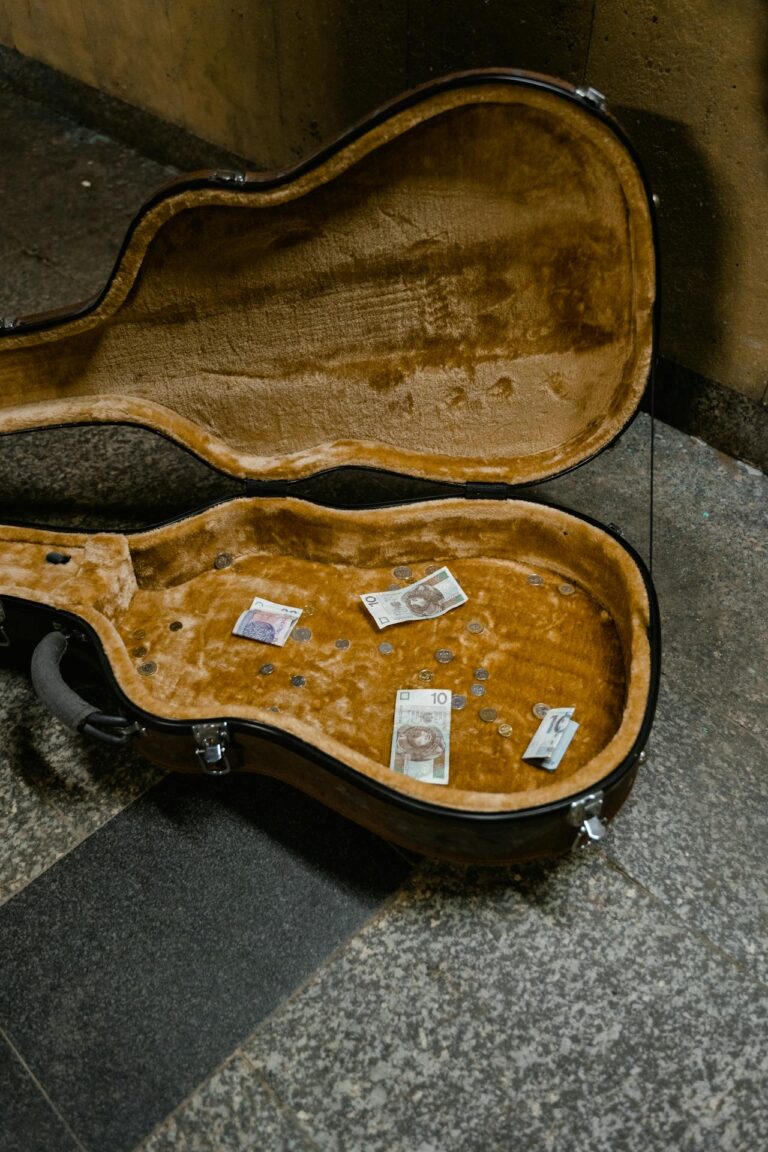
“I want to live. I want to give. I’ve been a miner for a heart of gold,” you sing, fixing the judder in your voice. You shut your eyes to the tumult of main street’s lunchtime rush—the peak time of your busking day. The offerings strewn in the open guitar case at your feet will accumulate again during the end-of-day rush, but the total will fall notably short of your midday take. It’s just one of several certainties that you’ve come to count on since you made the decision to swap your comfortable, secure existence as a retired high school music teacher for the patchwork life of a street performer. How long has it been—ten weeks, eleven? You can’t be sure because time’s passing—in your new experience of it—has steadily morphed from a straight line into a warped circle. “It’s these expressions I never give that keep me searching for a heart of gold.”
You were six months pregnant with Ethan, your first and only child, when the song was released into the world. You learned it on your new Martin, a university graduation gift from your father, who was the solitary source of any and all musical talents that you possess. Pressing the guitar against the swell of your belly, light-headed from the fresh-paint fumes lingering in the house that you and your husband, Michael, had recently signed over your financial futures to bring into existence, you imagined the chords, melodies, rhythms transferring from the guitar’s dreadnought body, through your taut tummy, into the nascent being of your unborn baby.
“Mrs. Lang,” notes a feathery voice from beyond the reach of your periphery. “I heard you’ve been performing downtown lately—I’ve been keeping an eye out for you.” The voice belongs to a former student—Aston, Ashton, Acton, Alton?—who approaches from the right and stands directly in front of you, smiling brightly, dipping their head awkwardly to catch up to the time signature of “Wild Horses”. They’re unreasonably attractive, with studded nose, eyebrow, lip, and cheek piercings; fuchsia flashes in their white-blonde hair; teeth that could launch a toothpaste empire. “Good for you for taking your music to the streets, Mrs. Lang—that smacks.”
You return the smile and transition to an upstroked A minor in the bridge.
Their grin wanes at the edges: “Ashton—I was in a bunch of your classes. I graduated two years ago.”
“Yes, of course, Ashton,” you say, foregoing the vocals of the second verse. “Sorry, I never forget a face, but names—that’s another matter.” You continue cycling through the chords of the lyric-less verse, palm-muting to dampen the resonance of your elderly, beloved Martin. Forty-plus years of teaching in the same town has guaranteed a rhyming of the scene, every day or two—a fleeting catch-up with a youthful stranger who seems to know you well enough to share remarkably intimate updates on the story of his, her, their life. “How are you, Ashton?”
“Pretty good. I’m slinging coffee at Grindhouse, taking a few courses at the college, keeping busy.”
“Good for you. Are you finding any time to play?”
“Piano? No. I live in a basement suite with two roommates, and I don’t get home very often—like, never.” Ashton is about to pad the chat with an additional layer of small talk—a classroom reminiscence, no doubt—when their expression shifts abruptly, and you recognize the underpinnings of the uneasy transition. When they give voice to the awareness that has prompted their face’s sudden alteration, you’ve already anticipated every word of their impending sentiment. You could recite the commiseration with them if you wanted, and every word, syllable, and stress would align without lag or overlap. “I’m very sorry for your loss, Mrs. Lang …”
He appears at the rim of your vision as a dark shape—equal parts height and thinness—and before you manage to register his impending arrival, he’s already bent down, scooped out most of your earnings from the after-work rush, and threaded his way back into the eastward flow of pedestrian traffic. You watch the black hood weaving and dipping, a full head’s height above the mass of walkers, until it eventually disappears around a corner at the end of the block. You’re sure that it’s the same kid—young man—who’s targeted you twice before, so you lack the grounds for claiming surprise, and the impressive amalgam of his speed, agility, prowess, and pluck fails to diminish the heft of your self-reproach. Why didn’t you empty the guitar case an hour ago?
“Sorry, it’s a bit light today,” you say.
“Don’t tell me you got hit by hoodie man again,” Darryl says, dealing the bills into tidy piles on the countertop alongside a scatter of coins. He’s managed Mercy Mission for decades, so he’s become synonymous with the charity, whose core goal is to facilitate the street-dwelling community’s return to society before they settle into the irrevocable habits of petty criminality and dying outdoors. He’s endowed with the build and body-hair viscosity of a brown bear, but you know him to be good-hearted and gregarious. He helped Ethan settle into his career as a social worker twenty-five years ago, and you’re grateful that he’s chosen to extend the same backing to you.
“It was my fault. I forgot to clear out the guitar case.”
“It’s your fault for getting robbed?”
“For letting myself get robbed—yes.”
Darryl grins: “Seventy-two dollars, sixty cents. Not bad—despite hoodie man.”
You return the smile and say, “See you tomorrow.”
“I’ll be here,” Darryl says, holding out a poppy.
Hoping that he doesn’t glean the meaning behind the expression flitting across your features, you nod, accept his gift, and pin it to your lapel. Can he discern that the upcoming commemoration of Remembrance Day was beyond the realm of your awareness? What is today’s date? You understand that any number you might present in response to the query will be a product of groundless guesswork, so you make a mental note to resolve the question when you get home.
“Maggie,” Darryl says.
You look back at him from the doorway.
“Thanks for the donation.”
You’d like to tell him that the gratitude goes both ways, that your returns are infinitely more valuable than anything $72.60 can buy, but you lack the confidence in words’ ability to meet the moment, so you choose the easier option. Leaning into the door, you smile and lift your hand in farewell.
You enter the cemetery through an open gate at the southern edge of the grounds and start hiking up the winding walkway. When you first started making the climb—however many weeks ago—you found yourself out of breath by the time you’d reached the quarter mark, so you take private pride in the fact that you can reach the upper levels without your breaths devolving into gasps. You stare at the pocky asphalt in front of your shoes, feeling the weight of the guitar case shifting on your back with every step. The sky is white with overcasting, and every huff of breath elicits a cloud that enfolds your face. It’s readily apparent that fall’s days are numbered.
Your legs carry you to the grave and its brand-new headstone with a stoic sureness gained by rote, and you don’t disrupt the process with thought or feeling. It’s a gorgeous grave marker—worth every last dollar—and it overwhelms you with pride. Removing the guitar from its case, you stare at the onyx marble, the portrait, the elaborate lettering of an epitaph that strives to honour a lifetime with a modest, truthful unfurling of words. Your words. You sling the aged guitar across your chest, clear your throat, formalize the timing with your foot, and begin to sing: “I close my eyes, only for a moment, and the moment’s gone. All my dreams pass before my eyes, a curiosity. Dust in the wind—all they are is dust in the wind.” You might as well be a spectator to the private performance; the song emerges from you without guidance, regulation, or restraint, like a gulp of air effecting its own release from an overwrought lung.
Emerging onto the sidewalk at the bottom of the path, you finally allow your thoughts to get the better of you. The transient calm that you enjoyed in the cemetery is displaced by the white noise of the here and now. You don’t try to resist it, but you don’t indulge it either; you simply give it the time and space to be. When you make eye contact with an elderly man shuffling along the sidewalk in your direction, you recognize a shared downturn of your individual fates, but it doesn’t occur to you to reciprocate his startled smile of greeting. You accept that the gesture would be false, and you don’t want any part in contributing to the deceit of the world.
It’s dark when you walk up the driveway, but the kitchen light is on—as usual—so you experience a fleeting feeling of coming home. You kick off your shoes, hang up your coat, lay the guitar case on the bench of the kitchen nook, and chat to Gus, who leans against your legs and purrs with impatience. After spooning a tin of cat food onto a saucer and setting it on the floor next to the patio door, you turn on the TV, glance at a brutally vivid depiction of animals’ cruelty toward one another courtesy of the Discovery channel, and sit down at the kitchen island, staring at the answering machine, which returns your attention with mesmeric, red blinks. You close your eyes. You don’t know if you have the fortitude to press play. You fix yourself a gin and tonic to assure yourself that indeed you do, and reach for the answering machine.
“First new message,” announces the robot voice.
“Hi, Mags, it’s me,” Judy says. “I know I promised not to keep pestering you about bridge, but I just wanted to remind you that we’re meeting tomorrow at Francie’s house. I can pick you up if you like.” The message fuzzes with static. Judy is your best friend, a retired English teacher whose long career aligned with yours, and for reasons that extend beyond the scope of your understanding, the sound of her voice—in person, through a phone line, on an answering machine—has attained the potential for scattering the remnants of your heart. “I know you said you don’t want me to do this anymore, but I’m going to swing by this evening with some lasagna. I know you don’t need it, Maggie, but I need it. I need to do something to——”
The answering machine ends Judy’s soliloquy with a comically long beep.
You’re making yourself another gin and tonic, side-eyeing Discovery, which is leaning into the voyeurism of two giraffes waging battle with their necks, when the word pops into your mind. You return to the baby grand, take a sip from the glass, and scrutinize the Scrabble board positioned on the piano’s closed lid. You carefully align the tiles on the board, five letters appending horizontally from the “T” in defeat—RAUMA—and then tally the score and record it under the “A” column on the pink sticky note. You shift your focus to the other rack of tiles. You’ve always enjoyed Scrabble as a multiplayer game, but since adapting it into a single-player experience, you’ve acquired a newfound fondness for its quiet deliberation and meditativeness. You scrutinize the letters in the rack to reveal their hidden articulation:
B R X K O E G
Returning your focus to the board, you pore over the lattice of words in search of an accessible “N”.
It’s a little past seven when a thrust of headlights penetrates the window, replacing the darkness of the kitchen with blades of yellow light. You flick off the lamp sitting atop the piano, and then shrink into motionlessness, watching the kitchen door, whose window eventually fills with Judy’s ample silhouette. Backdropped by the headlights’ glare, she taps her fist against the door—knock, knock, knock, knock—moving her face closer to the window and cupping her free hand against the glass to keep the light from corrupting her scrutiny of the kitchen.
She shifts the tinfoil-covered dish to her other hand and reaches for the doorbell before retrieving her phone from a jacket pocket and thumbing the screen. Your phone—situated on the piano next to the gameboard—lights up and hums with haptic shivering, and each new tremor compels the device to shimmy a few millimetres across the piano’s high-gloss surface. You don’t move—confident that the house’s layout prevents Judy from seeing into the living area. After several long minutes, Judy finally gives up, setting the dish down on the dust-covered table next to the door, turning away from the house, and walking slowly back to her idling car.
You awake to the feeling of fur against your face. You open your eyes to see Gus sprawled across the piano lid, nuzzling his head against your cheek, purring loudly. Blinking yourself back to lucidity, you double-tap the screen of your phone: 1:12 a.m. The agony in your neck informs you that the brief eye rest you indulged in a few hours ago expanded into a full-fledged, head-on-folded-arms slumber. When you attempt to stand up, your body registers its disapproval with an onslaught of cracks, pops, and pains, scuppering your intent. You sit back down on the piano bench, stretching your neck, back, arms, and legs until you’ve managed to quell your body’s revolt.
You set the glass in the sink and stagger down the hall to the bathroom, where you give your teeth a hasty brushing, splash cold water on your face, and slump onto the toilet for a much-needed pee. Heading down the hall to your bedroom, you stop in front of the framed needlework that Ethan gave you for Mother’s Day a few years ago. He’d come across the tapestry at a local craft fair, and he told you that it instantly made him think of you. It displays—in intricate, artful embroidery—an aphorism embedded into the foundation of your existence, a motto that was passed down to you from your mother, who’d inherited it from her own mother, a family heirloom to be intoned in times of strife and turmoil and desolation and doubt.
THIS ALSO SHALL PASS AWAY
How long have you been staring at Solomon’s celebrated proverb? You have no idea, but you know that you’ve had enough. Legend asserts that Solomon was tasked by a sultan to write a motto to honour the ephemerality of the human condition—the equitable impermanence of joy and woe—for display on the king’s signet ring. You used to take profound comfort in the adage, but its ability to buttress your resilience and outlook for the future has faded in recent months. Taking hold of the frame with both hands, you carefully lift it away from the wall, spin it on its hanging wire, and lower it back into position against the gyprock. You take a step back to observe the frame’s cardboard backing, tap on the upper-left corner to correct a slight slant, take another step back, nod in approval of the piece’s updated rendering of truth.
Lying in bed, staring at the ceiling, you tell yourself to close your eyes—to allow exhaustion to do its work—but your appeal is made moot by your body’s abrupt rolling over and reaching for your phone on the bedside table. You swipe to your contacts list, scroll down, tap on the voicemail entry, and engage the speaker, and when you close your eyes, it’s your body’s doing, not your own.
“Hi, Mom,” Ethan says. “I just got your message. Sorry, I won’t be able to meet for lunch tomorrow. I’m helping out at Mercy, taking donations for their food bank, but I can swing by in the evening if it works for you. We can order in—have a game of Scrabble—watch Survivor—get caught up.” He pauses to let the office noise in the background diminish. “Oh, and if you have any dry goods sitting around, feel free to pop in tomorrow—anytime between ten and six. Darryl wants to beat last month’s record—he’s really invested in it—so we need all the help we can get. Okay, I should get back to it. Let me know about tomorrow night. Love you. Bye.”
You end the call, return the phone to the table, and close your eyes to welcome the imminent void of sleep.
“I love that song—it’s straight fire,” Ashton tells you, emphasizing their appreciation of your performance of “Hallelujah” with a singular jazz hand; their other hand is occupied with the task of balancing an e-scooter at their side. “I saw Ed Sheeran perform it a few years ago. It was sick.”
You nod and adjust the guitar strap on your shoulder. “I’ve never heard his version,” you say. “I try to stick pretty close to the original. Leonard Cohen was kind of a hero of mine.” You power up the clip-on tuner and tweak the machine heads until the strings hum with pitch-perfection.
“Leonard Cohen—right,” they say. “‘Birds of a Feather’ is pretty dope.”
You grin, slipping the pick into your pant pocket. You position the capo on the third fret and start fingerpicking the opening chord of “Landslide”. You’re a few bars into the introduction when a blot of motion appears at the leftward border of your sight. Before you have time to register the source of the movement, a tall, dark form flashes between you and Ashton, bends down to snatch the meagre offerings from the guitar case, steps off the curb between two parked cars, and sprints across the street, threading the opposing flows of traffic Frogger-style.
“Did that dude just steal your money?” Ashton asks.
You hand them your guitar in a single fluid gesture that involves lifting it with one hand, ducking your head and shrugging to shirk the clutch of the strap, and offering the instrument across the space between you. “Can I borrow your scooter?” you ask—although you sense that the idea is a mistake before the words even exit your mouth. No matter—you’ve already committed yourself to the course of action. You take hold of the handlebars, prop your right foot on the narrow deck, and start pumping with your left leg. Feeling the engagement of the scooter’s engine, you position your left foot at the back of the deck to match the forty-five-degree angle of your right foot, steer the scooter into the crosswalk, and thumb the throttle for a speed boost. You swerve from the crosswalk into a gap in traffic, and when you tighten your grip on the handlebars to negate a gravel-induced wobble, you think: “I can do this.”
The young man—dressed in his trademark black hoodie—has slowed his pace to a nonchalant jog, passing alongside the row of parked cars; he has no idea that you’re half a block behind him, and gaining fast. He dekes in front of a parked delivery van and returns to the sidewalk, slowing his gait to a purposeful walk. You can read his self-congratulations in every reach of leg and swing of arm; he’s netted another easy take—less than the first three times, but enough to justify his efforts. Pressing the throttle to its limits, you lean over the handlebars and re-indulge in the self-assertion—I can do this—but an unseen divot in the asphalt rebuffs your certitude.
The front wheel of the scooter drops into the hole, sending a jolt of resistance through your wrists and arms, across your shoulders, into your neck and back. You pinch the brake lever and lower your left leg to the passing pavement, and by some marvel of timing, physics, and luck, you manage to halt the scooter without toppling to the street. You’re straddling the deck, panting heavily in the aftershock of adrenaline, when a passing driver leans into the horn, lowers the passenger window, and delivers a bellow of unsolicited feedback on your scootering skills.
The ruckus draws the attention of hoodie man, who glances over his shoulder—a half-second before a silver sedan emerges from the alleyway to his right. The front of the car folds him at the knees, and he collapses onto the hood, sliding up the windshield on his back, arms and legs splayed in vain pursuit of purchase. By the time the driver—an elderly woman with the look of someone undergoing an out-of-body experience—regains her senses enough to stamp on the brake pedal, hoodie man is sprawled across the roof of the vehicle, flailing haplessly. The car’s momentum sends him back the way he came—down the windshield and across the hood—pitching him to the pavement at the mouth of the alley. He doesn’t move, and you think: “He’s dead.”
You feel like a voyeur—unable to move, powerless to look away—and it makes you shiver with shame. Your actions led directly to the drama reaching its tragic conclusion in front of you. And for what—twenty, thirty dollars and change? Hoodie man is the reason that Ethan got into his line of work—all those years ago—and your ill-considered actions have made the young man’s situation worse, not better, and it leaves you reeling with emptiness and despair. You tell your body to move—to discard the scooter and check on the young man—but the imperative only lengthens your inertia. Moments later, as hoodie man begins to unfurl from his fetal repose and slowly rises to his full, lanky height, you watch in silent stasis, and it takes all your resolve not to look away when his eyes—bright with bewilderment—momentarily alight on you. When he turns and sprints into the alleyway, you’re overcome with relief—for both of you.
You play longer than usual—five, six, seven extra songs that gradually overlap with the evening’s deepening darkness—and you don’t give your mind leeway to question why. You sense that you’re making an extra payment toward a long-running debt, but you don’t think about who carries the balance, or how it accumulated. After donating your day’s earnings at Mercy Mission and swapping banter with Darryl, you decide to take the long way home—past the unkempt lots, foul nooks, and shabby shopfronts of Ethan’s work domain, where the blackness prompts pop-up tarps and propane campfires. You should feel wary—afraid even—but you don’t. You understand that you’ve entered Ethan’s world, and you’re sure that his belonging will extend to you.
You’re nearing the end of the block—a few paces from a brickwork corner whose turning will return you to municipal order—when you see him. He’s slumped on a sidewalk bench, head hanging over the backrest, hands fisted in his lap, sneakers overreaching the gutter’s muck. He doesn’t move as you approach, and you confirm that he’s asleep. The Narcan pack positioned on the bench at his side impels you to amend your assessment: he’s passed out. You stop walking and lean down to study the man’s face, partially concealed by the tatty hood. It offers no initial surprises: greyish, lesion-marred skin that exaggerates every point, edge, and angle of his skull; crusted, split lips; yellowed, decaying teeth. Looking more closely, you see it—below the mask of disrepair—a foundation of youth. It makes you realize that your initial estimate was correct. He’s just a kid, probably still in his teens, engaging in a way of life that has the very real potential of reducing his years-lived from a quarter to a half-share of his lifetime—if he’s lucky.
Relegating thought for feeling, you remove your guitar from its case and sit down on the bench next to him. After tweaking the tuning to open G, you ease into the slow, solemn strum of “Fiddler’s Green”—one of Ethan’s favourite tracks from his favourite band. You’ve never performed the song before, but you learned it by ear in the relentless fog of those first few weeks—during the handover of summer to fall—back when you still had the heart to listen to music. “August fourteen,” you sing quietly, adapting the date, “for a girl I know it’s Mother’s Day.” You gradually allow yourself to sing more loudly, to strum with more vigour, to animate the song with dynamics and between-beat embellishments. Why not? You know that you’ll never perform the song again. “Her son has gone alee, and that’s where he will stay.”
After you’ve sung the last lyric and strummed the final chord, you prop the guitar’s body on the tops of your trainers and balance it upright between your legs. You concede that it’s time for words, not lyrics; you start talking to the young man—the kid—whose only indication of living is the rhythmless billowing and deflating of his nostrils. You don’t know where to begin, so you start with the ending: the RCMP showing up at your door to inform you that Ethan, your only child, your beloved son, was discovered in his hotel room, deceased, after failing to show up to a day-long training session at a social work seminar that he was attending in Toronto. You use words like shock and disbelief and devastation, and they sound hollow, lacking, wrong to your ear, but you don’t allow their deficiency to impede your narration.
You talk about heart failure, a birth defect that afflicts the men in your ex-husband’s family, and you shift with disregard of transition to Michael, the former love of your life—flying in from Bangkok with his thirty-something wife to attend the funeral of your shared child. You recount his insistent, clumsy attempts at commiseration—at the funeral home, the cemetery, the wake held in the house that you both willed into reality a lifetime earlier—and you describe how they made you dizzy with spite. You relate a scene that played out as he was about to take his leave from the wake to return to his life on the opposite side of the world: Michael pulling you into his arms, holding you tightly against his chest like a man clutching a mannequin, wetting the crown of your head with his falling tears, murmuring sorry, sorry, sorry into your ear. You end your recollection by acknowledging that the sentiment might as well have come from a ghost.
You realign your focus, taking on the task of depicting your son, but you don’t get far with the endeavour. It isn’t nearly enough, and it’s way too much. Ethan’s generosity and kindness for others, his unbending dedication to service, his steadfast belief in the merit of goodness, justice, integrity, and virtue. His passion and talent for music—inherited from you and your father—his endless practising of guitar, piano, drums. Every word that you settle on—every descriptor and qualifier—clangs with cliche. You try to rationalize why he never got married, why his emotional commitment to every girlfriend over the years had a limited shelf-life, clarifying that his heart had already been taken—by the street and its coterie of misfits, underdogs, and unfortunates—but you find yourself at a loss for words. You mention a saved voicemail, recorded a few days before his leaving, which you access multiple times a day, as dutifully as a drug addict, and you explain how it prevents your son’s voice from being quarantined to memory, and you feel certain that you’ve made a point, but you have no idea what it might be.
You lower your head, shut your eyes, and reassure the young man huffing with unrest at your side: “This too shall pass.” How many times have you uttered these words in response to the latest strife of living? How many times have you heard them voiced by your mother in the aftermath of an unforeseen disaster? You’d like to refute Solomon’s famed saying, but you have to admit—even now, after everything—that he was right. Everything passes. The period that you’re living through will indeed pass—it’s only a matter of time—but you feel the need to point out that Solomon’s maxim fails to account for nuance, context, humanity. It fails to account for the perversion of nature effected by parents outliving their children. It fails to account for you. The recent and ongoing dismantling of your life will pass—there can be no doubt—but only with your own passing, and therein lies the miracle and curse of being human.