
They can indeed be places of danger, but the act of entering a ravine, often in defiance of parental orders, has for many Torontonians been an essential part of growing up.
— Robert Fulford, Accidental City
We called it ‘Ravineland’, our odd little family. Dad and Tabby and me.
It began as a protective mechanism, a nickname we gave it to ease the transition, like the setup to some joke: “A septuagenarian, his daughter, and her daughter move into a valley by their home…”
But then it became the name of the place, settled as a proper noun in Tabby’s brain and then in mine.
And, in any case, it wasn’t funny.
Tabby was only five when we left Malc’s house on Ossington for the last time, and it would have been difficult to explain to her, as we got on the subway eastbound, that we were going to live in the woods. It was difficult to communicate anything: I was breathless and guilty from one last altercation with my brother. But, if she noticed my hand shivering as it clamped hers, she didn’t comment. Her Brickworks brown eyes roamed the advertisement panels and the passengers’ faces like a little detective, gathering evidence. Her Paw Patrol backpack stuffed with clothes anchored her, so only her eyes could move, a periscope to the surface of the city.
Seated on my other side, I knew Dad could feel it, the fear in me. Even if he didn’t understand, he felt it. Surrendering a roof was a risk, a gamble without gambit, and his hand trembled, too.
As the train screeched out of the station, I leaned back on the red faux-velvet seat. My last strike at Malc was the end of it, the final move in a bickering exchange which had been building momentum for months. We couldn’t go back. And, hampered by Dad’s stubborn Kingston-Loyalist pride, we wouldn’t use shelters.
We were better than that.
Toronto is a city of ravines. The word itself comes from Latin: rapina, plundering. In this case, though, I felt like the plundered, rushing to the valley for refuge from the city, from life.
I had found our ravine en route to a cleaning job in Rosedale. As the 82 bus crossed the Glen Road bridge, a deep wooded gorge opened before me. A mature forest, somehow, in the middle of the city.
The bus from Yonge Street was populated by three types of people: kids in private school uniforms, business people, and my category, the support staff who moved counter to the residential tides. We were nannies and cleaners and gardeners and grocery store clerks. We came in the morning, left in the afternoon, and wore the costumes of servitude.
That day, a group in black Summerhill Market uniforms were in the middle of the bus, chatting in a foreign language. I had been up the night before arguing with Malc, and their conversation, their alien sorority, irked me.
“Where’d you put it?” Malc said. “Were you cleaning? You know I’m not paying you to clean here.”
I didn’t look up from packing Tabby’s lunch. She had asked me to buy grapes and I had—a basket of them, ‘Product of Ontario’—though they were expensive and perished quickly. It was her first week back in preschool after the summer and I couldn’t help spoiling her. I broke a branch of squishy pearls off the vine and slipped it into a Ziplock.
I shrugged.
He was looking for a Lotto Max ticket, liked to have them in hand when he listened to the draw, which was tonight. He’d been turning over piles of mail for twenty minutes.
“You take it?” he said. He cocked his head, fingers half curled, the well-trimmed cuticles pulling palmward in agitation.
“You put it there—” I pointed at the corner, at his collection of thrift store DVDs “—and then you came back from your room and took it. That was Saturday.”
“My room?” he said. “It’s my house, sis. It’s my hydro, my insurance, my bills.” He flapped an envelope at me. “I can go in any room I want. And when I put something somewhere, I don’t want it to grow legs.”
He took a handful of grapes from the basket, violently, so droplets squirted onto my hand as they broke from the stem. He stuffed them into his mouth and I knew he expected acknowledgement.
I looked at the floor. This was retribution for my naïvety, for moving in with a boyfriend without paperwork—when Desmond had grown tired of me and Tabby, that was it, we were out and without rights in an unaffordable city. To his credit, Malc had taken us in. But, of course, he kept score.
He judged my silence acceptable, I guess, because he changed tack.
“Maybe it’s Dad,” he said.
“Quiet.”
Dad was watching Wheel of Fortune in Tabby’s room as she fell asleep, but the house was small. Even if he wasn’t all aware of his surroundings, his feelings could still be hurt.
“Maybe he put it in his pocket and forgot about it. He’s forgetting more and more.”
Though I didn’t want to agree, he was right: Dad had been forgetting more. He had moved in with Malc just after Mia died and his mind, even then, had begun to slip. I knew it was natural, that it came with aging and his condition, but I was sure Malc had exacerbated the process. He stifled Dad, sequestered him to the top floor, paying the bills and making the meals, but begrudgingly, sanctimoniously. He didn’t want to be responsible for someone. By banishing Dad from the kitchen, though, he had created a self-fulfilling prophecy: Dad had become dependent and Malc despised it.
“I pay for everything,” he said. “I get the food, I change the sheets when there’s piss.” This wasn’t strictly true, either: Dad had some money from the government, and I had been his caregiver since we moved in, four months ago. Before that, Malc had only changed the sheets every other accident.
It wasn’t that he didn’t care, I thought. It was that Mia’s death had made him recede into himself. Though we had once been tight, it felt like the rest of us had become an inconvenience to him. Like we were interrupting his grief, even three years in. I was getting tired of his gruff egocentrism, no matter how pitiable.
He leaned in close to me, so I could smell the garlic dipping sauce he ate with his pizza beneath the sweetness of the grapes.
“I’m getting tired of it.”
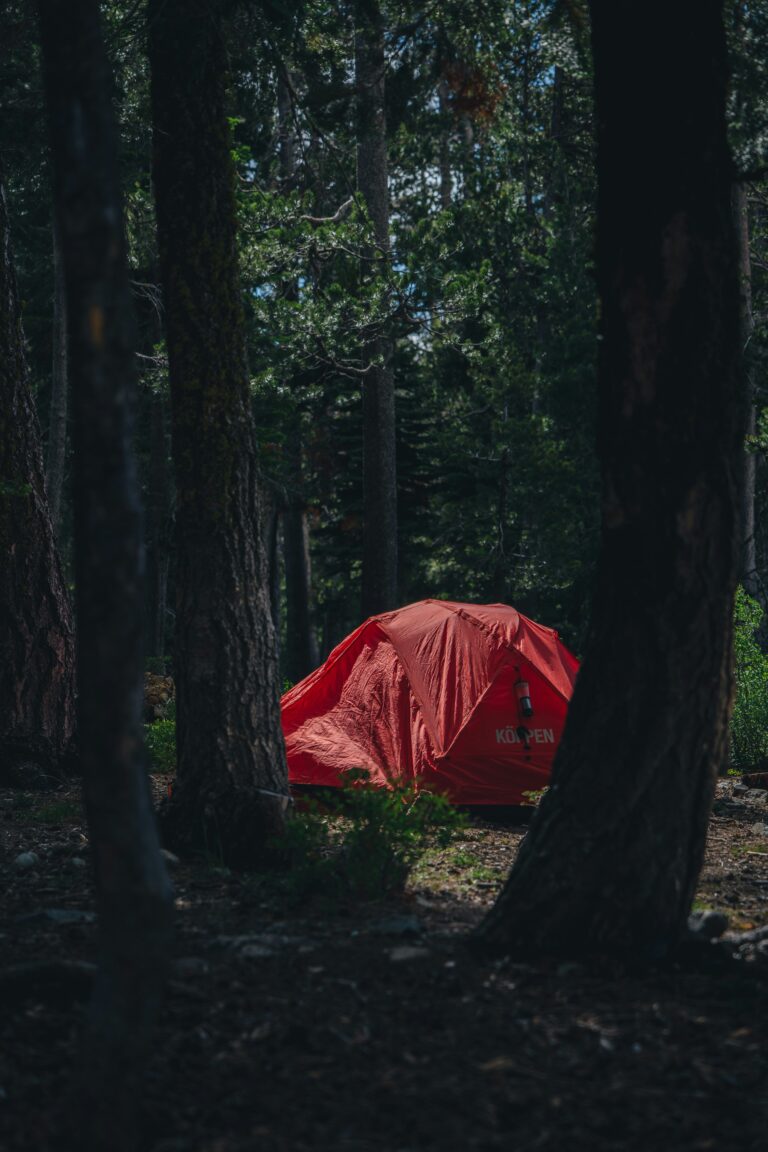
That first night, in the trees under the Glen Road bridge, I assembled the old Woods tent I had snagged in the 20 minutes my brother had given me to vacate his premises.
“Ravineland,” I heard Dad say to Tabby. They were sitting on a bench a little ways from the beaten path of the Park Drive Trail. The sun was setting, the bushes around us darkening from green to black. This was the flat spot I had chosen as our home for the night.
I was terrified of being homeless. Dad must have been, too, but there was excitement in his voice, an energy I hadn’t heard in a long time. It was the way he used to read me children’s stories in our house by Skeleton Park.
“It’s like a camping trip. See: there’s Mummy setting up the tent.” I pretended I wasn’t eavesdropping, that I wasn’t panicked. “What we’ll do is, every day, you and I will walk to pre-k together. It’s just up the hill that way. And every day Mummy will go look for houses to clean and we’ll save money—” his intonation rose, like cash was a carnival prize “—and we’ll get a house to live in, just the three of us.”
Tabby stared. Her little mouth—which, people said, resembled mine—hung open.
I was enthralled, too. Astounded that Dad had remembered it all, the frantic hopes I had hurried to him as we transferred at Bay-Bloor. Earlier that week he’d forgotten what city he was in, but today he had come through for me.
“Ravineland,” Tabby repeated, the name of some amusement park.
The ‘accidents’ had been coming more often.
When the burning sensation arrived, I had no choice: I told Janey I couldn’t work and took Dad to Toronto Western. The ER doctor gave us a prescription. Then, gently, she rolled him over and pulled down the back of his underwear. I forced myself to look. The skin was red.
Dad was docile; it was one of his quiet days, and the grave, sterile environment had made him recede further into the turtle’s shell of his mind.
The doctor gestured me past the curtain.
“Can he walk?” She was wearing a mask, but her eyes were stern.
“Yes.” She nodded; she knew.
“What I’m wondering is why a guy who can walk has the beginnings of a bed sore and a UTI?” She had already explained that the infection was from lying in dirty sheets.
I blushed like a child being scolded by a teacher, wishing she would keep her voice down. But the nurses moved around us uncaringly.
“I don’t know if I can send him home with you, in good conscience.”
I wanted to tell her about Tabby, about trying to save the money for an apartment while paying for preschool. How I couldn’t be home all day and how, when I wasn’t, there was no one to care for him. I couldn’t afford help. But none of that came out.
For a moment, even with my silence, I thought she would capitulate into empathy. I thought my hunched shoulders, my sad, sleep-deprived eyes would tell her everything she needed to know. Then she righted herself, standing with a straight back for her patient.
“Elder abuse comes in many forms,” she said. “It’s not always well-demarcated. But neglect’s a type.”
My wants became specific: to tell her about Malc, about the inferiority complex he’d been nursing since we were kids, since Mum died and Dad became a disciplinarian. How Dad wasn’t the only one to whom life had been unfair. But it was too much; there was too much history to cover it all, so I covered none.
“I’m gonna make a note on his file. If he comes back for the same, we’ll know.”
Two nights in and I wanted to go to the shelter.
The cars on the Don Valley Parkway were coyotes, their barks and growls hounding me even when I managed to fall haltingly asleep. And the depigmenting leaves had me thinking about what we would do after Thanksgiving, when it got cold.
But Dad said No.
Tabby was between us, under the overlap of our sleeping bags. The tent was dark, illuminated only by the light-polluted sky.
“Like raccoons, Dad. We can’t go on like this.”
He moistened his lips, composing a thought. Even then, when arguing a point that mattered a great deal to his principles, I wasn’t sure that he grasped the situation, entirely.
“No handouts,” he said. “I won’t. No daughter of mine is going to a shelter, like a dog.” He patted Tabby’s head as he spoke. Did he think she was his daughter? That I was his wife? I couldn’t tell, but I did understand the venom in him, the real truth behind his words: he would not go to a shelter.
I was quiet.
“Let’s go to Malc’s, he’ll take us.”
“We can’t,” I said.
“Why not?”
Water slipped down the side of my face toward my ear. His expression softened but his resolution remained and I realized that he had forgotten our expulsion from Malc’s, the abuses and the neglect that I had taken the blame for, that had put him in the hospital only a few days ago. Whether it was by choice or by condition, it felt deliberate, like he was trying to ditch me in the land of the remembering.
“Christ, Dad!”
My anger triggered nothing in him, though, no memory, and my frustration dissipated on his inability to comprehend.
There was movement between us. Tabby’s hair shuffled upward, tickling my nose.
“Why’re you mad?”
She hadn’t been there, she hadn’t gone back to Malc’s on the day of our departure and I hadn’t explained it to her. She didn’t know why we had come to Ravineland.
I touched her nose with mine and she shimmied closer, putting her face into my throat.
“I’m not, kitty,” I said. I was scared.
We got home from the hospital.
After I got Dad down for a nap, I wandered the front of the house, wondering what had become of my brother. Malc’s work was only on Dupont, a few blocks away. Yet he never came home to check on Dad during the day, he never made accommodations or arranged nurse visits. He was willing to check on Tabby, sure, but not me or Dad. It made me want to shake him, to say, “Wake up! Your family needs you!”
This, while I stood in the kitchen, looking through the home his deceased wife’s parents had paid for. The wife, Mia, who had made him pleasant for a while. Whose picture was still on the fridge.
My gaze landed on his DVDs, the stacks he’d been collecting since university. Even in the face of streaming he held on to them. I’d sneaked peeks while he was watching and it was then that I saw him as I remembered: a boy, my brother, calm.
I knew what I had to do.
I opened the drawer and took out a short, sturdy knife. I took a movie from the pile. Opened it. Turned the disk over and put a deep gouge across the reflective face, where my own image was distorted by the red and blue and yellow flashes of the ROM. I replaced the movie and did another.
And another.
I was in the kitchen when he came in. It was only two o’clock, he was early. Tabby wouldn’t be done school for another hour. He took off his dress shirt and tossed it over the rim of the hamper in the hall.
“How’s Tabs liking Old Orchard?” he said. “The kindergarten’s supposed to be lights out.” At the time of her death, Malc and Mia had been trying to conceive. Part of why they’d been willing to face onto a busy road like Ossington was the proximity it afforded them to schools.
“She’s liking it,” I said. “She’s flexible.” She had to be. This was our third home in three years and each time she had found reasons to love the place: a crack in a tile to jump on on her way to the bath, a pigeon’s nest on a windowsill to tap at.
“Mmm.”
I thought there was a note of jealousy in the way he grunted, the way he took a Steamwhistle from the fridge and went into the living room. It was a conversation too painful for him to finish.
Guilt rose but I kept my gaze locked into the sink, into the sudsy water where my gloved hands moved. I felt like a child waiting for her breach of the rules to be discovered.
I heard the tray of the DVD player open, the flimsy plastic rattle of the disk, the smooth closing, the leather of the love-chair squeaking as he lowered himself into it. The quiet, static sound of the TV coming on.
Then, to himself: “Whatthe—?”
The plate I’d been circling with the rag slipped from my grasp and hit the bottom of the basin. The chair squeaked again.
I imagined Malc turning the disk over, seeing the scratch. Puzzling, trying to remember the last time he’d watched it. I was waiting for a shout.
I heard another case open.
Then another. Then another. There was a clatter as a tower fell.
Still, no shout.
I went to the door, my dishwashing gloves dripping onto my toes, the adrenaline rising in me like bile.
He was on his knees in the collection, rooting through the titles like a desperate librarian. At random, he opened boxes, turning the disks over then dropping them to the floor, where a pile of spoiled silver circles was accumulating. He dug deeper.
I was mesmerized by his desperation. Doubt was sneaking in. I fought it back, reminded myself that his movies soothed him, yes, but so-doing they also enabled the pity-party that had to end.
He found what he was looking for and some of the anguish seemed to evaporate as he looked down at the box: plain black, no slip cover.
I think he knew I was watching him. Why he didn’t say something at that point, I don’t know. He already knew what had happened, that I was responsible — who else could be? He probably even knew the consequence he would assign: eviction. But this, apparently, was something special. It transfixed him.
He opened it gingerly, like a pastry box. The disk, too, was plain, the blank type you buy at Staples. He pressed the button in the middle to pop it from its compartment, turned it over, revealing the gouge I had made, a scar which rendered it unreadable.
He stared at the ruined disk, quivering on his haunches, a position I’d never seen him assume: curled over the destroyed video like a monk, a mourner, a shrivelled grape.
“Out,” he said without looking. “I want you gone. I don’t wanna see you.”
“We’re family,” I said. Not to save myself, necessarily, but as an alarm for him, one last set of rumble strips before the cliff of solitude he was racing for.
Which I had propelled him toward. I pushed the thought from my mind.
He flapped the empty case at me.
“Out.”
By October, I was desperate.
I had been finding cleaning work okay—Janey had been looking out for me—but I couldn’t afford preschool anymore, not while saving for first and last. So Tabby had been staying in Ravineland with Dad during the day. It wasn’t the life I wanted for her.
It was when I watched Dad lower himself to his knees to enter our tent, though, that I knew the situation was untenable. It broke me, broke my respect for his desire to avoid shelters. A child can adapt themself to anything; an old man should be comfortable.
“There’s no dignity,” I said to him. We were eating our dinner from Tim Hortons cardboard on the bench. On the other side of the clearing, Tabby was reading a book a client had given me for her. The evening was pink and blue and cold, the sky visible through the last clinging leaves. Though I wanted to press against Dad’s shoulder for warmth, I couldn’t eat through the smell of ammonia. “People sniff at me when I show up.”
He took a bite of his farmer’s wrap and I noticed his wrist shaking, how the hair there had turned pure white as though, like the trees, he was pulling nutrients back into his body for winter.
Janey had given me a pamphlet for a residence on Dundas: housing for women in my position. I had called to ask and they had assured me they could help. But not Dad. No men allowed, that was policy and it was inflexible. So I had kept quiet about it, had kept my promises vague. Now, however, desperate to not wear my maid shirt for another day without washing it, I passed him the pamphlet.
It trembled with his hand. He was like a leaf about to fall, its roots severing one-by-one from the branch.
Slowly, he went through the pages, his fingertip tracing the text even as I was sure he wasn’t following.
“It’s a shelter, Dad. A home for me and Tabs.”
The pamphlet settled in his lap.
“I’m not going.”
“You can’t. It’s just for women.”
He turned his eyes down. I touched his forearm.
“But I don’t want to leave you,” I said. “I’ll help you find somewhere. A shelter. Or a home. I’ll—” the words caught “—I’ll talk to Malc. I’ll make sure you’re looked after.”
My priority was Tabby. But I had to think about Dad, too. I was terrified for him to go to a public facility.
“I don’t understand,” he said at last. I fixated on the bristles on his chin. I remembered how they felt on my stomach as a kid, when he would make me and Malc scream with raspberries.
I explained again about the shelter, about the situation with Malc. While I was speaking, he closed his eyes, listening with all the attention he could muster. It had been another apathetic day but now he was fighting to understand. I loved him for it.
When I was done, he looked across the clearing that had become ours. Overhead, a bus rumbled on the bridge. It was nearing Halloween and we didn’t have a pumpkin, let alone a stoop.
“We have to rely on family,” he said.
“No,” I said, thinking of Malc. “I can’t.” I wouldn’t go back to a home that was supposed to care but couldn’t.
I slid closer, trying not to think about the help available for Tabby and me but not for him. How the nights were always getting colder.
I couldn’t speak. I pressed my head to his shoulder.
I had all our things on the front step—tent, clothes, Dad—when Malc came back around the block. My minutes were up. It was time to get Tabby and go away.
He opened the green wire gate and stood back, uninviting. The residue of tears was beneath his eyes and I was surprised by the strength of my desire to embrace him. But I couldn’t. That was beyond us, for now.
I went past him, onto the sidewalk. The 63 wooshed by; a Beck taxi. Dad followed me, confused but obedient.
“He’s going?” said Malc.
“Yes.” Even not knowing where we were headed, I couldn’t leave Dad behind. I thought anything would be better than disintegrating under the inaccessible management of a son who disliked even the slightest interruption. “He needs someone who will pay attention.”
I thought he would reply. I thought maybe this last barb would be enough to hook my brother back to the present.
It occurred to me in that moment that Dad had handled his wife’s death by being over-attentive to his kids, and that Malc was doing the same. Because he had no living children, however, he had become over-attentive to the hypothetical ones, to the future he and Mia would share nowhere but in his memory.
I thought if I could bait him enough it might be a reminder that there was a real future with a real family in it for him, and he might come back to us.
But then the gate rattled as he turned away from me and Dad and the street, heading back into his dead wife’s home.
I came back from work.
I half-walked, half-slid down the path we had made from the top of the hill to our campsite. I pushed through the brush into our clearing. Tabby was there, cross-legged. She was colouring with the scented-marker set I’d got for her birthday—grape and blueberry (her favourite colours) were already depleted.
“Hello, Cat,” I said, wary of sitting with her in my work clothes. “Where’s Grandpa?” I looked around. I listened. Two fears grew: that Dad was missing and that Tabby had been alone.
“He gave you this.” A small hand extended above her head, holding a piece of construction paper.
I read the note.
“He went that way,” said Tabby, pointing up the hill to the bus stop. Her attention remained fixed on her colouring. From a young age, she’d had an ability to focus—to tune out everything peripheral to her task—which I admired.
“When?”
“A while.”
I looked the way she had gestured. I looked at her colouring in her book.
“Come honey,” I said after a long moment. “Get your stuff. We’re leaving.” I kept my voice even, I fought to.
“Are we bringing the tent?”
“No,” I said. “We’ll leave it.”
“What about Grandpa?”
I wanted to sit, to cry. I had taken him from a home and let him down. And, even though I had failed him, he had still come through for me.
“No,” I said. “He’s going back to uncle Malc.”
We climbed the wall of the ravine and turned onto Glen Road, headed south across the bridge.
For the second time that fall, I was abandoning a member of my family.
Malc I had left victim to himself, alone in an erstwhile dream-home with a wedding tape that wouldn’t play, memories I had scratched from existence in—what I justified as—a failed attempt to bring him back to the surface.
Dad I had tried to rescue, too. But, in the end, I had to look out for my daughter and, despite his fraying memory, the paternal instinct which Mom’s death had amplified returned him to Malc. Even if he would suffer, he would try to help his son.
Halfway across the bridge, Tabby stopped. She liked to stick her hand through the pebble-concrete barricade, to hold it over the canopy of the forest, the drop. I looked for Dad through the bare branches, though I prayed he was already at his destination.
I forced myself to feel nothing, like a submarine clearing its ballast tanks. To feel hollow, to feel the absence of feeling. I cleared a space for eventual feelings—inevitable feelings—that, for now, I had to keep vacant to stay afloat.
After a minute, I tugged Tabby away from the rail and we resumed our long walk to the shelter. She dragged her feet. I felt myself in her hesitation. I felt the part of me that wanted to stay behind, to run back for Dad and Malc. To fight again for my broken family, to heal them or at least make them comfortable as they sank into themselves and away from us.
But I pulled her on, toward safety and warmth and a roof. That was the mother in me, who had to leave them for her. It was time for us to leave Ravineland.
# # #