
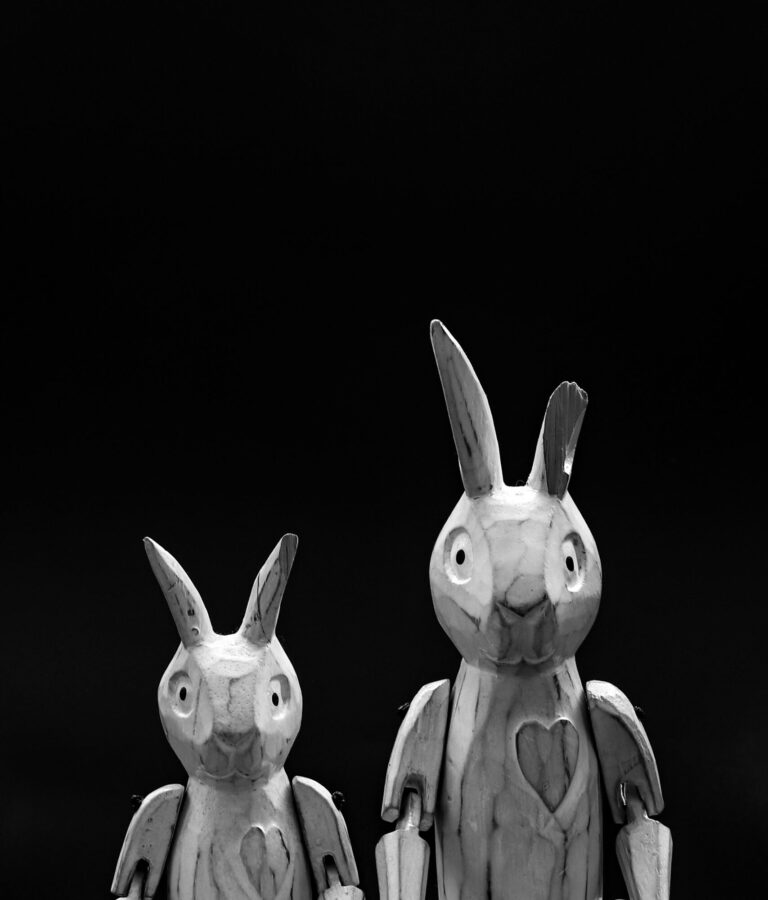
Peter stepped into the pet store to buy dog food for his elderly neighbor but stepped out carrying a rabbit in a cage. The bunny had brown fur with white patches and eyes black and shiny as buttons. As the doors swooshed closed, Peter stopped in confusion. His watch said that he was in the store for ten minutes, but he had no memory of it. No one was chasing after him; did he pay for the rabbit? He was missing something. He was missing a lot of things…
As a family of four approached the pet store, the parents glanced at him and ushered their kids inside. Panic gripped him at the thought of returning the rabbit seconds after buying it. The cashiers would think he was crazy. Mom and Dad went crazy—what else should he call it?—just like Grandpa Thom and Aunt Kate, and now, Peter feared, the family tradition fell to him.
Three days earlier, Peter was sitting at his favorite coffee shop, the one with the offbeat art on the walls, when the call came. His older sister, Amber, usually beamed with an inner positivity he lacked, so when he heard the catch in her voice he knew something was wrong. Thirty years old and in Minneapolis, five hours away, he pictured her standing and twirling a brown curl of hair.
“Are you sitting down?” she asked.
Peter stared out the cracked window as cars rushed by. “How did you know?”
“I didn’t, but it’s good that you are.” She sounded so far away.
Static ran across his skin and the usual buzz of nearby conversations boomed in his ears as Peter listened to his sister: Mom and Dad were found dead in the garage, sitting in the front seats of the old Buick they used to take on family trips. Peter’s forehead grew cold. He tried to speak but couldn’t even swallow. Earlier that week, he had called home and told his parents he was thinking of quitting school. While Mom urged him to stay in college, Dad sounded detached but less than thrilled. When he’d called, had his parents already decided their fate? When they got in the car, were they thinking of their last chat with their failure of a son? Peter couldn’t help but blame himself. Then Amber read from their parents’ letter: “‘If you chase two rabbits, you will not catch either one. Please do not go chasing after us.’” Mom must have written that. She used to read him The Velveteen Rabbit when he was a kid: the story about loving a toy bunny so much it became real, and then the boy got very sick. Those warm moments before bed, resting his head on Mom’s shoulder while she turned the yellowing pages and spoke in that soothing voice, were some of the best memories of his life. Grandpa Thom read the story to Mom when she was a girl, and so Mom passed it along, a family heirloom like their shared illnesses, passed down to Peter.
On the call with his sister, Amber insisted he come home so that they could be together for the funeral. But where was home now? The house they grew up in had been gutted of life. The garage, newly haunted, all cracked cement and cold walls. He’d said more to Amber than he remembered. Trying to recall the conversation was like playing a film reel with holes burned through. More missing time. “I can’t,” he kept repeating at the cafe, louder and louder, “I can’t, I can’t, I can’t!” as the other customers and the barista watched. No one was smiling. As soon as he left the coffee shop, Peter knew there was no going back.
On his drive home, Peter bought some off-brand dog food from the grocery store to save face for when Mr. M, his stern but cordial neighbor, came to get it. Balancing the large cage, Peter used his elbows to unlock the front door of his brownstone apartment. A wooden crate of vegetables sat inside the entryway, overflowing with carrots and lettuce and cucumbers and broccoli. Mr. M, a widower with a long Hungarian last name, liked to trash-talk America’s processed foods. But fresh veggies, he said, were “perfectly simple and simply perfect.”
Up the stairs and down the carpeted hallway, Peter entered his one-bedroom apartment. The kitchen’s small island was piled with unopened mail, most of it junk. His unit had two windows, one looking out into a brick wall and one facing a thicket of trees. Not a lot of light got in. All he had for furniture was a twin mattress and a plush saucer chair placed in front of his TV. Peter convinced himself he was living simply, that there was virtue in this, though he worried others might see it as sad.
He set the cage down on the floor in the middle of the apartment. The rabbit trembled and made a high, whimpering cry.
“How are you doing?” Peter cooed to the bunny.
How was he to keep a pet alive? Even his dorm room cactus had wilted on his watch. And if he couldn’t manage a cactus or a rabbit, how was he supposed to manage his parents’ funeral? He pictured himself cold, numb, and crying before a church full of silent loved ones, then standing before an endless line of outstretched hands. He had nothing to give them.
A soft whisper from the cage.
Peter walked to the rabbit and poked his fingers through the wire mesh. Stiff whiskers brushed his hand as he petted the soft fur. The bunny’s glassy, unblinking eyes pierced through him.
A heavy knocking came at the door.
Peter opened the door to find Mr. M wearing a paint-splattered shirt. Mr. M was short, balding, and wiry; tendons stretched along his neck and arms from years of manual labor. He had a rough voice that Peter often heard singing folk songs through the floorboards. Mr. M’s black Labrador, Buddy, panted at his side. A practical name given by a practical man.
“What happened with the kibble?” Mr. M’s accent thickened whenever he got annoyed.
Peter handed him the off-brand dog food. “This is all I could find.” The half-truth made him blush.
The old man didn’t reach for the bag. “That type will make Buddy sick. Do you want that?”
“No…” Peter ran a hand across the back of his neck, avoiding eye contact.
“And what’s that?” Mr. M pointed at the cage. “So, you did go to the pet store.”
“I know it looks strange,” Peter admitted. “There’s a lot I can’t explain lately.”
Mr. M crossed his Popeye-thick arms, looking dour. “This does me no good.”
Meanwhile Buddy beat his tail against the doorframe as if expecting a treat.
“You look sick.” Mr. M’s frown deepened. “Are you okay, son?”
“I’m not your son.” Peter’s voice came out flatter than intended.
From the cage in his mind, his mom whispered, “We’ll always live in you.”
Peter spun to check on the rabbit, now facing away and burrowing in straw. Buddy the dog took the chance to dart inside. The black Lab pressed its nose to the mesh of the cage like the planchette to a Ouija board. If he could commune with his parents, Peter would ask why they hadn’t offered him a seat in the car; he could have sat in the back like he had on their family road trips.
The rabbit let out a high-pitched cry, like a child—Peter rushed to protect it and grabbed Buddy by the collar.
Mr. M took hold of his dog and straightened himself. “Sorry to bother you,” he said,
not sounding sorry. “Enjoy your evening.”
Peter closed the door. Back in its cage, the bunny shook all over, gnashing its long teeth with a strange clicking sound. Even when the rabbit stopped chewing, the whispering continued.
By sunset, the rabbit was whining and wheezing. Peter still hadn’t fed it, and his own stomach nagged at him. Tomorrow he’d force himself to face the world and buy more food. For now, Peter opened his fridge to find a half-eaten sub and nothing else. He took the sandwich out and peeled off the wrapper that stuck like wet paper mâché to the bun, plucked off the soggy lettuce, tomato, and spinach and dropped them into the cage. The rabbit sniffed a spinach leaf and tried a nibble.
From the den, the TV’s glow painted the carpet in shifting colors, playing the nightly rundown of famines and plagues, fires and floods, wars without end. A Looney Toons meets Book of Revelation world. The sound kept him company.
His phone rang and rang: it was Amber calling. Again. When the music stopped, his phone beeped with a new voicemail. Numbness ran down his arms and needled his fingertips. A strong resistance held him back, like how a dog with a shock collar fears an invisible fence. The texts his sister sent shortly after—Hey are you okay? Why won’t you answer? When will you be here?—said it all. Peter missed her, but she asked questions he had no good answers to.
He hadn’t slept at all the night before, turning over old memories for red flags he might have missed. Schizophrenia, psychosis, and all kinds of crazy ran in the family. His grandpa had talked to birds and said they talked back, and his Aunt Kate once said every color had a taste, that gray looked like concrete but tasted like sushi. They made connections that weren’t there. Dad had been mild-mannered enough, when he wasn’t losing his temper over late packages or the price of gas, and Mom used to stare off in the distance for minutes at a time. Peter could spend the rest of his life wondering what she’d been thinking.
He plugged his phone in to charge and lay on his back, sweating a silhouette onto the bedsheet and staring up at the whirring fan. When he closed his eyes, Peter imagined his parents slumped in their car, holding hands like the old couple in Titanic. There was a police report, but Peter refused to read it. He needed to believe they were happy in the end.
It will be a painless transition…
Peter sat up and held his head in his hands. His eyes burned and his jaw ached. As he looked down at the maroon carpet between his feet, nausea rocked his stomach. The same uncanny feeling gripped him as he’d had outside the pet store. How much time had passed, and what had he done?
The TV now sat silently, its screen black. Peter reached for his phone and saw that it had also died. When he picked up the phone half the charger cable came with it, frayed wires chewed in two. Peter inspected the living room and found the TV and internet modem cords chomped through. Meanwhile, the rabbit lay nestled in its cage, staring at him. One of its long ears twitched as if to wave.
Peter held the power button to his phone, but it stayed dead. “How the…”
Then, like a teacher at the start of class, the rabbit asked, “Do I have your attention?”
Peter looked up. “Is this real?”
“As real as anything else.” The rabbit hopped over to its water bottle. “I know all about you, Peter. The good, the bad and the ugly, like your dad’s favorite movie.”
Peter pressed his eyes shut and rubbed them. “Who are you?”
“Call me Rabbit,” the bunny said without moving its mouth. “‘Rabbit’ is perfectly simple and simply perfect.”
Perfectly simple and simply perfect. That was something his mom used to say, or was it Aunt Kate?
“Neither,” Rabbit answered. “That was your neighbor.”
“Jesus,” Peter whispered, “I’m—”
“Losing it?” Rabbit finished for him. “You’re lost, child. But I’m here to help.”
The blood drained from Peter’s face. Goosebumps ran up his arms. Lightheaded, his vision fuzzed grainy and gray. The world turned to static. He grabbed the side of the plush chair and hyperventilated.
“You need to take better care of yourself.” Rabbit pawed around in its matting then flopped down. “Or at least me. Now, what will we be having to eat?”
“I’m working on it.”
“Work harder.” The rabbit chewed at the cage then stopped. “You think you have it bad? I never even knew my parents.”
“This is crazy,” Peter wheezed.
“Crazy is living in a cage when you can be free,” Rabbit countered with the measured cadence Peter remembered his dad using on the phone with legal clients.
Peter kept his head down and gulped air until the blood returned to his head along with his vision. The world outside his windows was gray and hazy, morning or dusk he couldn’t tell. Bone-tired, his stomach gnawing at itself, he longed for sleep.
Three fast knocks rat-a-tap-tapped at his door.
Peter startled and padded over. Through the peephole Peter saw two officers in uniform: a white woman in her thirties and a Hispanic man in his forties. Both stood with strong postures and impassive faces. Maybe he’d stolen the rabbit from the pet store after all. Why else would the police be here?
Peter opened the door and tried to sound calm: “Hello?”
“Hi,” the female officer said. “Are you Peter?” Her name plate read, Olsen; her partner’s read, Cortez.
Peter glanced back at the rabbit cage. “Did the pet store send you?”
“No,” Cortez answered. “Your sister asked that we check on you.”
“I’m fine,” Peter lied.
“She told us about your parents,” Olsen explained. “You told her, ‘You don’t have to worry about hearing from me ever again,’ and then stopped answering your phone.”
Peter wanted to tell them, I didn’t say that, but he no longer knew what was true. “I’m fine,” he repeated.
“Don’t you see how that could be interpreted?” Cortez asked.
Peter saw but did not answer.
“Can we come in?” Olsen asked. “We need to confirm you are safe before we can leave.”
Peter stepped aside as the officers entered the apartment without taking their shoes off. As he closed the door behind them, the two police walked around his apartment, at once wandering and purposeful, the way people do at museums. Except Peter’s walls were empty save for one framed photo bought at the café, a black-and-white snapshot of loons gliding across the lake.
Cortez eyed the cheap saucer chair and dead TV. “Did you move in recently?”
“A couple of months ago,” Peter said.
The two officers exchanged a look.
They asked Peter if he was thinking of harming himself—“Not really”—and why he told his sister she’d never hear from him again.
Peter looked out the window into the gray and admitted, “I don’t want to talk right now.”
Olsen raised her phone as if presenting evidence in court. “Your sister told us about your parents,” she said. “We are very sorry for your loss.”
“Very sorry,” her partner echoed.
“A tragedy that big is more than anyone should take on alone,” Olsen continued. “We’ll get your sister on the phone so you can let her know you’re okay.”
“Please don’t,” Peter begged. “Please.”
The officer dialed anyway. The phone gave three long rings before Amber answered loud enough for all to hear: “How is he?”
Olsen reassured her and held the phone for Peter to speak.
Peter stepped back and shook his head.
“Peter, are you there?” Amber sounded so far away again. “I’m coming to get you tomorrow. Just wait where you are.”
Peter looked up at Olsen and said, “Tell her to go back. Tell her I’m fine.”
“I can hear you,” Amber called out. “Pick up!”
Cortez cleared his throat and told Amber, “He doesn’t appear to be a threat to himself.”
“Nothing more for us to do,” Olsen agreed.
When the two officers finally left, Peter watched through the peephole as they stood in the hall with their backs to his door, speaking in low voices.
“We’re running out of time,” Rabbit hissed from behind.
Peter picked up his phone and tapped the dead screen. “I need to tell her not to come.”
“If you listen to me,” Rabbit coaxed, “none of that will matter.”
Peter’s whole body shuddered, his chest heaving in and out. He collapsed onto the floor and held his head in his hands, sobbing for the first time since he was a little kid and hating himself for it. In death, his parents had saved themselves from his embarrassments. After a few agonizing minutes of this, Peter wiped his eyes clean.
“I don’t want to forget,” he whispered.
“You won’t need to worry about remembering or forgetting,” Rabbit cooed. “Soon you’ll just be.”
“I love them,” Peter said, choking on his words. “It’s that I can’t…”
“Oh, Peter…” Rabbit hopped to the front of its cage. With a nudge of its nose, the gate pushed open and the latch popped up, defective from the start.
Rabbit’s button-sized eyes shined, and in them Peter saw his shadow doubled—If you chase two rabbits, you will not catch either one—and the longer he stared into these twin reflections, the more the rabbit made sense: He was born in the Year of the Rabbit; was named Peter like the rabbit in the children’s books, not to mention The Velveteen Rabbit; and Dad used to chide him for being so timid, like Frightened Rabbit, a band Peter liked that sang of death dreams and whose singer, like Peter’s parents, killed himself; and now like Frank the Bunny in Donnie Darko, Peter’s slipping in time, trapped in a loop and desperate to break free. No, this is crazy, he thought. None of it made sense, these random links, and yet—when Peter looked back into Rabbit’s hollow eyes everything clicked into place: if he released Rabbit from its cage, Rabbit would release him from his. It all made sense. Anything can make sense if you think about it long enough, if you need it to.
Peter lay down on the carpet and curled up himself, listening to the clicking of the Rabbit’s teeth.
“You need to sleep,” Rabbit soothed. “When you wake, everything will be different.”
“I want to go to the funeral,” Peter said, meaning the funeral, “I just—I can’t…”
“It will be a painless transition,” Rabbit assured him. “You’ll see.”
That night, Peter’s parents came to him in dreams. He was six years old again in the backseat of the family Buick as they drove from Minnesota to Florida, Dad hunched red-eyed over the steering wheel, sleep-deprived and near hallucinating, determined not to “waste a night” or pay for a hotel. Meanwhile Peter and his sister flexed their feet to prevent blood clots on the long drive, something Mom taught them. They were in Tennessee when the smell of smoke and a rattle under the hood forced them to pull over. While their car got fixed, Mom traced her finger along a road map while Dad shoved quarters into a payphone and Amber sat on a bench singing nonsense to herself. All the while large spiders crawled up and down the walls of the mechanic shop and across the parking lot. Spiders bigger than daddy longlegs and covered in spiky fuzz, a whole line of them crept closer and closer. Peter backed up to the edge of the lot and a steep drop-off of dirt and rocks. Hungry and sick from the heat, he waited for his family to call out for him. When no one did, Peter lifted a foot over the ledge, like in Indiana Jones and the Last Crusade—a leap of faith—and jumped.
He woke on the floor, fully naked amidst straw bedding strewn across the carpet. The rabbit was nowhere in sight. Everything was quiet save for the sparrows chattering outside like children at recess and the ticking of his watch on the counter. A few feet away his clothes lay neatly piled at the foot of his bed. They only weighed him down. Peter did not need them, for Peter was not Peter anymore. No one could hurt him now.
His calves and hamstrings strained as he hunched on his hindquarters, bobbing an inch above the floor. In the reflection of the TV screen, Peter saw his shadow. Two small, dark eyes stared back at him.
He sniffed the stale air. Straw and urine, lettuce and mayonnaise. Hungry, so hungry. His mind was free from worry save for the base ache that ate at his stomach. In his mind he saw lush lettuce and carrots poking out of a wooden crate.
Stairs. He needed to go downstairs.
Fresh food was there, ready for the taking. A force inside him pushed him forward. Fumbling his way across the floor, he didn’t wonder or worry, didn’t imagine or think. Starved of so many things, he’d finally feed on instinct.
*
Amber approached Peter’s brownstone apartment complex. The last she had seen Peter, he’d been dumped by his girlfriend, and school wasn’t going well. What had he even been studying? Psychology? Amber had spent the last few years in a cubicle working off her own student loans, and these last few days grieving for a mom and dad who chose death with barely a goodbye had left her wrung-out and gutted. Now Peter’s all she has. And he needs her. Amber kept replaying their phone calls and texts: What would it take to show him that life went on even if their parents didn’t?
Amber took a deep breath and buzzed her brother’s apartment number. Her purple cardigan lifted with a cross-breeze while she waited. She swirled her thermos of cold coffee, took a drink, and buzzed again. Still nothing.
An older, balding man with a black Lab opened the front door. He wore a dingy shirt with blue paint smeared across one sleeve.
Before the door closed, Amber grabbed it and asked, “Do you know where I can find Peter Reilly?”
The dog nuzzled Amber’s hand, dampening her palm with its wet nose.
“Who are you?” the man asked, gruff and with an Eastern European accent she couldn’t place.
Amber forced a smile and answered, “I’m his sister.”
The man grew tense, his cheekbones stark. “Something’s the matter with him,” he said, as if accusing Amber. “I think he stole some of my veggies.”
“I’m sorry about the veggies,” Amber offered, as if she knew what he meant. “Our parents just died. That’s why I’m here.”
The neighbor pointed at the stairway. “He’s up there, try your luck. He won’t answer for me anymore.”
Amber took the stairs alone and looked down at the end of the hall. A brown rabbit sat on the lawn-green welcome mat that their parents had bought for Peter. The rabbit was chewing on a fat carrot. When Amber neared, the rabbit hopped to the edge of the welcome mat and stayed there.
She tried the doorknob. To her surprise, it turned—it was unlocked. The loose door swung inward and caught midway on the carpet. Amber braced herself and entered.
Inside, the kitchen counter was littered with fast-food wrappers Peter had scrawled with gibberish: Get groceries + kibble, I want to be well, “State Hospital Beds,” Don’t chase after me. Nonsense and dead-end clues. Then a longer passage she vaguely recalled: But these things don’t matter at all, because once you are Real you can’t be ugly, except to people who don’t understand. That was from the worn book Mom used to read… but what did Peter mean?
Half-eaten turnips and cucumbers littered Peter’s apartment. In the middle of all this mess she approached a mesh crate. A wire cage with a single, soggy spinach leaf. She followed a trail of lettuce that led to her brother’s bedroom, where the clicking of teeth grew louder and louder.
As Amber approached the half-open door, she called out, “Peter?”
Her brother lay naked and shivering on the floor next to a bed of straw, holding his face in his hands and chattering loudly. Goosebumps spread like a rash across his pale skin.
“Peter, what happened?” Amber took off her light cardigan and gingerly draped it over him.
As the cotton touched his skin, Peter bolted up with wild eyes. He shrieked sharply and tried to spring from her. Amber wrapped her arms around his bony shoulders and hugged him tightly. Rocking them back and forth, she tried to soothe him. “We’ll be okay,” she said, channeling their mom’s reassuring voice, the one she used when reading to them. “It’s me.”
Peter lifted his head from her shoulder. Faint recognition softened his green eyes.
“I feel sick.” Peter glanced at his pile of clothes and the straw strewn across his mattress. “And why are my clothes…?”
“I feel sick sometimes, too. It’s okay.” Amber kept her voice steady as she helped him sit up. “Let’s get you something real to eat.”
Peter exhaled heavily and nodded. As he pulled on his rumpled jeans and hoodie, he mumbled, “Perfectly simple and simply perfect.”
“What?” Amber asked.
Peter smiled faintly. “Nothing.”
They passed through the cluttered living room, past the chewed cords and cryptic notes. Peter stopped suddenly, staring at their reflected silhouettes on the dark TV screen.
Amber touched his arm. “Ready to go?”
Peter hesitated. “Sorry.” He closed his eyes, as if willing something away. When he opened them, he stared at the TV. “I thought I saw something.”
Amber nudged him toward the door. Peter scooped up the rabbit from the welcome mat as he stepped through the doorway, leaving behind the empty cage. Funeral or not, they were leaving together—and for once, they were done chasing.