
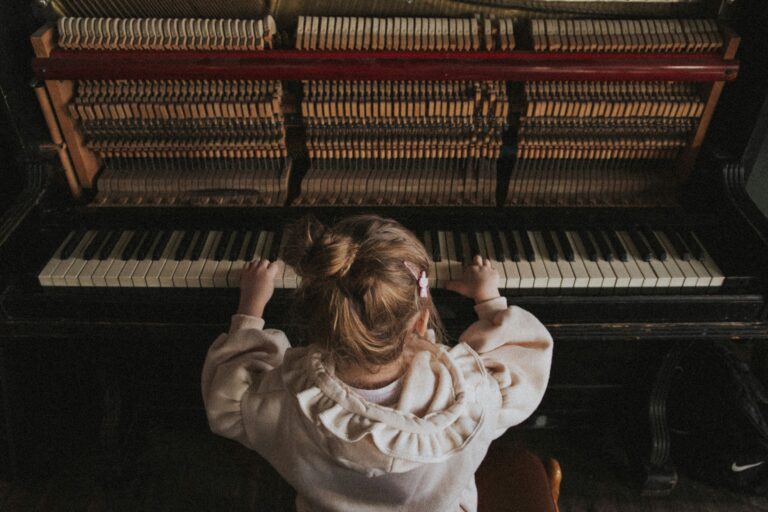
In the apartments, Ms. Hwang was the only one who had a piano. It was an impossible thing in her little square room, seemed too big to have come in through the door. Some people said the piano had always been there and apartment built around it. Some people said Ms. Hwang had brought it in pieces that she put back together, lower lip tucked under her teeth, part by part, as she did.
All of us girls took piano lessons from Ms. Hwang. Our mothers had us go over and knock on her door with a dollar in our hand and our best ruffled dresses on. Ms. Hwang always wore the same blue housecoat, or she had a closet full of them.
Come in, come in, she would say to whichever girl was at her door, and usher her to the piano, pressed up against the wall. There was a basket on her kitchen table for putting the dollar bills in.
Once a year, Ms. Hwang had her man come in — she always called him her man. My man is on the way, she would say, plucking at the distressed piano keys. He and his son would tune the old piano, tuning fork humming in the air (the son had a little machine that made the same sound, but the father would always shake his head till the son put it back in the pocket of his overalls). The father seemed very old, older than our fathers, and he would always make a big production of bending over the piano, groaning as he went. The son, though, seemed to be only a bit older than us, and we would watch for him when he came, those delicate hands poking out the ends of his shirtsleeves.
There were no young men in the apartments. It was fathers, grandfathers and the landlord, who always smelled of cinnamon gum and the tops of cat’s heads. Our mothers only had daughters, and our despairing fathers went off to work, cursing the air in the apartments, or, they said, maybe it was something in the water.
Until Ms. Whitefish in 312 had a little baby that turned out to be a red-faced boy. Our mothers quietly went and exchanged all their pink gifts for blue, and we would all wave at them when she pushed him in his stroller around the block. So, there was him, Harold Whitefish, and nobody else. He was only a baby, and not a pretty one, but our fathers looked at us after he was born like there was something they would like to see in our places, then shake their heads and ruffle our hair.
Good girls, they called us. Good girls.
They were the ones who gave our mothers the dollar bills for our piano lessons, they were the ones who went out the apartments at the same time every morning, nodding to each other in the underground garage, taking their turns to come out on the street, one by one, in their rumbling cars.
Our mothers worked small jobs within the parentheses of our fathers’ days, as store clerks or caretakers, leaving after we’d been sent off to school and home before we knew they’d been gone, waiting for our key turn in our apartment locks.
Welcome home, our mothers always said to us, and later to our fathers when they returned.
Only Ms. Hwang didn’t leave the building — Ms. Hwang and the landlord, who knew the quickest way to fix the dripping faucet in 210 with a rap of his wrench in just the right place, and the right shade of putty to fix the Floor Four hallway crack so it looked like it wasn’t there at all.
There was one story that the landlord and Ms. Hwang had been lovers once, that he brought her the kind of flowers she liked best (roses, said some; orchids, said others), that they kissed in the stairwell, that it was her hand loosened the banister between the first and second floors it always jiggled when we touched it.
There was a story that he had brought the piano for her, levers and pulleys and a wall that came down, but nobody really believed it — the landlord was tone deaf for one (said the residents who endured his humming while he’d fix their clogged sinks) and the only instrument he called by name was Old Mr. Horstwirth’s trombone that was kept polished on a stand by his door.
Nice sackbut, the landlord called it, and old Mr. Horstwirth would bob his head along. Yes, he’d say, yes it is.
On top of Ms. Hwang’s piano was a sepia photograph of a handsome man in a uniform. He had Sessue Hayakawa eyebrows and a mouth that looked too firm to smile. Nobody knew who he was — some thought a lost husband or lover, some said a brother or father, some said a son she would never see again. Some said Ms. Hwang had come here from far away. Some said she had been born in her apartment, along with her piano.
If we pounded the keys — Ms. Hwang said pounded — the photograph would tremble in its frame.
Gently, Ms. Hwang would admonish us, gently.
After our lessons, she would lift the photograph up and then set it back down, like she was putting it in a better place, but it never looked like it was any different to us.
When her man came to tune the piano, the photograph would come off and sit on the kitchen table. Her man and his son with those soft, pale hands would always give the photograph a respectful nod before getting to work. We girls would do the same when we sat down at the piano bench. Some of us called him sir, the sir on the piano, but most of us called him nothing at all.
We got used to his eyes watching us, the way we got used to Ms. Hwang’s nodding head as we played, the way we got used to rushing across the street in the brief beats between cars, every day, to get to school.
None of us girls ever really learned anything from Ms. Hwang at her piano, except Elena from 1218. She was afraid of the elevator and would come down all the twelve flights of stairs to her lesson, dollar bill clutched in her hand, skirts rustling around her knees. She had long, straight black hair that shimmered like the shadowy spots in a riverbed, and delicate wrists that bent just so at Ms. Hwang’s piano.
We were all in love with the ribbons her mother tied in her hair. Katja from 408 found one lying in the hall once and kept it tucked beneath her bedroom pillow. She said it smelled like cotton candy — the pink kind, not the blue.
And the lucky girl who had her lesson after Elena, if she arrived early enough, could hear those lovely notes that only whispered through the building walls, and Ms. Hwang saying beautiful, beautiful, which she never said to the rest of us.
We thought Elena’s father would be happy to have a daughter like her — the way she raised her hand in class when she knew the answer, straight and firm as an arrow; the way she helped little Chae-rin Park after she fell at recess, wiping the damp from the hem of her skirt.
Her father, though, like ours, stayed late after work, came home to dark rooms and latched doors. They told our mothers they had to work long hours to support us, they told our mothers they just needed some air. And we sat at dinner tables with floral-edged plates and told our mothers about our days and quietly forgot the shapes of our fathers’ faces.
Our fathers all called Harold Whitefish little man when they saw him in his stroller, how’s the little man doing they’d say, and tickle him under his chin. When he was born, they clapped his father on the back and smoked the cigars he gave them in the alley behind the apartments puff-smoke cloud lingering for days; for days, we all smelled like congratulations and cheap ash
Who’s a good little man, they’d say when they saw Harold Whitefish with his round baby cheeks, and we’d stand behind them in our pretty dresses and pretty smiles and wish we could shine like Elena with her moonless night hair.
Elena was Ms. Hwang’s favorite, we all thought, the way she arrived early for her lessons, the way she practiced her hand positions at the kitchen table in her apartment before it needed setting for dinner. Her mother didn’t brag like some of our mothers did, but we all still knew that Elena was trying so much harder than the rest of us, doing so much better.
The photograph never trembled in its spot when she played, and we thought his eyes might be softer for her the way our fathers’ were for Harold Whitefish in his stroller, the way our eyes were softer for her, the way we smiled and said Hello, Elena in voices we didn’t use for anyone else.
Our fathers saved their soft looks for the little man and when he started learning to walk, everyone watched out their apartments for him so he wouldn’t stumble, so he wouldn’t fall. He never went down to Ms. Hwang’s — men never did, except for her man and his son, and the landlord if she needed something. Ms. Hwang’s apartment always smelled of dry flowers and brown sugar, even the photograph of the handsome man on the piano had a soft, sweet smell to it. We wondered if the man in the photograph smelled like that too, in real life. We wondered if he missed Ms. Hwang, if he was lonely, if he was happy, if he was dead.
There was a story that he had been supposed to come to the city with Ms. Hwang, that they had been separated — torn apart, the story claimed — and we all imagined their hands reaching for each other, the desperation in Ms. Hwang’s elegant fingers.
There was a story that he was searching for her still, that someday he would come for her, that Ms. Hwang was just biding her time till he arrived.
His photograph was perched atop the piano, and we nodded to him as we sat down, stretching our hands out over the shining white keys.
We wondered if he would be surprised by the piano if he came (when he came, said the more certain and romantic among us), we wondered if he would expect it.
Elena said that Ms. Hwang had played the piano when she was a girl like us. Elena said that Ms. Hwang used to give grand concerts. She said Ms. Hwang told her she still had a dress in her closet, in a shade deeper than fallen rose petal, that had come with her from home, that she had held onto when everything else (except the photograph, we inserted, and Elena agreed except the photograph) was lost.
We wanted to see Ms. Hwang in that luscious red dress, we wanted to hear her play the piano. But if she ever sat down before it, she did it once we were all — even Elena — gone.
Once a year, Ms. Hwang would have what she called a recital, our mothers crowding into her apartment and us girls in our best ruffled dresses taking our turns at her piano, from youngest to oldest, except Elena, who always went last and played the prettiest song. She curtsied so perfectly after that we would all practice for days, never managing to match her grace.
Our mothers clapped politely after our performances, then Ms. Hwang would serve cookies and sweet tea. We girls watched how Elena held her cup and tried to match.
Even for the recitals, Ms. Hwang wore her blue housecoat, kept her hair twisted back in a long braid shot through with grey. She smiled at our mothers with the same firm lips as the man in the photograph.
Lovely girls, she always told them when we were leaving to go back to our own apartments. You have such lovely girls.
When we got old enough, our mothers stopped having us go to Ms. Hwang’s for lessons, the dollar bills our fathers had given going back into their musty leather wallets. We all retained the fine posture Ms. Hwang had instilled in us, but Elena sat especially straight, even in school, the rest of us slouching over our books. She would sit, we thought, perfectly.
After we were old enough and the lessons stopped, we began to miss the piano and the blue housecoat and the bob of Ms. Hwang’s head as she stood behind us. We would make excuses to go visit her in her basement apartment, the growl of our fathers’ cars going in and out of the garage beneath our feet. We were older and brave, and we knocked at her door with sheet music we’d filched from school thank you notes our mothers thought we should have written years ago. We wanted to ask her about the red dress, about the photograph, about the faint scent of orchids from her bedroom.
We said, instead, Can we play for you, Ms. Hwang? And she would open the door the way she had always done for us, come in, come in, and watch us sit down on the bench before the piano.
Lovely girls, she said. Lovely, lovely girls.