
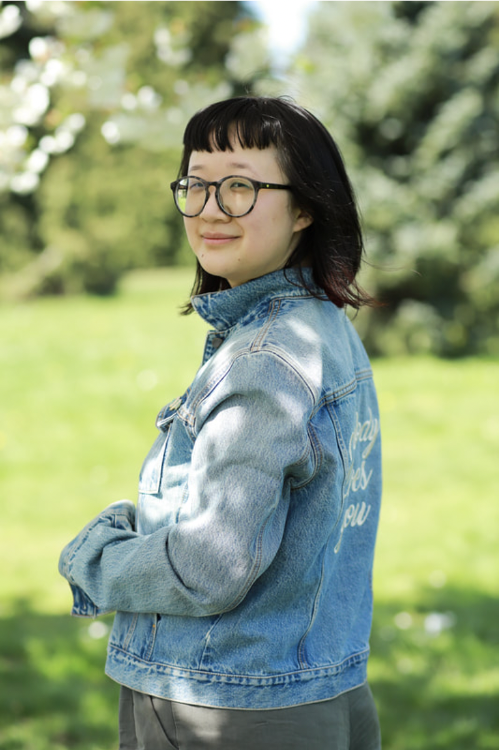
Jane Shi is a poet, editor, and author of her recent debut poetry collection echolalia echolalia. As a diasporic writer who resides on the stolen and occupied lands of Musqueam, Squamish, and Tsleil-Waututh peoples, Shi hopes for a world where “love is not a limited resource, land is not mined, hearts are not filched, and bodies are not violated” (from https://www.janeshi.org/). Shi is the winner of The Capilano Review’s 2022 In(ter)ventions in the Archive Contest, with her poem “before you were born.” Her work has made appearances in Disability Visibility Project blog, Briarpatch Magazine, The Offing, CV2 Magazine, ROOM Magazine, The Ex-Puritan, Canthius, and Queer Little Nightmares: An Anthology of Monstrous Fiction and Poetry (Arsenal Pulp Press), among others.
In October 2024, Jane Shi released her debut poetry book echolalia echolalia, a full throttle introduction to her rich realm of writing, alight with queer wonder and wishes. Opening up about disability and alienating worlds, Jane Shi’s collection is a presence woven with the humility and curiosity that comes in echoing across the distance between oneself, and one’s ancestry. Her work hones in on the sound of language through the movement of syllables–or the interruption of them. Her “Little / post-its of reject grammatology” (from “Reading Practice”) both subvert the poems’ language, and embody resistance through its intersections of identity.
The poems from this collection are versatile in their shape and form; sometimes written in blots or sweeps, other times in fractures or short breaths, but always in motion. Jane Shi accomplishes what many poets set out to do, using her words as a fine-tuned instrument for the senses. Placing you in her narrative fields, Shi creates dioramas of saturated language in which each poem is alive.
Hazel Yott had the pleasure of meeting with Jane Shi to discuss echolalia echolalia, her creative process, and other insights into her writing.
HY: As a writer, what was your pathway into poetry like? What drew you to the form?
JS: Very initially, it was early exposure to poetry as a serious art form through classical Chinese poems, like Li Bai’s poem about the moon and my own childhood experience of memorizing that poem. More casually, it was songs and tongue twisters. I had a copy of Lewis Carroll’s Through the Looking Glass and What Alice Found There, which features the poem “Jabberwocky,” that I was really drawn to. I had Carroll’s book with Chinese on one side and English on the other, and at some point this translated book was brought to Canada when my parents and I immigrated. So this poem had moved across the ocean and I rediscovered it as a young person when I became more fluent in the English language a few years later. And then a few years after that, poetry for me became a place where there was freedom to play and be weird. In poetry I found a capacity for language to create new worlds and reinvent oneself and survive. Soon poetry became a way for me to survive, emotionally.
Another interesting context is that in the early 2000s, everyone was blogging, using Xanga or Myspace, and coding their own little blog sites. On those platforms, there were no strict formats or rules, so exposure to HTML and its ability to create weird formatting gave me a lot of freedom to play, and was also an exposure to poetry.
Because I studied literature in university, I enjoyed memorizing poetry. I was studying Shakespearean and modernist and postmodernist works, but I had a difficult time wanting to write about these poems in essays because I felt like I didn’t have enough time to spend with a particular poem. Still, I enjoy doing it from time to time. While studying literature and reading others’ works, I was writing poetry throughout, so after my degree ended, I was very excited to work on poems for a while.
HY: I love how you bring in this idea of poetry as play and as a medium not being limited in space. You shared how you enjoyed writing poetry while you were studying literature, were there any poets in particular that influenced your work?
JS: I feel that everything I read has influenced me in some way. At some point, I rewrote John Donne’s “Batter my heart, three-person’d God.” The poem’s metre offered me a structure within which to write. But also, I was reading a lot of modernist poetry–E. E. Cummings, T. S. Eliot–and I was distraught by the fascist context in which they wrote and the way that they have been canonized. Nonetheless, reading and studying their work has influenced me. Prose influenced me a lot too, as a teenager I read a lot of José Saramago, Vladimir Nabokov, Virginia Woolf–but I was also influenced by Theresa Hak Kyung Cha and Dionne Brand also, who I read later in university. So even though I was influenced by a lot of poets, I was actually influenced by a lot of these more experimental novelists, autobiographists, and artists, too.
HY: Fast-forwarding from these early figures of inspiration, how would you describe the making of your debut collection? What were the inspirational pieces or elements that went into its creation, or curation?
JS: One part of it was that I had at some point collected and written enough poems where it felt like there was some kind of manuscript to be shaped. The other part was the idea I had for five sections and a shape of a book where a driving theme was this idea of being a chameleon, of code-switching or autistic masking and camouflaging, or just being a person in an alienating world: the ways in which we are multiple things–multiple forms–shifting from space to space and adapting to the environment. I think that was one of the paths for the shape of the book.
I was also thinking about things like intergenerational resistance to different political upheavals and what it does to a generation, or what it does across generations, when there are repressions of those struggles. I was thinking about, for example, June 4th and my family’s participation in it. I was thinking about the One-Child Policy and what it’s like for a whole generation to not have siblings and to be forced to conform to this reproductive, patriarchal state control. I was thinking about how eugenics shows up in everyday life, how it’s experienced by people. I was also writing about a history or an experience that I myself hadn’t really read in poetry before; every person has a different, very specific history.
In terms of curation, I had a lot of help from many editors and readers–Phoebe Wang, Shazia Hafiz Ramji, Beni Xiao, Cynthia Dewi Oka, and Alayna Munce–in that process. A lot of it was paring the book down to hit the notes it needed to, so to speak, and putting a little bit of everything in the book. The editorial process helps you to see where you may be saying the same thing over and over again, or how you are saying something differently, in a new way. So that was a big part of the curation process, it all (technically) unfolded and came together up until the last minute. It wasn’t that I had always planned this book to be in this order, it came gradually, but I did know for a fact that I wanted the book to be in multiple forms. I wanted there to be a lot of movement and diversity and tactics on the page.
HY: I’m really glad that you’ve brought up this point of “resistance,” because as I was reading through your book, that was something which I’d felt was resonant throughout. Talking about all the different forms that went into this collection, and how they’ve all been put together, my next question is about the title choice, which I was really pulled in by: echolalia echolalia, the words themselves are performing an action on the page. What brought you to this title for your debut collection of poems?
JS: The last section of my book was going to be some variation of “echolalia as a second language,” which I had originally thought about as a title, but one of my first readers, Beni Xiao, suggested “echolalia echolalia,” and I really fell in love with it. It reminded me of onomatopoeia and the reduplication that happens in the Chinese language, such as 多多 (“duo-duo”), which means “a lot of”, or 点点 (“diǎn-diǎn”), which means a little bit. The repetition creates a new kind of meaning or emphasizes that word. It also reminded me of the first Chinese characters I saw and read: the character for “double happiness” (囍), which is usually what married couples hang above their bed. So, I think the title reminded me of a child’s way of rewriting that reduplication through echolalia, and that was really powerful to me. Of course, in Chinese it’s just one syllable, but in English it does a similar thing, in a way. So after finalizing that title, I decided to emphasize those repetitions throughout the collection, because repetition is also something I play around with a lot in the book.
HY: In line with these choices of repetition and the forms or relationships of language, I noted that your poems feature abbreviations, statistics, or Chinese characters. How did you go about choosing the forms of language for your pieces?
JS: The form of the language is often the poems themselves, and they wouldn’t come to be without them. One example is how “notes app apology” echoes the netspeak I “invented” as a preteen, because the poem channels that younger self. I think it was a way to stay true to that younger voice and bring some of those creative choices back into the present day, or honour the choices I had made then. With Chinese in particular, it’s how I sometimes speak as a heritage speaker. There is often deliberate wordplay or an insistence on opacity in order to honour, document, or make present the languages and atmospheres that I grew up in, where there were multiple dialects and accents. There’s a sense of multiplicity because that was what I grew up around. I also feel like there is a lot of poetry in these different forms–with statistics and polls, or other kinds of formal documents–that exist out there as places that you can write poetry through. They’re ripe places to play.
HY: Tell me a bit about your writing process and maybe what was one of the biggest lessons which stood out to you in creating and editing a collection of this length?
JS: The biggest lesson for me is that poetry teaches new things about yourself that you didn’t know before. For example, I didn’t know that I was playing around with humour until I saw that it was what they put on the blurb at the back [of the book]. I didn’t know that I was using humour as a coping mechanism or that it was such a strong force in my work, as well as style. I also didn’t know–or I wasn’t really conscious of the fact–that I was writing about staying on this earth until the book was finished. Which is to say, the writing process is a learning process. It’s a process of becoming, and that process is almost more important than the final product. I think the process of creating, itself, is so instrumental and so rich with learnings and revelation, and it is worth celebrating. That is the biggest lesson. Obviously, I was stressed out about finishing a book, but looking back, the little moments when I realized certain things were happening on the page, those were very freeing moments.
HY: I really appreciate that messaging, I’ve often heard poets talk about poetry writing in the sense that the writer almost acts as a conduit for what the final poem is trying to be. Along those lines, were there pieces in particular which were surprising for you, whether it was how they evolved or in terms of the voices that were displayed on the page?
JS: What was surprising was that I could go read a poem again, after a few months away from it, and still take something from it. The poem somehow does the work and it wasn’t just something that helped me when I wrote it. I think that was how I knew that the book was doing something for me both as a reader, and as the person who wrote it, if nothing else. The surprise was the speaker’s revelation, understanding, or discernment about what is going on. It’s like reteaching yourself something. The fact that the poems could do that was very remarkable to me. They’re usually poems that are not speaking towards the outer world but speaking towards the self, and that internal revelation often surprises me.
HY: I definitely understand your reference to a sense of these inner or outer worlds. I think that while reading through some of your poems, their level of language and description really made it feel like I was being let into the created world, and that felt really special to be able to partake in. Do you have a favourite–or a couple favourite poems from this collection?
JS: I really enjoy reading “i wish i could write poems,” because I get to do different voices. The poems where I get to read and embody different ages or people feel really fun to do. I’m also fond of “Deep Inside You’re Just a Tool Fan” because there is a dorky inside joke or Tool illusion in the poem’s form involving the Fibonacci sequence and it takes me back to a really nostalgic but comforting place. I also enjoy looking at the concrete forms that I created because they create a gestalt where I can just look at the thing and I don’t have to read the poem, and it makes the subject matter a little bit easier to take in. It’s why I wrote those concrete poems to begin with, so that myself and the reader could take it in on multiple levels. I’m also proud of “Industry of Caring” because I feel like it holds many secrets, but they are secrets you can find if you go looking for it.
HY: This brings me to my last question, which is if there are any forthcoming projects that you’re excited about, or how your creative process looks now, following such a momentous project?
JS: I have a piece that recently came out in the Queer Epistolary folio of ANMLY called “Shattered Pixels, Shared Oxygen,” which was originally shortlisted for The Malahat Review’s 2022 Open Season Awards, read by Erin Soros. I also have two essays coming out in anthologies, one of them is new, co-written with Leah Lakshmi Piepzna-Samarasinha in, Read This When Things Fall Apart: Letters to Activists in Crisis edited by Kelly Hayes and the other is a reprint appearing in We Are Each Other’s Liberation: Black and Asian Feminist Solidarities, edited by Rachel Kuo, Jaimee A. Swift, and TD Tso. In terms of my writing process, after finishing writing and publishing echolalia echolalia, I want to write more. I feel more confident in the craft and more excited to do more writing–obviously, nervous about it too–but I think that the process feels exciting because I’m not yet committed to anything in particular. If I am moving towards a project, I feel like I have a bit of freedom to suss it out before moving forward. I think I’m just feeling excited to write more and definitely less nervous or anxious than when I started out.
echolalia echolalia is praised as a CBC Best Book of Poetry 2024, and is available for order from Brick Books and Toronto’s Another Story Bookshop. You can also find more from Jane Shi, and where to get her debut collection, at https://www.janeshi.org/.