
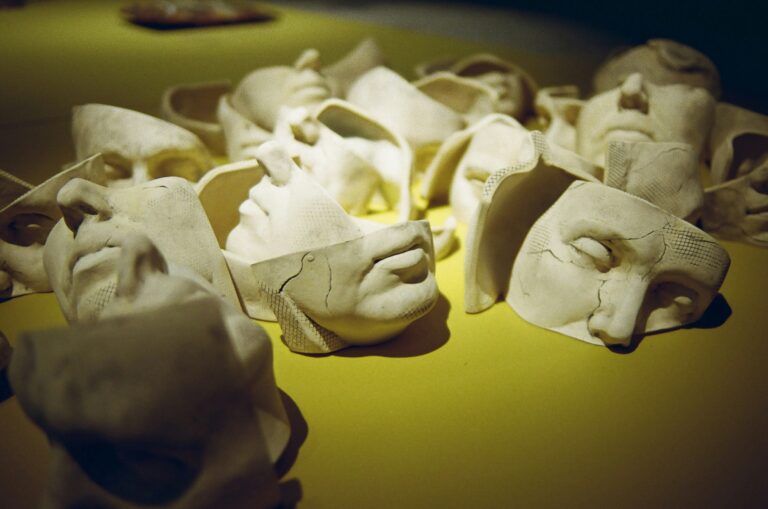
My identity has always been fluid. In the carefree liminal space between genders, my selfhood is like a scrying pool, deep waters that warp my reflection the longer I stare into it. My shape is ever-shifting and eternally mutable.
There might have been a solid self years ago, but I became convinced at a young age that I had something to hide. There was something wrong with me, deep down, but I could never quite articulate it. The whole world was playing a game, and it was as though they’d all gotten the rule book in the mail while I was still waiting for my copy. In the meantime, I tried to play along, but every move I made was stiff, like a doll come to life, an uncanny valley imitation of what it meant to be a kid.
But it was something that could be remedied if I only put my mind to it. I’ve never failed at anything I’ve put my mind to. I took on the abandonment of my old identity with the fiery passion of a convict on the lam, and the shape-shifter was born. Building a new identity isn’t that hard, especially when it remains an amorphous amalgamation of the best parts of everyone else. All it took were a few carefully mirrored mannerisms, a practice in matching energies so exactly that every conversation felt like an echo. I became a performer of countless roles and had a closet stuffed to the brim with costumes and masks.
I grew to love my shape-shifter. I was the shape-shifter, the shape-shifter was me. The shape-shifter was my best friend, the willing host to the useless brain I needed to lug around.
All good things have a catch, though. And the shape-shifter is no exception.
What no one tells the shape-shifter is that when there are no other souls to siphon – when they’re alone in their room, in the dead of the night – a tiny wormhole opens up in the centre of their chest. When it first begins to grow, it’s hardly invisible to the naked eye. But the shape-shifter has nervous hands and cannot stand to leave any rift alone. They pick at the wormhole, like a run in a sweater, until it grows, and grows, and grows. The wormhole becomes something that cannot be filled, ever-expanding and infinite.
***
I turned nineteen in a mental hospital.
I say this now, to acknowledge the scrubs-clad elephant in the room, the one that’s been sitting on my chest ever since the last year of my teens. This trip to the psych ward marked the total implosion of my short adult life. It symbolized a complete failure to adjust to the “real world,” a remnant of adolescent childishness that I feared would cling to my every move, the same way the phrase “revolving-door-patient” clings to your records.
I was mortified by the way that my illness snuck up behind me when the rest of my life was supposed to be going well. I had a friend group too large to count even on both of my hands, I was academically successful, and I was adjusting as well as I could to life in a totally new city.
Yet, when I was alone – in my room, in the far corners of some desolate building on campus, in a bathroom stall that reeked of disinfectant – I felt nothing. It’s a feeling I’ve now come to know as the wormhole, the tiny speck of nothing that opened deep in my chest and had been growing steadily for years.
Picture this: a hungry beast of negative space opens up in you, and it can’t be filled no matter what you pour into it. You try everything you can. Binge eating, reckless spending, anything to fill you up, up, up. But the beast eats everything it comes into contact with. It belches, then asks for more, gets belligerent when there isn’t anything left. Soon, you enter a state of emotional ketosis, eating yourself from the inside out. A hangry ouroboros.
Halloween, my favourite holiday, came and went without acknowledgment. My guitar fell out of tune, dust settling under the strings after months without use. I cancelled plans more often, the momentary buzz of a new swath of “alone-time” dwarfed by the sudden, painful realization that most of my time had become “alone time.”
Given all of that, it was no wonder that I could hardly stand being alive. I had been taken over by a parasitic host of absence. I was possessed by the nebulous form of myself that existed only in the form of grey sludge.
I thought I had hidden it well, but looking back, I think everyone else could tell. My eyes were empty; my whole face took on a ghostly pallor. I became a walking sieve – everything just whooshed right out. I spent those months convinced that if you were to rap your knuckles against my chest, the hollowed-out cavity would ring like a bell.
But you know what they say:
Fool me once, shame on you.
Fool me twice, shame on me.
Fool me three times? SOMETHING HAS TO CHANGE.
***
In order to escape the ever-expanding wormhole before it swallowed me whole, I had to kill the shape-shifter, a task easier said than done.
My therapist taught me about the concept of masking, the elaborate ruse an undiagnosed autistic person adopts in order to survive in a neurotypical world. It’s not an uncommon practice. But for those afflicted, its insidiousness is the way the mask creeps into every part of your life, wrapping its tendrils so tight that you can’t pull it off your face without ripping some skin off.
So that’s who my shape-shifter truly was, then. Not a friend, but a maladaptive coping skill. The shape-shifter had not discovered that wormhole by happenstance. The shape-shifter created it, building a universe so unstable and rickety that it wasn’t too hard to slip into a new reality, one where everything was sepia-toned.
I had learned to love my shape-shifter. And I was convinced that everyone around me loved it too, more than they would actually love my true form.
Worse still, I wasn’t sure if I even knew what my true form was, not anymore. What if I killed my shape-shifter but couldn’t mend the hole left behind? What if I launched my only friend and protector out into space just to find myself stranded too?
The shape-shifter had buried me — no, I had buried myself. Trying to find the remnants of my true self would be akin to an archaeological excavation. It would take a whole team, it would take years, and it would probably take some reconstruction done in the lab.
But there was only one way out, so I picked up a trowel.
***
My crawl back to a human form was not a triumphant one. It was ugly, calloused, the way these things often are. I survived being buried alive but had to claw my way out of packed, wet earth, and spent the next few weeks (read: months) cleaning my cuticles and spitting out mouthfuls of dirt.
It was a slow crawl back up to being okay. I was like a newborn foal, walking for the first time on shaky legs. I called my therapist for the first time in weeks, and I finally asked for help. I told them I was ready to change, ready to meet myself for the first time. I started biweekly therapy sessions again, and grew so used to crying that I kept a box of tissues on my desk during each call. Never in my life had I been so honest, and though at first it felt like every truth was pried from my chest kicking and screaming, it started to get easier.
I got to know more of myself, day by day. Little by little, I placed pieces of myself taller and taller until I got something approximately Alex-shaped. I learned that my new face – my real face – crinkles a bit when I smile. I learned that I can make myself laugh so hard that I start coughing. I learned that I feel deeply, I cry at movies, I jump around to songs I can feel in my soul. I learned that when I’m excited, words pour out of me like a flowing river, and there are people who care to follow it all the way downstream.
When I turned twenty, I cried for almost an hour. I was hit with the immensity of everything that I had almost missed, everything in my life that had been in the collision course of the shape-shifter’s inevitable implosion.
I’ve been trying for a whole year to find an ending for this story, but there isn’t one, and there won’t be, not for a while yet. Not all of my days are good ones, but the bad days don’t last as long. I don’t always like who I am deep inside, but I can smile when I see myself in the mirror.
I don’t know where my shape-shifter went after I exterminated them. Maybe they were absorbed into the true bits of me, and the falsehoods sloughed off like a second skin in the shower. Or maybe I threw them out the front door, to be picked up with the Friday-morning trash collection. They could sit now in some dump deep in the boonies with the discarded remains of the city’s spring cleaning.
Wherever my shape-shifter is, I hope they’ve found stillness. Or stasis, or whatever it is you’d call it. Even the most ambitious perpetual motion machines get tired eventually. I hope my shape-shifter finally gets to rest.