
I walk past the booth offering unpasteurized honey and beeswax candles, past the garlic guys and the eggs. There are people at this market who sell handmade items—pastel woven blankets, leather pouches and purses studded with little stars, wood worked into cutting boards and rolling pins and holders for cards or dominoes—but I always quickly pass these booths, avoiding eye contact with the purveyors. On the one hand I never have artisanal prices in my budget, and on the other I’m not really a things person, especially things that are new. My boyfriend is a things guy. He’s a collector, or he was. We still have all his records and games, and he crawls through them nightly—what was once hobby is now habitat.
I push onward through the crowd and eventually out the door that leads to the portion of the market where there are food trucks and farmers hawking their produce. I watch as swarms of people float from table to table, middle-class parents pushing strollers that cost more than my rent, retirees sporting jewellery and brand-name coats. I begin to browse the vegetables, looking for something my boyfriend will enjoy.
It’s fall, so there are squash and apples on offer, their warm hues suggesting summer sun captured and turned into sweetness. I think of our summer, of the warm and long days that he called out of work, and we lay in bed for hours, resisting the world’s imperative to move. In stillness, resistance forms around the body like a soft green shell. At one farmer’s stall, there is a butternut squash the size and shape of a small child. But what catches my eye are the Brussels sprouts. I’ve never seen them like this before: still on the stalk, the buds growing in the stunningly symmetrical way that so many of nature’s fruits do, culminating at the top with a glorious leafy plume. He will love it, I know. First of all, there’s the fantasy-staff feeling of the thing. I hand the farmer five dollars and take the Brussels staff in both hands, appreciating its heft. I smack one end of it against my palm and it feels right, even though I lose a sprout or two to the ground. Let the pigeons have them, I think. There’s no way he’ll eat all these anyway. Walking back to my apartment, I overhear a young kid exclaim “Whoa!” as I nearly whack him in the face with the Brussels staff. “Whoa,” I echo, as I cross the threshold back into my apartment. “Whoa.”
We began our relationship as coworkers. A tale as old as time: me, the barista at a chain hotel café; him, the cook who supplied the chain hotel café with baked goods. When I remember our early interactions, I think of him walking through the lobby, arms filled with a tray of warm croissants. I remember admiring his upright posture and the rich sound of his voice. I was always trying to get him to say things. “Root beer.” “Bananas.” My name. Anything.
Nine-day workweeks are not unusual in the hospitality industry, and we never got normal weekends, so we were always saying things like, “Today’s my Friday.” Days of the week became floating signifiers. You were on or you were off.
After we started dating, it felt like a cosmic slight every time he had to work and I didn’t or vice versa. Seeing Frankie and not my boyfriend walk through the lobby, muffins in hand, made me want to hand in my notice. There was a week when our schedules were so opposite that he’d worked four days in a row while I’d been off. He was on one of those nine-day stretches, too, so he still had five to go.
I remember he said to me, “The last four days have felt like Wednesdays. It’s kind of fitting that the day you come back finally feels like a Thursday. Thank you for resuming time.”
So many of our dates have involved food. In the kitchen we synchronize, the rhythm of knife on cutting board, the sizzle of meat in a pan our own vibrational communication. My boyfriend is a dedicated guardian of hot pans, stirring, temp-checking, steadily steering the meal to completion. The part of cooking that I find most relaxing is the mise en place—peeling, chopping, taking a vegetative whole and breaking it down into its constitutive parts. I love a fennel because of all the elements at play: the fronds you can pick or chop and use as garnish, the crown of stalks you can remove and save for soup stock, and the bulb, which is just begging to be sliced, first down the middle and then into thin half-moons.
Once, I’d prepared a bunch of ingredients for a salad I found a recipe for in a magazine—a mix of citrus including grapefruit and blood orange, avocado, jalapeño, shallot marinated in lime juice, grilled halloumi, and pita bread that had been drizzled with olive oil and salted and then toasted. He sidled up next to me and the cutting board where I’d laid most of it out, wiggling his fingers at the ingredients to suggest he was going to steal something.
I gestured for him to go ahead.
He made a base out of a toasty bit of pita and stacked on it halloumi, orange, avocado, and like a newsboy cap ever so gently on top, a jalapeno slice.
“You’re not going to fit that all in one go,” I teased.
“Aren’t I?” He layered on a couple pieces of shallot and shoved the whole stack in his mouth. His eyes widened, and his full mouth smiled around its burden. With his hands beside his head he made gestures like little fireworks popping.
“It’s good?”
He chewed, nodding slowly. He swallowed. “It’s great. I’m having a total ‘rat trying strawberry and cheese at the same time’ moment. Fireworks, in case my mime wasn’t clear.”
“Rat trying strawberry and cheese?”
“Yeah. Rat trying strawberry and cheese. À la Ratatouille?”
“My Remy. I love you.”
I put the Brussels staff down on the counter where I’d once cut up all that citrus.
“I’m home!”
I wash my hands, slowly, getting in between each finger. My ex’s dentist once told her that brushing your teeth without flossing is like washing your hands without getting between the fingers, and now I’m careful both to floss and clean between my digits with extra care.
“I brought you something,” I shout from the bathroom.
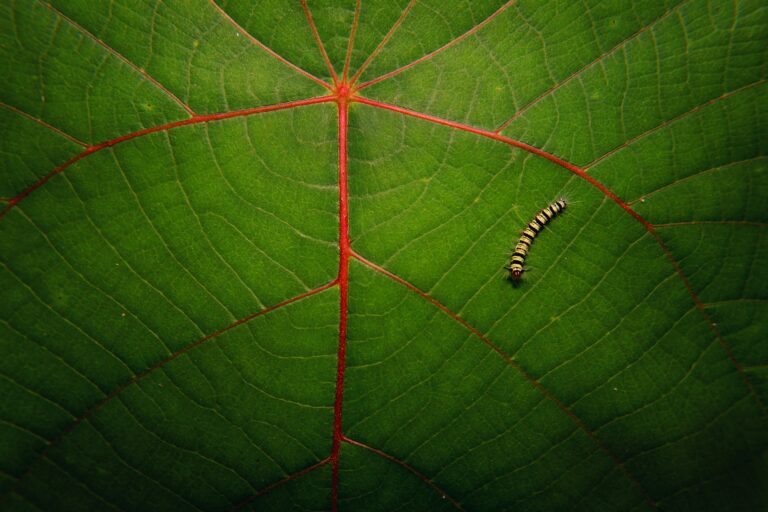
When I return to the kitchen he is there on the corner of the kitchen table, looking at me greenly. His torso is lifted in greeting, his front six little legs wiggling.
“It’s an all-you-can-eat buffet,” I say, placing the staff on the table behind him, gently. At just under an inch, he is small, so I am careful.
He worms toward the offering, his inconspicuous antennae reaching, mouthparts opening and closing hungrily.
I leave him to his methodical eating and turn to the scraps he’s left on the other side of the table—what used to be a cabbage and now looks to be just a few lacey leaves, full of boyfriend-sized holes, and a stump.
“You’ve been a very hungry caterpillar.” I pick up a leaf and turn it over. Bits of silk stretch from ridge to ridge of the underside of the leaf, some taut and others hanging limply. He’s been eating and eating. Soon he will pupate. I have precious little time left.
We were lying the wrong way across the end of the bed, because it was too early to lie in bed properly, and yet being in bed together was too sweet to resist. I was on top of him, pinning him under me and reciting one of Benny Feldman’s bug-based one-liners.
“The Very Hungry Caterpillar would’ve absolutely gone to town on The Giving Tree. They matched each other’s freak,” I said, barely getting the words out because I was making myself laugh too hard.
“That’s so stupid. I love it,” he said, also laughing.
“He has a lot of good jokes about bugs.”
“Oh yeah? You know I’m a bug guy.” He wiggled his eyebrows suggestively.
I kissed the spot of bone between them that was perfectly shaped to receive kisses, then pulled back and looked down into his eyes. The moment stretched, elastic, and I thought of molasses and golden-hour light. That was the hazel, a mix of those. And there was the curve of his brows, the line of his beard across his cheek, the smile lines beside his eyes that I was always trying to make appear. I looked and looked, trying to memorize every line of him, every colour exactly.
Interrupting my reverie, he asked, “Which of your eyes is dominant?”
“Huh?” I began to laugh again. There I was, my internal monologue so purple, and he was thinking about ophthalmology.
“You look into someone’s eyes long enough,” he said. “And you start to ask yourself, ‘who’s running the show?’”
I laughed hard enough to fall sideways off him, unable to control myself.
Later, we cooked, and before long we were eating homemade gnocchi in brown butter sage sauce.
“So he says to me,” he continued, swallowing, “your girlfriend is getting a PhD? She is going to make more money than you.”
I choked on my last bite of food. “That is not the impression I have of postgrad life, but go on.”
“He said that’s no good. He said the man is meant to be the tree and the woman is meant to be the soil that nourishes the tree and makes it grow big and strong.”
I snorted. “Yeah, right. What did you say? Did you tell him he’s an idiot? Did you tell him no woman is going to want to be his dirt? Did you inquire as to what metaphor this lovely co-worker of yours might have for lesbians? Is it just dirt all the way down? Did you remind him we’re bisexual, and we don’t go for that heterosexual horseshit?”
He shook his head slowly and ate another gnocchi, letting me get it all out. “I told him that neither of us is a tree, making the other our soil. I told him that we are more like photosynthetic algae and fungus that function symbiotically as lichen.”
He is eating his way through the Brussels staff, but I bring him some cilantro anyway, in case he wants variety. On our first date, we made Banh Mi and I remember asking him whether he liked cilantro or if he had the gene that made it taste like soap. He said he had the gene but he liked it anyway. I knew I was already done for then. That I’d want to know his opinion on everything from that moment onward. I wanted to taste food through his taste buds, get so acquainted with the way he thinks that our thoughts began to follow similar patterns. Where he went, I would go. Like soapy cilantro, he added an intrigue to the flavour of my days, and I wanted to taste it all.
I watch him move furiously for such a small creature, traversing the vast kitchen table like it’s nothing, prolegs and true legs both shimmying toward the new leaf. He has eaten so much now that his tiny body looks overstuffed, his segments all seeming to bulge at the seams.
“I love you tremendously,” I say, petting his thorax gently with the tip of my finger.
Then I turn to where I’ve set everything up. I am drowsy with all the spinach and chicken I’ve eaten in preparation for this moment. I take one end of the hundreds of thrifted silk scarves I’ve tied into a long, long string. I tie it to my ankle, and, holding it taut, I begin to slowly wrap myself in silk. The scarves begin to cover me, first calves, then thighs, leaving the knees free for bending until the next layer of wrapping. Then I cover my waist and torso. I individually wrap each arm, leaving the elbows and hands for the second pass. Tightly, so that I’m almost choking, I wrap my neck. I take one more look out the window of the apartment we love, blinking at the laundromat where we played Gameboys to pass the time. The sky is pink and it’s growing pinker.
I wrap the top of my head—clumsily, but it will have to do. And then I wrap my eyes, my mouth and nose. The silk feels hot against my skin. Feeling my way, I attach what’s left of my silk scarf skein to what used to be our paper towel holder, which I have fastened to a heavy side table so that I can pull my wrapping taut around me, and I slowly spin, enveloping my joints in the silk scarves, plastering my arms and hands to my sides. I become rigid, encumbered. It is only my feet and the very tip of my head free now. My vision starts to blur as I struggle to breathe.
Finally, I relax into it, the hug of the silk a strange comfort as I lose consciousness and give in to change, to chaos and nature and whatever comes next.
“What a boring question,” he said. “Of course I would still love you. I’d treasure you. I’d become a worm myself if that’s what it takes. Yes. Duh, okay? Yes!”
“Obviously, I feel the same,” I said, tucking us both snugly under our orange comforter. I pressed my legs together and pulled the edge of the blanket up under my chin, so that only my face was exposed as I looked at him. I wriggled happily, burrowing into the warmth. “Obviously.”