
Celestina was eating enough for two. Her grandmother had been growling this for the past three months, but nobody was around that morning to corroborate: her father was working first-shift at the clinic while her mother was attending a funeral. And with her grandmother busy with the usual chores, Celestina was left alone in the kitchen with her dominos and a single mandarin orange.
She sat and arranged the bones in endless loops as every surface gleamed with memories of the family’s favorite meals: pozole on her father’s birthday, caldo tlalpeño on Independence Day, and Celestina’s favorite mole on Saturdays. Yet, even with the usual Friday barbacoa bubbling on the stove behind her and the scent of the orange sticking to her fingers, Celestina sensed an even sharper presence lingering beside the back door.
Outside, beyond the frosted glass, a small patch of brown grass laid next to a square of concrete in front of the garage. Her grandmother’s flowerbed stretched along the retaining wall in back; her sunflowers were jagged monsters huddling in the late November chill, their massive heads dangling from brittle stalks like discarded fencing masks while the few irises that remained standing looked like corsages cobbled together from onion skin and rawhide.
A v-shaped gap split this group in two, as if something had barreled through and never bothered setting the flowers back in place. Piles of broken blooms littered the earth below, most of them casualties from the scorching summer days and pre-winter frosts. She remembered Remedios coming over for dinner in August as something small and hard dug into Celestina’s heel, tucked between her sock and tennis shoe: her grandmother refused to bring any of her flowers inside, so Celestina’s mother went and bought a bouquet of roses for the dining table.
She also attacked every scuff, splotch, and speck in sight, saying to anyone within earshot that Remedios had come to a lot of difficulty lately: she needed an evening in a clean house with great food and caring company. Meanwhile, Celestina’s father lit the charcoal grill and set it beside the garage before leaving for work, announcing that he already had his weekly card game scheduled for tonight, as Celestina’s grandmother, tasked with making the cochinita pibil and nicuatole, struggled to conjure an image of a girl named Remedios from the long list of classes and school dances her daughter provided as proof.
And amidst these preparations, Celestina was tossed outside and warned not to cause trouble or get in the way. She readily complied and sat on the back steps, watching the grill sweltering on the other side of the yard and imagining a black dragon’s egg glittering in the sun. She knew that her usual habits would not be tolerated today: no running through her grandmother’s flowerbed and twisting the slender stalks into mangrove trees adorned with hanging vines in her mind, or throwing stones at the crows crouching on the powerlines above the retaining wall because of the playground insults they made about her family, and absolutely no digging in the dusty soil and bringing a pail full of creepy-crawlies inside to show off the hard work of a junior entomologist unafraid to get dirty.
Instead, she sat on the bottommost step and tucked herself inside the sliver of shadow reserved for her. These were the last days of August, the time of year when mornings already came pre-heated, afternoons blazed, and evenings gorged themselves on the last scraps of humid sunlight, as if knowing that the lean shears of autumn were lurking nearby.
Then, at six o’clock, Celestina’s grandmother came out in a white blouse and black skirt to collect the pibil and shepherd the little girl inside. And even though the latter had tried to keep her distance, the aroma of the pork steaming in its banana leaves had flooded the backyard and rubbed achiote and bitter orange into her skin. However, a bath was out of the question once Celestina saw her mother wearing an ivory blouse and grey skirt. And even if she turned up her nose at her daughter’s arms sticky with sweat and zest, this was easily covered up by a tan dress, a pair of black church shoes, and a comb struggling through frizzy locks tangled with smoke.
And by six-forty, all three women sat on the couch, watching the darkness deepening beyond the screen door. The grandmother sat on the left, her hands reeking of cinnamon from her hours of kneading and stirring while her daughter’s fingers stung from the cleaner she scrubbed into every single bathroom tile. The youngest was tucked in between them, dreaming of the pibil resting on the kitchen table with all the fixings while dessert crystalized in the fridge: nicuatole, sixteen alabaster spheres laid in a glass pan, each topped with a twinkling smear of rubied sugar.
Two of them kept perfectly still, the eldest of the three focusing on her husband’s portrait hanging beside the front door. Only the mother crossed one leg over the other and jiggled her foot up and down, marking time at two hundred beats per minute as a moth battered the porch light outside. Then, at six fifty-five, the growling of an engine overwhelmed the crickets and cicadas as headlight beams sliced across the doorframe: someone was pulling into the driveway.
All three women rose from their seats. The mother leapt to her feet first and dragged her daughter to the front door while the grandmother dusted off her skirt and shuffled towards the kitchen. And pinned against the metal screen with a pair of hands pressing down on her shoulders, Celestina looked up at her mother first: her face was a mask, cheeks and forehead smooth as silk as her eyes darkened at the sight of the rusted-out Saturn rumbling in her driveway and the woman carefully climbing out of the backseat.
She wore a pair of white tennis shoes with a strapless dress that stopped an inch above her knees; the pattern was vertical strips in pastel colors that made Celestina think of a cotton candy buffet: powdered blue, dusty rose, sandy yellow, and mossy green. A braided leather thong weighed down with dozens of rings clanged against her chest while her hair was the wing of a copper-colored swan cradling both sides of a narrow face.
“Remi?”
Celestina’s mother called out, but the woman didn’t look up at first. She carefully closed the car door and whispered something to the driver, who stared at the two women standing behind the screen door before nodding once. Then, as the Saturn reversed and drove away, the woman adjusted the canvas purse thrown over her shoulder and shuffled towards the front steps.
Celestina watched from above and frowned: this woman didn’t have a single crease or spot on her arms or legs like her grandmother, but she moved even slower. She shivered at the hand that gripped the rusty iron railing below: she liked the long scarlet nails, but her wrist was even thinner than Celestina’s. Her forearm and bicep didn’t widen either, and the balls and sockets of the woman’s shoulders gleamed like clockwork components in the porchlight.
She climbed all three steps, inhaling deeply with each ascent, before lifting her head and smiling at Celestina’s mother. Her face was heavily powdered with brows and lashes just as full as the halo of hair looming behind her. She showed two rows of gleaming white teeth, but they couldn’t distract from the fact that her cheeks slanted towards her chin too sharply, giving her face the appearance of a scrap of wood cut too thin for use.
“You need to see my ID?” she said breathlessly. “Or can I just come in, Pilar?”
Celestina’s mother laughed and unlocked the screen door; the little girl backed away as this new woman carefully crossed the threshold, one of her hands in her mother’s grip. The two adults discussed the drive over here, and tonight’s guest answered each question with her eyes locked on her feet, as if making sure they weren’t going to fly away once she looked elsewhere.
“Maxi thought he knew the area,” she said, “but he managed to find the place after seventeen u-turns. Ten minutes late is his new record!”
This new woman laughed first, firing off a single ragged bark, while Celestina’s mother ducked her head and giggled in private. And once the two of them were firmly planted in the living room, tonight’s guest looked up and found a little girl standing beside the couch.
“Well hello there!” She said with a sparkling grin.
“That’s my daughter, Celestina,” her mother said as she locked the screen door behind her, “and my mother’s in the kitchen. Come and say hello, Celestina.”
The little girl slowly stepped forward, progressing one foot at a time until she was within reach of this new woman. She tensed as the latter lifted a single hand and laid it upon her shoulder, expecting the usual force whenever an adult put their hand upon her, but this limb was soft and light, as if it was sculpted out of feathers and dandelion fluff. Long scarlet nails pressed against Celestina’s shoulder blade, and she smiled at these two new sensations. There was even a third discovery when she caught a whiff of concealer: she was used to this dusty smell on her mother’s cheeks whenever she carried her towards the corner of the kitchen reserved for timeouts, but never on the back of a person’s hand before.
“This is Remedios,” Celestina’s mother said. “Remedios, Celestina.”
“Hello, Remedios,” Celestina squeaked, her mouth curling up shyly.
“You can call me Remi. All the beautiful girls call me Remi.”
Remedios removed her hand from Celestina’s shoulder and insisted on keeping her purse with her as the three women slowly moved through the living room and towards the kitchen in the back. They saw the grandmother busying herself with the tortillas, rice, salsa, and pickled onions through the doorway; she even adjusted the pan holding the cochinita pibil to give it a more photogenic angle as her daughter and granddaughter entered with Remedios tucked between them.
“And this is my mother, Imelda. Mom, this is Remedios.”
“Nice to meet you,” the grandmother said, somewhere between stern and preoccupied.
“Nice to meet you too. And thank you for having me for dinner.”
The usual chatter commenced right away: Remedios was fine with water, same as everyone else, as she allowed herself to be pushed into the chair closest to the living room. Meanwhile, Celestina sat on the right while her mother took the left; her grandmother sat opposite from tonight’s guest, flanked by the kitchen window and the back door. Both rectangles were the same shade of bluish-black, like two sheets of newsprint soaked in a gallon of ink.
And once everybody was settled, Remedios’s necklace clattering the loudest as chairs scraped in closer and napkins unfurled across diners’ laps, Celestina’s mother reached for the serving fork and was met by her grandmother clearing her throat. Three sets of hands instantly rested on the edges of the table, a fourth pair a second behind the others. The eldest squeezed her eyelids tight and breathed in deep before speaking, each wrinkle on her face darkening with effort as a solid gold band glittered on the fourth finger of her left hand:
“Dear Lord, we gather together under Your Graceful Presence in order to share this meal. Though we have done no good with our lives, Your Son saw fit to come down amongst us to suffer and die for all our transgressions. We deserve no mercy, yet it has been given to us: let that Truth guide the rest of our days. In Your Name we pray, Amen.”
Her daughter and granddaughter muttered their amens in unison before lifting their heads and plates. Remedios watched dishes orbit a cream-colored pitcher filled with red and white roses as she quietly dropped two tortillas onto her own plate.
“So, Remedios?” Her grandmother said, inspecting her guest’s slender hands.
“You can call me Remi. All the beautiful people do.”
Remedios tittered but instantly stopped when Celestina’s mother held up the serving fork for the pibil: no thanks, she wasn’t hungry. Instead, she smiled at Celestina and asked for some rice. The little girl nodded as Remedios held out her plate and half a spoonful rose from the tightly-packed bowl. And like an audience falling into fearful silence as an acrobat suddenly flounders atop the highwire, there was a heart-quickening moment when the spoon and plate both began to wobble. Yet, the grains of rice were successfully transferred, and Remedios returned her plate to the spot in front of her with another smile and a “thank you, sweetie” for Celestina, who beamed and gripped the wooden spoon like a conqueror’s sword.
“So Remi,” her grandmother said slowly. “You’re not eating?”
The guest’s plate looked like a minimalist composition compared to the hosts’: two full moons laid beside a crumbling hill whereas the other three dishes featured intricate landscapes constructed of spicy reds, sharp pinks, shining whites, and muddy browns.
“It’s my stomach,” Remedios sighed. “I can’t handle spice anymore.”
She tore a long strip of tortilla and carefully pushed it into her mouth, nibbling at it like a rabbit; then, still chewing, Remedios reached for her glass of water and took small, patient sips. The grandmother glared at her daughter, but the latter avoided her gaze as she warned Celestina to watch the end of her taco, red sauce and pickled onions already spilling out and onto her plate.
“But it looks great,” Remedios said, already finishing her glass. “You should be proud.”
And at that moment, Celestina dropped her taco, climbed down from her chair, and took Remedios’s drinking glass. She hurried to the sink, balanced on the tips of her toes as she jerked the faucet handle upward, and carefully filled the cup with both hands wrapped around its base. Then, the glass was swiftly and wordlessly returned to the table before Celestina climbed back into her seat and proceeded with her meal.
“And you’ve got two wonderful women in the house with you,” Remedios said with a patient smile as she carefully wiped away the streaks of sauce on her glass.
“Thank you.”
The grandmother blew on a forkful of rice as her daughter got up to turn off the kitchen faucet. The latter spoke about how happy she was that Remedios still made it despite her poor health before her mother asked if Remedios had any children. None was the answer. But didn’t she want children? Of course, but that was for the future to figure out, and who knows what the future’s up to these days?
Her grandmother shrugged: put your faith where it belongs, and it will surely grow.
“And what about you and Pilar?” She said. “What’s the connection there?”
Remedios, working on her second strip of tortilla, looked up at Celestina’s mother as she finished her first taco. Both women quickly lowered their scraps of food and dabbed at the corners of their mouths.
“I told you, Mom,” Celestina’s mother said first. “We met in high school.”
“But I don’t remember Remedios,” her grandmother said definitively.
“You wouldn’t recognize me from back then, to be perfectly honest.”
Remedios laughed as she held out her hand and hovered it at the height of her waist.
“I was a scrawny little thing,” she crowed. “Nothing to look at.”
“You’re certainly looking better now,” Celestina’s mother added.
“Oh you’re too kind. And a liar.”
The two women wore crooked grins as they snickered to themselves, the noises they made not going any further than halfway across the kitchen table. Celestina’s grandmother watched her daughter reach out and touch the hand of her guest while her granddaughter, bored by the adults’ conversation, dropped pickled onions into her mouth one-by-one like they were worms.
“Do you have a husband?” Her grandmother said sharply.
“Not right now,” Remedios said, her chuckling slowly fading away. “Same with the kids. We’ll see what the future holds.”
“So who dropped you off tonight?”
“Mom…” Celestina’s mother sighed.
“Maxi did. You could say that we’re under each other’s wings.”
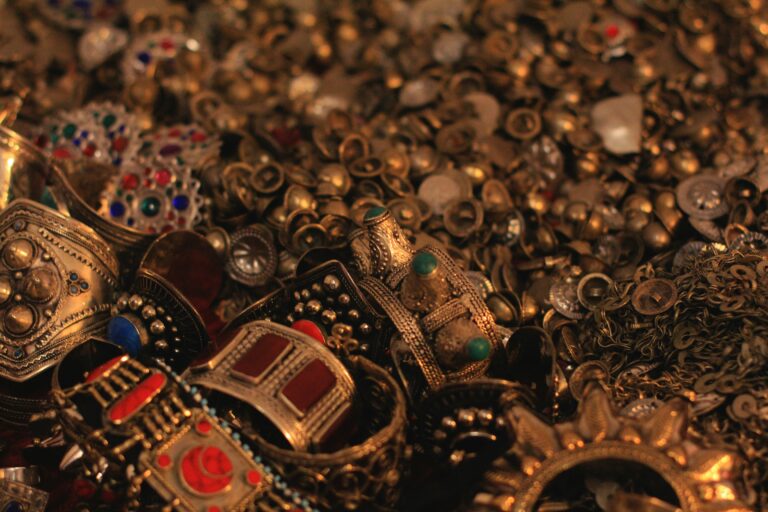
Remedios wiped her unsoiled hands on her napkin before holding up the twisted leather thong looped around her neck. There were at least two dozen rings strung along its length. Gold, silver, and brass hoops jangled together: some designs were simple, others more ornate with filigree and inset stones. A couple even looked like costume jewelry, or a piece of fakery won at a carnival: too sparkly, or too big with amethysts and emeralds flatter than stained glass. Remedios stuck out a finger and pointed at a silver band with a Greek cross punched into its side.
“He drives me around and picks up my medicine, and I try to keep him on the straight and narrow.”
“And are you with all those people right now?” Her grandmother said, lifting her own finger to trace Remedios’s neckline back and forth.
“Mom…” Her daughter said, exasperation bubbling up in her voice.
“Only a couple.”
Remedios answered with a tired wink, resting the weighted thread against her chest.
“There are lots of memorials on here too…”
The grandmother didn’t look up at her guest as she gathered another forkful of rice.
“Well, it’s a little flashy of you, walking around with enough jewelry for an entire department store,” she said lightly. “But it’s sweet of you too.”
Imelda glanced to her left as she worked, and her granddaughter was still picking at her onions with fingers glistening from the lime juice and vinegar. She was also kicking her feet as she held the wiggly bits above her mouth and dropped them inside, making a soft galloping sound as the heels of her church shoes knocked against the underside of her chair.
“Hey, you’ve got a memorial too,” Remedios said, gesturing to the grandmother’s hands. “And I bet it’s made out of real gold too.”
The grandmother jerked up at this comment and wrapped her right hand around her left.
“No need to be embarrassed! We all have memorials–”
“I’m not embarrassed!” The grandmother hissed. “I’m not embarrassed of my husband, God bless his soul, and what he did for all of us–”
“Mom,” her daughter said softly, leaning closer, “calm down–”
“I won’t be lectured by someone who runs around, sick as a dog!”
The grandmother shouted this to her right side before twisting to her left.
“And stop it!”
Even three months later, Celestina still felt her grandmother’s grip on her forearm as she wrenched her hand away from her mouth. Sitting on the kitchen floor, imagining her rows of dominoes as parades of ladybugs, she tried matching up all their spots while still seeing the three dashes on the top of her arm and the shorter, darker dot on the underside: it took until the second week of school for all four of them to fade.
And back in August, it was Celestina’s mother who shouted next after the slamming of a little girl’s hand against the tabletop and the burst of silence that followed. But Celestina didn’t stay to listen; her grandmother released her grip as she whirled towards her daughter, and her granddaughter leapt from her chair and dashed towards the back door when no one was looking. It swung wide and slammed against the railing as she stumbled down the steps and into the darkness: forward was the only way to go with two voices rising behind her.
Celestina ran until the soil of her grandmother’s flowerbed crumbled beneath her feet. Then, she covered her face as she barreled through the mummified sunflowers, as if pushing through a crowd of yardsticks; a carpet of burnt-up irises crunched against the heels of her church shoes before the retaining wall stopped her progress. The little girl placed a hand on its rough, bulging bricks and struggled to breathe as she looked back through the jagged leaves, her eyes stinging as she pretended to be peering through a dying jungle.
It wasn’t her best attempt at disguising what stared back at her. She could still see the kitchen window and back door: both were rectangles of golden light pasted onto the black outline of the house. Through the window, she could see the back of her grandmother’s head twitching up and down as she spoke rapidly to someone just out of sight.
And just then, the screen door swung open with a squeal. It was Remedios, who slowly lowered herself onto the topmost step and rummaged through her purse. There was a flash of light and a red pinprick glowing in the center of her head. Her face was another shadow hanging in the air, and Celestina couldn’t tell where she was looking: towards the empty grill sweltering beside the garage, the powerlines overhead dissolving into the late summer sky, or straight through the sunflowers at Celestina watching her?
The little girl kept perfectly still despite the mosquitos tickling her arms and cheeks and the dot of water descending from her left nostril. Soon enough, the whining in her ears thickened until it was a conversation: two adults yelling, their words unintelligible but with a cadence familiar to Celestina’s ears. She missed the first movement as she stumbled through the sunflowers; now was the overlapping middle portion as one voice wove through its partner like two serpents coiling around each other as they tried to trap their opponent in a knot that could never be loosened. Then, the slamming of the refrigerator door, audible even from the back of the property, declared that the conclusion had arrived.
It always ended in the same, abrupt way. Like one of Celestina’s toys running out of batteries, it’d take two pushes of a button to get a response, then three, before there was only the clicking of plastic for company. Her mother shouted the last word first. Then, after a couple seconds of silence, her grandmother answered at a regular volume. The seconds stretched themselves even further afterwards, accompanied by the clattering of cutlery, before her mother retorted even lower but also sharper. Then, a full five seconds went by without a word from anyone before Celestina’s mother appeared in the doorway with two plates in hand and a muttered comment from her grandmother.
There was a scathing glance to her left before Celestina’s mother undid the latch with her elbow and stepped onto the back porch. Trying to stand as tall like a marble statue, she whispered something to Remedios as both women studied the sliver of sky tucked between the garage and the powerlines. Celestina didn’t even breathe as she watched them, knowing that the slightest motion would rattle all the stalks around her.
Her mother went back inside after handing both plates to Remedios, who laid them on the step beside her. The screen door slammed shut, and silence resumed its reign over the backyard as Remedios’s cigarette glowed in her right hand. Celestina dared to look closer, and each plate was loaded with a ball of ruby-dusted nicuatole.
Her eyes widened as her mind suddenly raced ahead of her, imagining what would happen to these desserts if no one ate them. Would they be locked in the fridge forever for just the adults to enjoy, or tossed in the trash like so many other treats, since dinner dissolved into yet another argument?
And having to know either way, Celestina stepped all the way around her grandmother’s flowerbed, imagining herself as a tiger stalking through the tall grass with amber eyes locked on her prey. And once she was fully unveiled, she stopped and waited to see if anyone would notice, if any other tigers were ready to pounce and tear her limb from limb. But no shouts came from inside the house, even when Remedios held up one of the plates and showed it to Celestina.
The little girl shuffled closer to the back steps. No words were spoken between the giver and the taker as the mosquitos cheered and the fireflies pulsed here and there amongst the brittle stalks of grass. The plate of nicuatole soon wobbled within reach; Remedios gave the dessert an additional bounce, and Celestina slowly took it with both hands.
Tonight’s guest moved the second plate off the step beside her, and Celestina sat in its former spot. The ivory orb topped with sparkling red dust emitted its own chill in the stifling summer air, and Celestina carefully picked up the spoon provided with the plate and carved out a portion, leaving the remaining paste in the shape of a blood-soaked crescent moon. She raised the spoonful towards her lips and immediately tasted joy.
It was just like other summer evenings: Celestina chased fireflies as her parents laughed and shouted encouragement from the steps while nicuatole waited inside for her, but now she was the one sitting, eating, and watching the bugs twinkle and flash. She knew this was a moment that wouldn’t happen often, so she focused even harder than usual, not even bouncing her heels against the side of the step beneath her.
“Is it good?” Remedios said.
Celestina swallowed her first spoonful before nodding vigorously.
“I bet. It looks really good, just like how one of my aunties used to make it.”
Remedios snuffed her cigarette on the step below her. She then brushed the ashes away with her tennis shoe and slipped the remaining stub inside her purse.
“How old are you?” She asked.
“Six,” Celestina said, her voice brighter than her expression. “I’ll be seven in December.”
“That’s awesome.”
Remedios stared at the sunflowers swaying in a breeze that was barely even there.
“I was going to say that seven is a great number, but I don’t remember a single thing about it,” she said with a chuckle. “Tell me how it goes, alright?”
Celestina, calculating the proper amount of sugar on her second spoonful, realized that Remedios had asked her something. She quickly looked up at her and nodded. Remedios smiled, but, again, her mouth seemed too wide for the narrowness of her face.
“Good. I’d love to hear all about it.”
Celestina nodded again and immediately returned to her work. She and Remedios sat in silence, accompanied by the clack of the spoon against the plate and little noises coming from the former, the kind that her grandmother said were inappropriate to make during a meal. And during all of this, Remedios sat with her chin in her palm and watched the fireflies floating past.
“What do you want to be when you grow up, Celestina?” Remedios asked.
“I want to study bugs,” the little girl said right away.
“You like bugs?”
“I love them!”
“Then you can have them!” Remedios laughed.
The first plate was now immaculate, and Celestina’s heart worked double-time as Remedios lowered the second plate onto the first: twice the weight of ceramic pressed down on Celestina’s thighs, but now there was a forbidden second helping of nicuatole to compensate. She looked up at her benefactor, and the latter laid a hand on her shoulder.
“You’ll need to be big and strong to go exploring,” Remedios said.
“What did you want to do when you grew up?”
“I wanted to be a lot of things.”
“Like what?”
Remedios looked down at the little girl inspecting her second nicuatole for the best ratio of sugar to paste per spoonful. With eyes like those, she thought, Celestina should have said a chef, or a general.
“I don’t know. All I knew was that I didn’t like a lot of things when I was younger,” Remedios said quietly. “I didn’t like my name, or my clothes, or my face. Or what my future was supposed to be.”
Remedios lifted her hand and pulled aside a strand of Celestina’s hair.
“But then I realized that all those things were given to me by someone else. My parents, my friends, my not-friends. And you can throw them away and make your own things, if you want to. You can even make your own name and clothes too. And your own future.”
Celestina lifted her gaze, and it landed on Remedios’s necklace.
“I never said it was easy, but it is doable. With the right people…”
Remedios noticed Celestina staring, so she reached behind her and undid the leather thong hanging around her neck. She held up the long row of rings clattering against one another like a windchime and said that she couldn’t wear most of them anymore: she had slimmed down too much after getting sick, so this was the solution. She inspected the length of her collection for quite some time before offering a ring to Celestina, making her promise that she would never lose it or give it up.
Celestina nodded right away, feeling the air cool around them, like when adults stood in the kitchen with something to say to her. But instead of presenting an incriminating piece of evidence or delivering a punishment, Remedios was picking out a sparkly thing for her to keep.
She eventually chose a gold ring with tally marks running all the way around the band: most were a repeating pattern of bright blue, red, yellow, and green while a cluster of eight were dull black. Remedios laid it in Celestina’s palm and even taught her how to count all the marks: forty in total. Then, as she closed the girl’s hand around her gift, Remedios said that she had put in all those lines after her mother passed away. She had once said something cruel to her child, and now she was going to prove her wrong. Remedios was going to turn thirty-two in January, which meant nine more marks to color in, starting with green.
And soon after this exchange, the two women walked into the kitchen together, each carrying an empty plate. There was a fragile hug between Remedios and Celestina’s mother, many promises of more dinners in the future, and well wishes all around, even if her grandmother’s bedroom door was firmly shut the entire time. Then, Celestina watched Remedios shine beneath the porch light before the same rusted Saturn appeared to carry her away. Someone had insisted that she take the bouquet of roses with her, and that cloud of red and white petals vanished into the darkness as well.
The ring stayed inside Celestina’s left church shoe for three whole months: she couldn’t risk it going inside her pillowcase or under her mattress, in case someone suddenly decided to do the laundry and change her sheets. It dug against her heel during worship and visiting relatives, but it was a necessary price to pay. And every night, even after a day of wearing no shoes at all, Celestina took out the ring and counted the tally marks to make sure each one was there. Thirty-one lines like a cotton candy buffet, and nine black.
Then, on the Monday after Thanksgiving, she awoke late in the night to hear someone sobbing. She tiptoed all the way from her bedroom to the edge of the living room and found her mother sitting on the couch with her face pressed into her hands; this continued for three more nights, culminating in her mother’s disappearance on the fourth morning. Celestina asked where she went, and her father said that she had gone out before he slipped away for a shift at the clinic. She asked her grandmother next, and she said it was a funeral but never explained whose; instead, she pushed Celestina towards the kitchen so that she could iron clothes in peace.
So now, with barbacoa bubbling on the stove and the peel of a single mandarin orange scattered amongst her dominos, Celestina silently unlocked the back door and slipped outside. The late November chill instantly stripped the warmth from her skin, but she hopped down all three steps before dashing across the backyard. She sidled through the seam separating the sunflowers from the irises before clawing at a patch of frozen topsoil tucked between the flowerbed and the retaining wall. She winced as her fingers touched earth that wouldn’t be warm for another five months, then grimaced again as she pulled off her left shoe. It was her tennis shoe with purple swoops on the sides, since Celestina had four days to organize a special transfer from her usual church shoe.
The ring was placed inside the hole and covered up. Then, after a short prayer of her own making, Celestina looked up from her work and peered through the burnt-up leaves. The peak of the house bled into a grey sky instead of black. Two dark rectangles made up the door and window instead of bright yellow, and three sloping steps laid on top of one another without Remedios sitting with two plates of nicuatole beside her.
Celestina knew that Remedios had to be somewhere nearby. Maybe in the frost sparkling on her bedroom window that Tuesday morning? Or in the wind that whipped up her hair on her walk home from school on Wednesday afternoon? Or maybe in the warmth of her bed on Thursday night as everybody snored around her, except for her mother’s sniffling creeping in from the living room?
But wherever Remedios was that Friday morning, Celestina had already done the math. She was going to be seven in three weeks. Add nine to seven and get sixteen, then add twenty-four to get to forty. Easy! And as Celestina walked back inside the house, adding more and more numbers together until she was well past a dozen digits, the sunflowers creaked behind her, eagerly awaiting the springtime as mountains of gold jangled deep underground amongst their withered roots.