
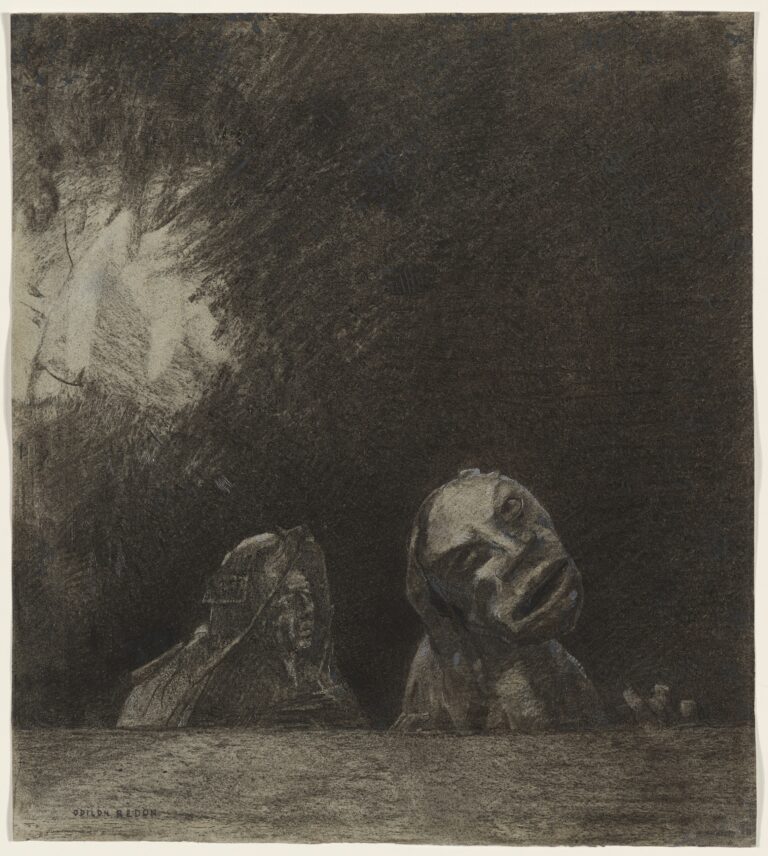
I stepped on the face of a dead man when I was thirteen. My dad and I were fishing from the shore of a local lake. He’d wandered off to find a better spot, leaving me alone at the boat launch. I rolled up my pant legs past my knees and waded into the water to get a better angle on a patch of lily pads. The tannin-tinged water was cool in the summer sun, and the black muck of the lake bottom felt cold and slimy between my toes. My foot instinctively recoiled when it fell on something soft, spongy, dense. It took several seconds for the features of the pale blue blob to click in my brain. I saw two dark slits for eyes, a nose, two black eyebrows. I ran to shore.
Death was not unfamiliar to me at that age. I had never known anyone, personally, who had died: the closest was the odd kid at school who met some tragic end, who was more a name than a face. I had witnessed death many times, though, thanks to a video series called Faces of Death. The original Faces of Death was created by John Alan Schwartz in 1978 and quickly became an underground cult classic. The movie was a collection of short videos of gruesome deaths. The clips were interspersed with philosophical commentary by the pathologist Francis B. Gröss on the meaning, or lack thereof, of death. Almost thirty years later, I can still vividly recall the various grisly images: a gagged man with tape over his eyes being electrocuted; someone being beheaded with a huge sword; a person in white being drawn and quartered. I didn’t know then that I could look away.
I crossed paths with the cult film as a teenager in the 90s. The Faces of Death VHS cassette was the sort of thing that could only be found through an ad in the back of professional wrestling magazines. A friend of my older brother had ordered the video and, shortly after it arrived, four or five of us gathered to watch in my basement. We didn’t just play the movie once, our curiosity sated: we watched it over and over in the ensuing weeks. When we learned that there were three more videos in the series my friend ordered those, too. Faces of Death II-IV had a different tone. They were comprised of grainy security camera and home footage of normal days gone terribly wrong. The narration was gone and we were left to contemplate and make sense of the gruesome deaths on our own. I can’t say I enjoyed the films, but I did find them fascinating.
It turns out that this fascination with horrific and scary things might serve a purpose. Research suggests that morbid curiosity has evolutionary benefits. An article by Coltan Scrivner and Athena Aktipis details how humans aren’t the only species that has morbid curiosity. In animals, it is called predator inspection. It occurs when an animal approaches or investigates a predator rather than running away. The theory goes that this helps younger animals learn the behaviors of predators so they can tell when a predator is preparing to attack. This allows the prey to preserve their energy for when they really need it, rather than running at every possible threat.
The benefits of this curiosity go beyond just learning when something is a threat. There is evidence that familiarizing ourselves with scary situations, whether it be through play, a haunted house, or a scary video game, helps humans respond more calmly in real life-threatening situations.
This could help rationalize my actions that day on the lake. When I was back on dry land my heart beat with such intensity I was almost convulsing. What I was feeling was fear. Of what, I didn’t know. There was no danger. Still, real dead bodies were almost mythical at that age. No one I knew had actually seen one outside of a funeral home.
I stood there on the shore, alone, contemplating my next move. My heart never settled back to its resting pace, but I collected myself enough to think logically. I could have run to get my dad and let him deal with it. I could have come up with some excuse as to why we needed to leave immediately. But none of those even occurred to me. I guess I was still on autopilot, giving into my primal instincts, when I walked back to the body.
I crept closer and closer as if the face might lunge. Anything seemed possible at that point. I inched up, trying to make out the details from as far away as I could. I wanted to confirm that I saw what I really saw. I side-stepped, as if I was trying to get as close as possible to a precipice, without falling over. There was no going back from seeing real, first-hand death.
The wind whipped up small waves that rippled to shore. I could feel them on my ankles as I got closer and closer, the water rising and falling, registering as warmer then cooler on my bare legs. The small waves were disturbing the silty bottom, too. Leaves and other detritus swirled in the motion.
Six feet away from the face, I could see that it, too, was undulating with the movement of the water. The skin around its neck had come loose and fluttered. So much had come loose, in fact, there was a gaping black hole surrounded by a thick line of blue flesh. The more I looked the more I could see there was no body. It was just a fleshy, flimsy head in the lake. The way it bobbed in the water was unnatural, like the thing was made of rubber.
I kept creeping until I was three feet away. I could make out the lifeless face in more detail. It looked just like Dracula. It was Dracula. It was a Halloween mask.
Back in the pre-internet days of the 90s I took many things at face value. I didn’t know then that all of the footage from the first Faces of Death film was staged; no one died, no animals were harmed. Knowing this now, though, doesn’t change the effect. I can still recall those images with the same vivid detail that I can recall that lifeless face in the water, or the “real” deaths that were shown in Faces of Death II-IV. Believing they were real was enough to scar my psyche.
I can’t say the Faces of Death videos gave me any deeper understanding of death, but I did learn that curiosity has its price—both good and bad. The gore I witnessed in those videos, and the countless disturbing scenes I saw when I moved to New York City in my twenties, effectively killed my curiosity. In a city with so many people, I was confronted with facets of the human experience I had been shielded from in the Midwest. Most of this happened while I was trapped in the confines of a subway car, dozens of feet below ground. Early on in my time in New York I approached a rushing crowd with more curiosity than fear. It was only after seeing the man with the knife, or the bloodied face, or the naked unhoused person, that I would push through the throng of people to the next train car.
Eventually, I learned to tell from the reactions of others whether there was a threat without the need to verify it myself. If I suspected the guy a few seats down was pulling out his penis to masturbate, it was better to just get up and walk away without getting a visual confirmation. When I drive past a car wreck I have no urge to rubberneck lest I see something unforgettable. This seems to confirm the theory that our morbid curiosity serves to protect us. I may not have learned how to better protect myself from violent situations, but at least I can protect myself from having to live with the effects of seeing the bloody aftermath. Evolution taught me to look the other way.
While play may prepare us for dangerous situations, no amount of practice will prevent the reality of what we see from being seared into our brains. With the proliferation of tragic imagery being presented on the news and social media since 9/11, and especially after the murder of George Floyd in 2020, videos of tragic and untimely deaths are now commonplace as they are considered just another form of content on social media feeds. This constant exposure to death and harm has wide reaching effects.
In 2013, a study was conducted on the psychological impact of viewing the graphic images that flooded the news in the wake of the Boston Marathon bombing. Their findings gave strong evidence that viewing graphic images is directly correlated to higher levels of acute stress and posttraumatic stress symptoms; there was also a correlation between how much of this content was viewed and how severe the stress symptoms were. On top of that, there was a heightened fear in individuals that they would be the victim of such an attack.
Not only are we experiencing stress from viewing these graphic images, but we are becoming desensitized to the violence. That doesn’t mean that we just become numb to the imagery: a study in 1982 suggests that overexposure to graphic material causes us to become less sensitive to the pain and suffering of others, we become more fearful of the world around us, and it can lead to higher levels of aggression. The evolutionary instinct for morbid curiosity, when put into overdrive, is making life less safe, rather than more.
Being inundated with so much death on our daily newsfeed no longer teaches us to identify threats to avoid them—it teaches us to not care. It seems that if I want to care, I shouldn’t look. But what is the difference between looking away and looking the other way?
After I realized that what I had stepped on was not, in fact, a decapitated head, I laughed uncontrollably. Maybe it was the silliness of the truth that made me laugh, or a natural response to the dissipation of fear. Or perhaps it was relief that I had been spared from the responsibility of dealing with a gruesome death that was not my fault.
I walked back to shore, rolled down my pant legs, and waited for my dad to return. Fishing had lost its appeal. I leaned on the car and stared at the gray aura of the face I could make out through the surface of the water. I occasionally laughed to myself at the insanity of it all, that something so harmless could have such an intense effect on me.
When my dad returned, I told him what happened as we packed our gear. The way I relayed the facts made it seem as if it was a fun little prank that gave me a fright. I was too embarrassed to tell the truth I learned that day: death has a gravity that increases with proximity and it comes with a weight I’m not strong enough to carry.