
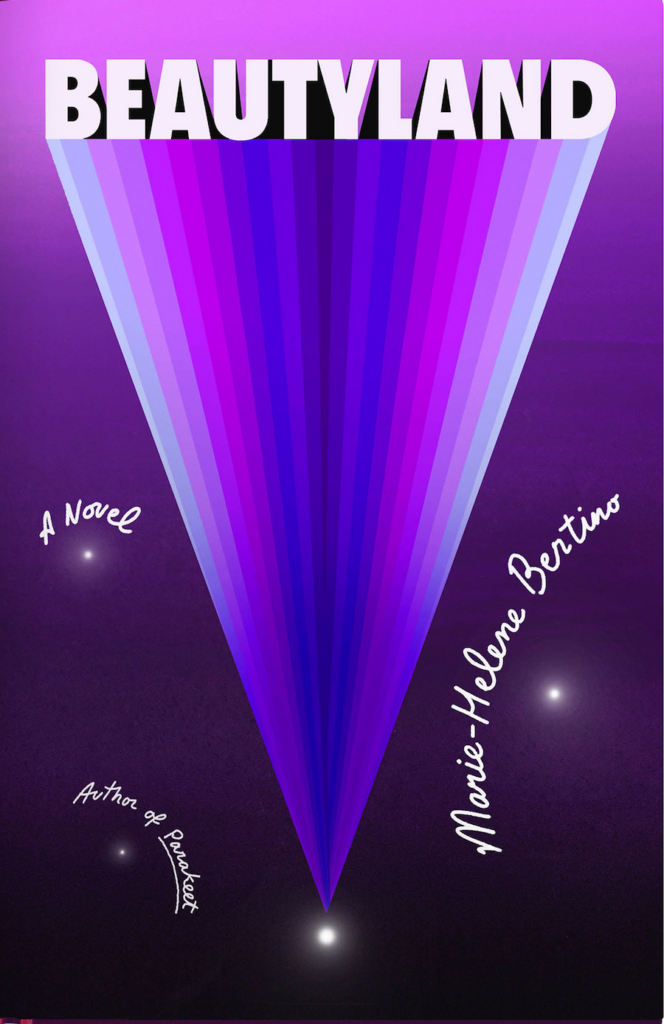
Review of Beautyland
Farrar, Straus and Giroux. 2024. 336 pages.
On September 5th, 1977, the Voyager 1 was launched into the outer reaches of space, in possession of a gold-plated disc. Known as the “Golden Record,” it compresses a sliver of life on Earth into photo and sound: whale songs, the sound of wind, greetings in over 50 languages, “Johnny B. Goode” by Chuck Berry. A far-flung message in a bottle zipping through interstellar space, the Golden Record transmits to extraterrestrial life: “Hello. This is what it means to be human.”
This very message is the life’s work of Adina Giorno, the singular protagonist who pilots Marie-Helene Bertino’s Beautyland. The very same day the Voyager takes flight, she arrives on Earth, a premature baby born to an Italian-American mother in Northeast Philadelphia. Despite the particularities of her birth, Adina has already left another home behind: a planet 300,000 light years away, in the neighbourhood of the star Vega, cradled within the constellation of Lyra. She is an alien; her and Voyager 1, it seems, were sent out on similar assignments, in what Bertino calls “an interstellar criss cross apple sauce.”
Adina is “activated” one night as a child, waking into what she affectionately refers to as “the Night Classroom,” where her fellow extraterrestrials, her “superiors,” telegraph meaning to her: she is to report on human life on Earth. Her conduit will be, of all things, a fax machine that her mother recently rescued from the garbage. (Adina, phone home.) Her first dispatch, at age four: “I am an Adina. Yesterday I saw bunnies on the grass.” Her superiors’ response: “DESCRIBE BUNNIES.”
Adina’s lifelong assignment is weighty, but she has time to settle into it. She comes of age in 1980s and 90s America, a world Bertino cheerfully furnishes with roller skating, bargain shops, and dance crazes. After a brief scene of violence, Adina’s father leaves her with her mother, Térèse. Three become two, and the mother-daughter unit is left to forge a scrappy life together. The whirling narrative spiral of Beautyland begins with Térèse and Adina, the near-death experience of bringing a tiny and jaundiced baby into this world. Like any child, Adina’s sense of self is enmeshed with her mother — “the she in Adina’s head” — and Térèse is her first object of study: “Adina is a student, and her mother is her main concentration.” The borders of her world expand as she enters the social landscape of school and comes to crave experiences outside of her single mother’s capability — “ski trips, libraries, meadows she reads about.”
As Adina ages, her mother’s identity begins to split off into a radically new form: that of an individual, a person. Her mother has moods, dreams, and fears. She goes to work, dates a man named Mark, and has an internal life unknown to her daughter. Adina becomes attuned to the kinds of frequencies emitted by a parent that are only perceivable to their child — the kind of relationship Bertino calls “the microchip of mother to daughter.” She can read her mother’s emotions by her posture, or “the length of time it takes her to leave the car in the driveway at the end of the workday, so that even before she enters the apartment Adina knows her mother’s mood.” Through vignettes equally profound and mundane, the author depicts the emotional weather patterns of a mother and daughter, the friction and tenderness that animate their relationship through time.
Bertino employs the charmingly strange and speculative touches of Beautyland with a light, playful hand. The most potent human experiences are distilled through Adina and her uniquely atomized coming of age as an alien— the ultimate “other” — as she seeks to understand what it means to be a person, both for herself and for her superiors. The novel unspools Adina’s life in bursts, illuminating the familiar joys, rejections, existential angst, and everyday oddities that fill a life on Earth. Adina is a diligent observer of the human condition, noticing and contending with contradictions both simple and complex: the way a friendly tone of voice can couch an unkind comment, the subterranean levels of ourselves that crave acceptance or love. Another dispatch: “Human beings spend their lives pretending their parents are people with no needs. They do not want their moms to talk about sex or die.” She strives to get her superiors back home to understand the gravity of petty human matters and fascinations, which are met with a dry indifference: “WE GET IT.” “LESS ABOUT HUMAN TELEVISION.”
Adina’s perspective reflects Bertino’s eye for finding glimmers of profundity, humour, and magic in a lifetime of mundanity, like a loving beachcomber. The author first launched Beautyland as a short story, in which an unnamed woman took notes on human life. Bertino continued to detail a folder with her findings, eventually magnifying life’s minutiae into an expansively original bildungsroman. In Beautyland, we are reminded that the act of “becoming” is done by being of this world, observing and surrendering to its impermanence and pain and beauty, like the Velveteen Rabbit was made real. In a particularly lovely passage, Bertino writes, “Her past passions sound tinny when clinking against the jar of time. But they add up to a stack next to her elbow, a growing collection of desire and insight that might acquire significance if she trusts that it will.” Adina models how we can succumb to the experiences and people that imprint upon us, the ordinary and the transcendent. For her, this means finding meaning in the acting of Daniel Day-Lewis, in loving a little dog she calls Butternut, and in taking spin classes with a singular instructor named Yolanda.
“For me to do my job correctly, I must get close to human beings,” Adina faxes. Despite the fastening of extraterrestrial identity to her life — visits in the Night Classroom, a longing to connect with other aliens, a lifetime of faxes — she is still situated as another person on a very crowded, complicated planet. Reporting on the complexities of human nature from her alien vantage point does not protect her from the overwhelm of experiences like rejection, loss, or harm. The body’s frailty is a point of frustration, a thing ill-equipped for holding the magnitude of feelings like joy and grief. Bertino renders depression as an assault on the body, an unbearable heaviness that Adina calls “Something Else.” More than once, she simply faxes a plea to her superiors: “Please, please come get me.” “Where are you? Pick me up.” If she comes from a planet that has seemingly transcended corporeality, is this fickle, feeling body a curse? Is it a privilege?
The novel borrows its title from a beauty supply store formerly frequented by Adina and her mother: a two-floor, carpeted hub of femininity where Térèse bought pantyhose and Jean Naté perfume. Adina revisits Beautyland as an adult, bemusedly reminiscing on the storefronts that populated her youth with names like AutoWorld and United Skates of America. “They’re named after places to sound like places. Places you know,” the beauty store cashier reminds her. “So you think you’re home.”
What is home to an alien who is deeply, cosmically alone? For all of Beautyland’s wit and wryness, the novel is also unafraid to sit with the oppressive and true alienation of Adina’s existence — a feeling that resonates with us earthlings, too. “Humans want to find aliens so they feel less alone,” she faxes one day, before the communications from her superiors become more infrequent and enigmatic. “They don’t know there is nothing lonelier than an alien.”
Adina finds many homes in her lifetime, encountering a sense of recognition and safety in Carl Sagan, her best friend Toni, her rickety L-shaped apartment in New York and its accompanying bodegas and halal meat carts. The life that awaited her on Earth came by loss and estrangement, from her home planet and people; these connections offer the same promise. She comes to know, intimately, how grief and loss can be a portal to profound understanding and transformation — “she’s never experienced a new life level without pain, some brutal shedding.”
Adina’s dislocation as an alien was tied to the understanding that she was meant to be retrieved eventually, that a homecoming awaited her. And yet by busying herself with human concerns, she created an expansive sense of home, family, and communion, illustrated by one of her earliest realizations: “There are endless ways a human can achieve connection if they broaden their horizons, Adina reasons.” Like the Voyager 1 wandering the space between stars, this is a novel that crosses vast binaries — belief and scepticism, loneliness and belonging — to find the infinite matter that exists in between. With Adina as our guide, Bertino has fashioned a Beautyland for all of us to explore.