
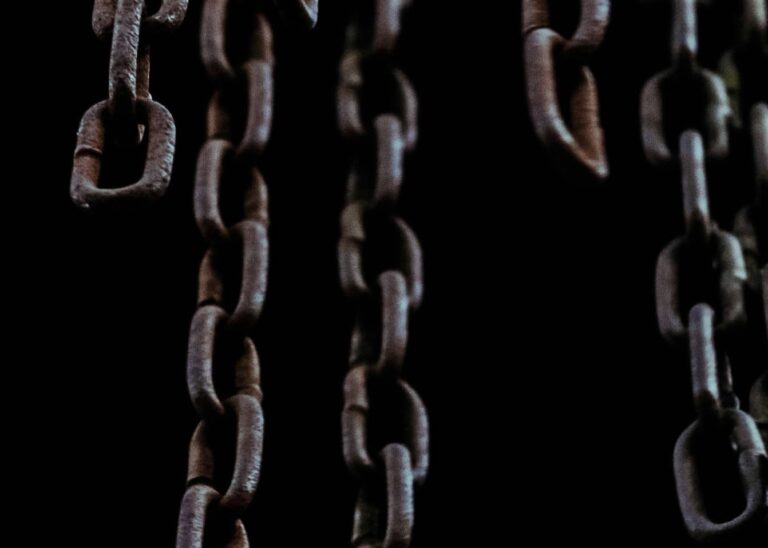
I regard the dibia’s leg with suspicion as he lumbers around me, chanting incoherently. The tiny bells hanging from a dirty wool strapped around his ankle jingle; they remind me of the day my mother caught Okwudili wearing a leg chain and slapped him so hard he almost lost his footing. He was seventeen. The slap did not terrorize me more than what she had done after she pulled the chain from his loose fist—the swiftness of her hands and legs as she rushed into the kitchen and brought the hammer to it. She beat the chain so hard on the cemented platform behind our house, until it came apart in halves. Even then, she did not stop. She kept pounding and pounding the halves into shards that flew into the air, all while cussing, “Tufiakwa! No son of mine will be lost to Satan. No son of mine will be lost to Satan.”
Later that night, as we sat on his bed with our backs to the wall, Okwudili and I, stared intermittently at the half moon. It was Okwudili’s reaction that got to me, the way he shrugged when I asked him how he felt about his dead chain.
“It’s just a cheap piece of silver,” he said, with a half-smirk. “And if she keeps behaving like this, I’ll keep buying more chains. And I’ll wear them and strut around her. Nonsense.” He clicked his tongue, and I chuckled. There was something bright and unbound about the sound, about his voice. He turned to me with a raised brow and asked if I was ok.
I nodded and then said, “Sometimes, mama will just be behaving like a witch.” Okwudili narrowed his eyes, and furrowed his eyebrows. Then he leaned in, our heads touching, and almost immediately, we burst into chuckles.
Even now, I start to chuckle, picturing the dibia in a leg chain and a frilled gown. I scratch my thighs, trying to swat away mosquitoes buzzing around me. But the shackles on my arms and legs make it painful for me to stretch. The chuckle fizzles, anger surges up my throat. This man, with cracked heels and a mean face, isn’t Okwudili, can never be my brother. The dibia pauses. His face blanches, as if in fear. “Open the window, now, something is about to leave her body,” he says. Nzube rushes to draw the curtains and the window, ushering in a spade of light. I manage to shield my eyes from the sudden glare. “The demon is resisting. It doesn’t like natural light,” the dibia says in an excited voice. My stomach grumbles, perhaps a product of the watery pap and akara I was given the previous night. I wait, blinking, until I lower my hand once he instructs Nzube to close the window.
He lets out an exasperated sigh, shakes his head and bends over to gather a stick of feathers, nzu, cowries and animal bones into his bag. “This one is strong,” he says, glancing at me, but I sense he isn’t referring to me but whatever he thinks has possessed my body, this thing he has been trying to exorcise for the past three days. Nzube’s mother steps into the light, clapping her palms together. I do not know how long she’s been standing by the door because sometimes my mind drifts in and out of reality. I do not remember when she arrived at our house. But I know that she’s succeeded in stealing my Iloh from me, herding him about as though he couldn’t move on his own, as though if he paused to look at me, he would lose his masculinity. Except on days like this, when his absence means that he’s probably at school.
“Are you saying nothing can be done?” Nzube’s mother says, without meeting my gaze.
I scream at them, as they converse in hushed tones. I pull at the chains, from where they’re wound around an iron rail above me and secured with a padlock. I let them know that I am not mad, like I have done the past week. They turn to me, only for a moment, before looking away as if I am a mere distraction. I manage to catch a wisp of their conversation. The dibia says that the gods are silent. He has until two days to know what they will tell him. And if my demon cannot be exorcized, he’ll wash his hands of me. The rest of their words are almost sloughed off by the whirring of the ceiling fan, but I stiffen when they talk about Iloh. She suggests that Nzube send him to Ibadan to live with Ifunnaya, Nzube’s sister. I release a cry of plea, snort and tears dribble down my face. I beg them not to take my boy from me, that I’ll comply with their instructions. But Nzube and the dibia have started towards the door that leads into the living room. My mother-in-law doesn’t leave, at least not immediately. She draws closer and leans in, as if trying to touch my face. Then she steps backwards as if something about me repulses her. “Please, mama, don’t take my child from me. I beg you. I am not mad. I swear to you. I did what I did only because I believe my brother has returned. He’s in Iloh. Okwudili is in…”
“Close your mouth, osiso,” she snaps. “My grandchild is nothing like your dead brother and he will never be.” My blood boils and my fists shiver as she rains invectives on Okwudili, this woman, who does not know half of Okwudili’s story, the horror he endured from a world that closed its palms against him, when all he wanted was a space to live and breathe. When she moves closer, I raise my hands a little above my head, trying to grab her neck. She decodes my intention and dashes out of the room. The locks click and I start to howl and slam my fists on the floor until I pause and start to stare at my bruised knuckles, as though they belonged to someone else.
***
I know when Iloh returns from school because I hear the TV come on. Tuned to its highest volume. WWE is currently playing, and I smile, picturing him sitting quietly on the sofa, transfixed by the tangle of limbs, of people jostling to subdue the other. Wrestling was one of those sports that held us together. On most Saturday nights, we sat in front of the screen, Iloh sandwiched between me and Nzube, waiting for the usual short intro to wind up. Sometimes I flinched or looked away when a wrestler punched another wrestler consistently, until he slumped on the ring, covered in blood and the referee stepped in to pull him away. “But it’s not real, mum,” Iloh would taunt me, smiling, and my response would leap out of me like a rebuttal.
“Biko, don’t say that. Are you saying the blood isn’t real?”
“Maybe it is. Maybe it isn’t. But come on, it’s just wrestling. Some of these things are just stunts for publicity,” Nzube said, as if to soften the violence displayed on the screen.
Now, these memories—the longing for wrestling, the thrill and fear that once clutched my throat each time we sat before the screen—have become a sieve slipping between my grips. I don’t know if wrestling means anything to Iloh, if he thinks it awkward watching it on a hot Friday afternoon. I am still thinking of this when the door unlocks and opens slowly, like whoever is behind it is eager to make an entrance. My breath catches, and my heart gallops against my chest. Then, he appears. He’s a little taller than I remember. His full crown of hair becomes visible when he steps into the light. The tears dribble down my cheek as I gaze at his face, which is no different from Okwudili’s, his defined cheekbone and especially that slightly narrow nose bridge, which I sometimes pore over each time I dab his face with makeup.
Okwudili would whirl around and curtsy whenever I fawned over his nose, wishing I could exchange my flat nose for his. “Don’t worry, you can have mine in another life,” he quipped. Then he suggested that I go under the knife, like the first lady did, if I couldn’t wait.
“Tufiakwa! It won’t happen,” I cussed. I couldn’t imagine going for a surgery, my body laid out on the table like an offering for the doctor’s knife to dig, prod and rearrange to fit a certain aesthetic. What if something terrible happened to me, just like the Nigerian first lady, who died days after a botched surgery? I told Iloh about Okwudili, revealing the labyrinths of his life, his joys and struggles. I remember how my boy had smiled and stared at me transfixed the first time I told him about Okwudili, how they were both uniquely alike and different.
It was on a Sunday, and Nzube had just stepped out to play tennis at the university staff club. I sat beside Iloh, who was splayed out on the bed, his chin balanced on his palms. Every so often, I would run my fingers through his hair and dab his cheeks to evenly spread the makeup, as I regaled him with anecdotes of my brother’s past. Okwudili loved to wear women’s tops and skirts and jeans more than he wore the tee-shirts and trousers our mother bought for him. Of course, mama was quick to hurl insults at him each time he dared to appear before her in those denim jeans and sequin dresses, and sometimes she tore them to shreds on his body, even though he bought them with the money he got from making people’s hair.
But Okwuilidi was a flame, deviant, resolute, and unpredictable. He wasn’t afraid to flutter around the streets of Nsukka in his gowns, and skimpy tops and jeans, maintaining a straight head whenever people sniggered and clapped their palms together. His laughter was a creature assured of its presence, its boundlessness. Sometimes I was afraid for him, afraid of what his freedom could do to those who felt uncomfortable around him. What it meant to people who did not understand being different, who frowned at it; individuals who tried to control it, and if they couldn’t, they hacked it down, set it on fire.
Okwudili had a whole chest of jewellery. Sometimes, he allowed me to borrow from him and when he didn’t, I stole from him, especially the golden earrings and necklaces that glittered in the dark. When I got to this part, my boy burst into laughter, clamping his hand over his mouth, his palm smudged with lipstick when he let his hand fall to his side, his mascara-tinged eyelids glossy enough to catch the sun. I realized how his mannerism, this harmless gesture, connected him more to my brother.
“Mummy,” Iloh calls out now, and in his eyes is a fear shrouded in uncertainty, as though if he draws closer, I may transform into one of those monsters in his comic books I sometimes read out to him during bedtime. My nose swirls with mucus, which trickles down my lips and mixes with the tears. I sneeze and beckon him to come to me. His palm is warm when it touches my face. I close my eyes and attempt to reach for the years when those tender hands pulled at my hair and cheeks and chuckled when I tickled him.
When he was born, I felt it, an unfurling in my chest, that my brother had returned, but in my son’s body. At first, I didn’t tell anyone, because I didn’t want to douse the excitement rippling through the air, from the relatives and friends teeming into the ward to see the baby and bumping their fists with Nzube. Still, I suspected that my mother had felt it, as she peered into the colt where the baby lay and hesitated, going still, as though she had seen a ghost. She turned to me, narrowing her eyes in suspicion. And then she smiled, scooping him into her arms. But it was a smile overlaid with fear, a menacing kind of fear.
Months later, while dressing him up, I noticed a birthmark on Iloh’s thigh, stretching into the shape of a starfish. My heart skipped a beat. This can’t be happening. I reached for my phone and dialled my mother’s number, watching Iloh bite the empty powder container. The words leapt from my mouth, as if a faucet had broken inside of me. I told her about the mark, how strangely identical it was with Okwudili’s, and how so many things about my boy bore strange similarities with my dead brother. Did she also feel it at the hospital, this strange connection between Iloh and Okwudili?
My mother shushed me up. “Ozugo. Do you know the implications of what you are saying? Okwudili died a decade ago, and whatever it is you’ve noticed about Iloh, is nothing but a mere coincidence. Did you hear me? Your son is not Okwudili. The walls have ears.” The call ended. I dialled her number again, but it was switched off.
Iloh sits on the floor with his legs drawn in, and I am impressed by his attention to hygiene, how it reflects in his clean toenails and fingernails, in his bleached teeth, devoid of stipples of brown stains born from too many chocolates and sweets. He seems to have evolved from the seven-year-old who wriggled whenever I lathered his back with soap and sprinkled water over his body, to a ten-year-old boy capable of showering by himself. I remember the first time I saw my brother come alive in Iloh. I was climbing up the stairs to my room when I spotted Iloh through the half-opened door. I had just finished washing and airing the clothes on the clothesline at the back of the house, and I was stunned to see him trying on one of my old dresses. Of course, the dress sagged around his shoulders and dragged when he moved. He was five. I froze, watching him prime his thin lips and shadow his lashes in front of the mirror. Then, he smacked his red lips and leaned in to kiss the mirror. I felt the rush of electricity through me and tears pricked my eyes so that I sniffled as if from a cold. I darted away, before he could see me.
Next time, I found him painting his nails with my polish. He went rigid when I opened the door and walked into his room, his blushed face blanching as if in fear. When I asked what he was doing, he quickly ran to me with the makeup kit, pushing it into my arms. “I’m sorry, mummy. I was just playing around. I’ll go wipe them off now,” he said, turning around to leave. But I held him back and bent over to examine his face and nails, scraping the smear of lipstick from the corners of his mouth. I steeled myself from breaking up, from spilling tears of joy. “You look beautiful. But next time, inform mummy before you take her personal stuff. Ok?” His eyes went wide with shock, then, he nodded and scuttled out of the room.
“Mummy, what’s wrong with you? Daddy says you’re not well,” he says.
“I am fine. Nothing is wrong with me. Don’t believe anything anyone says. Did you hear me?” He says nothing. He just stares, as if he has heard nothing. I parry him with more questions. Does he believe that something is wrong with me? Does he think I am mad or evil? Does he think I will hurt him? He shakes his head. I remind him that I love him, that I’ll never harm him. A small smile creases his lips. My eyes fill up too quickly.
He asks about Okwudili. He wants to know how he died. I take a deep breath and close my eyes for a moment, but this time around, the darkness does not overwhelm me. I don’t tremble. As I open my mouth to speak, I hear the thudding of feet approaching the door, and my mother-in-law materializes. She calls to Iloh, who hurries towards her. She ruffles his hair and examines his body, like a surgeon trying to fix a wound. I don’t know what she says to him. But he nods and looks at me, and there’s something broken in his gaze. He walks away.
A flare of irritation and anger floods her face as she faces me. I am surprised by how quickly her love and admiration have mutated, taking the shape of something dark and ruthless. She had showered me with praises the first day Nzube introduced me to her. “Where did you find this goddess? This one looks like the morning sun,” she teased. Then, Nzube reeled off the things I had accomplished within a space of seven years. And in the same husky and almost breathless voice, she said that I was not only beautiful, but intelligent. She tapped Nzube’s shoulder and said, “Nwam, you are lucky to have met this one. Hold her carefully like an egg.”
In many ways, Nzube’s mother was different from mine. She didn’t squinch her face in disgust when I wore my ankle chain. I was about to step into the kitchen to make lunch when she sighted it and said, “You wear chain,” a glint of surprise in her tone. I half-expected her to scold me, like my mother, or worse, begin one of those boring sermons about the unrighteousness of wearing an ankle chain and flaunting it around, how people who wore chains and waist beads were prostitutes doomed to an afterlife of perpetual torment in hell. But her eyes glistened as though she had just stumbled on a box of diamonds. “Gold matches your beautiful skin,” she remarked.
Something settled inside me as she said this, and I must have gazed at her for too long, the urge to run over and hug her welling up inside me. She said many other things that day, about how she wore chains as a young girl to the point some people thought she was possessed by a marine spirit. Until motherhood came along and she allowed its many demands to replace her love for chains. But it was first her acknowledgement of my humanity, before my womanhood that stood out for me, the way she did not feel intimated by my MBA or the handful of properties scattered across the country.
She quickly locks the door before I can say, Mama.
***
When the dibia performs his ritual, my mind is a wave, shuffling in and out of reality. I wince when he digs the blade in my palm and carves a line. I gaze at the thin layer of blood as though it didn’t come out of my body. Until he catches it with leaves squeezed into a pulp. Nzube, my mother-in-law and my son stand close to the door, like people watching a mournful movie, their faces veiled by something like sorrow. My dead mother comes to me. I see her suspended in the air above me, crowned with ribbons of light, just like she had wanted. Her eyes do not shift when I ask her if she’s satisfied wherever she is, knowing that she pushed Okwudili to his death. If only she had been kind to him or pretend to be; if only she hadn’t looked away when Okwudili asked if she loved him, if she truly loved him, maybe he wouldn’t have stormed out of the house in the dead of night. But she had buried her face in her palms, as though in quiet resignation of the things she couldn’t accept about him. She hadn’t looked up when he slung his bag across his shoulder and walked past her.
For a while, Okwudili and I spoke over the phone, trying to keep tabs on each other’s lives. He said he was in Port Harcourt, squatting with a friend and working part time at a makeup and hair salon until he saved enough money to get his place. Suddenly, he stopped calling and when I called back, his line was either switched off or out of coverage. I do not know if my mother called him or not, but each time she asked about Okwudili, in her almost muffled tone, her questions appeared to skirt around: “How is he doing? Does he eat well? I hope he doesn’t stay outside beyond midnight.” As though something in her would collapse if she deepened them, beyond the ring of formality.
The voice of the dibia cuts through my thoughts. He says that I am communicating with my demon. He dips a strand of palm frond into a bowl and sprinkles water over me. I flinch from the acuteness of the cold, and I allow his rantings jolt me back to a moment in the past.
Okwudili started wearing leggings and crop tops at fifteen. An age that seemed to announce his deviance. He snarled and scratched the air with his fingers like a feral animal whenever I refused to let him try mine. At first, I loathed what the dresses did to his body, how they highlighted his perfectly curved waist. And like my mother, I snapped when he wasted ample time in the bathroom, singing so loud his voice did not crack, or when he stood in front of the mirror primping his fingers with my nail polish. I hated the jeers and insults his chosen lifestyle drew to our family, the name-calling. I heard people say that if our father were to be alive, he would be firmer with Okwudili, never letting him go astray. But my father was alien to me. He died a week after I was born. All I knew of him were stories passed down to me by my mother, of his involvement in the Boma war, which left a permanent limp in his hip. Okwudili rarely talked about him, and even when I got him to say something, he spoke about our father like a man he didn’t quite know, like the wind that rustled in and out of a room.
When Okwudili began to hang out with boys like him, who wore crop tops and gowns, arched their brows and lined their eyelids with mascara, my mother threatened to stop his monthly allowance, which she eventually did. But it seemed to embolden him. Then, she imposed a 9 pm curfew, which he flouted and continued to return home some minutes after the witching hour. Within a month, men and women in suits and gowns stretching beyond their knees, wielding big bibles, stormed into our house. They circled Okwudili, pinned him down to the floor, and squirmed and cried and babbled in strange tongues. They left our house, but not with their prophecy. They said my brother was possessed by the demon of homosexuality.
They recommended prayers and more prayers, to keep the demon at bay. They said he would run mad if he returned to his old lifestyle. In those years, I became afraid of my mother, of what she had become. She fasted herself bone thin, and every night, her prayers dissolved into wails that shook the walls. But the following morning, she was a different person. She hurled invectives at Okwudili and threatened to kill him for breaking her expensive chinaware. Did her inability to contain Okwudili, to clip his wings, push her to do the things she did to him? Or was she trying to steady herself against the current of peoples’ sneers, the things they said, to prove to them that she, too, could hold her family together?
The dibia’s medicine bag crinkles as he bends over the floor. But he pauses to give me a direct stare that fazes me in an eerie way. He faces Nzube and says, “This is it. The demon is too strong. The gods are silent. My libations and requests go unanswered. It’s now up to you.” Nzube thanks the dibia and walks him to the door, but his mother follows him out into the living room.
For the first time, Nzube looks at me since that night he tipped my coffee and dragged me into this room. His eyes show aging rings, and his hair is slightly flecked in grey. He beckons Iloh to come to him and he does. He wraps his shaky arm around my boy and says, “Please, let her go, for the sake of her son. He’s suffering because of this. I am suffering. Please, let her go.” His lips quiver when he says these things, but not to me. Those pink lips were the first things that attracted me to him during one of those boring CDS programs in Orlu. Then, there was our love for Rihanna, that seemed to cement everything. Many nights later, during our compulsory national service, we made love to Rihanna’s smoky and textured voice, trilling for hours on the radio. Some days we sang along, and mid-verse, I’d burst out laughing when I caught him lip-syncing because he couldn’t recall the lines. Has he forgotten his promises to me, to always respect and honour me? Why doesn’t he believe me when I tell him that Okwudili has returned? Doesn’t he see the proof in our son, the facial resemblance, the way Iloh flutters when he walks? Did I make a mistake by telling him about my brother, about his lifestyle and how he died?
I clear my throat and try to reach for Nzube, but he steps backwards with Iloh. I tell him that I am not mad. I am not possessed. It’s me, his Nonye, the one he would show off to his friends because he trusted me enough not to hurt him, to stay with him. Sometimes, he told his friends that I was the reason for his success in academia, that I challenged him to further his studies in Engineering, to get his doctorate. Have I become the thing that he readily flees from?
“All I ever did was to love you,” he says, snorting. “But you crossed the line when you insisted that my son was a reincarnation of your brother. It’s like you were obsessed. I couldn’t stand it. Then, you tried to turn Iloh into something else, forcing him to wear those gowns and skirts and painting his face. My son is not your brother. And he will never be.”
I see tears climb into Iloh’s eyes, and I remember how Okwudili died, how his headless body returned to us in the punch newspapers; how he was splayed out on the roadside. How my mother screamed and fell to the ground in the morgue, when she saw the mark on his thigh, half his body covered in machete wounds. They said he was murdered by unknown gunmen during a cultists’ clash in Port Harcourt. For weeks, I couldn’t wrap my head around their report. My mind spiraled with questions. When did Okwudili become a cultist? Was it after his line became unreachable? Did he ever try to reach out? I couldn’t sleep without seeing my brother’s headless body spinning around, as if searching for a place to settle. And every food I ate tasted like blood, forcing me to puke. My mother did not grieve in the way I had expected. There were no moments of shredding; she didn’t cry and beat her breasts, like I did. She did not erupt into tears in the middle of a movie or stare ahead for too long, looking at nothing. Sometimes she stared at my teary face and looked away quickly. She gave herself over to church activities, to weekday fellowship, as though she wanted to reach for closure, to put the past behind her.
A bug buzzes, tugging me out of my thoughts. It zigzags about a fluorescent lamp. “Please, release me, Nzube,” I cry out, attempting to break free. “I promise to be myself. Please, don’t take my son away from me.”
He sneezes and at once my mother-in-law strolls into the room. She and Nzube share a knowing look. She takes the phone to her ear and walks out of the room. My chest thuds. Everything else happens within a flash. I hear the roar of an ambulance entering the compound. I ask Nzube what’s happening, he pouts and stares at me. His eyes grow big, so big as though they’d fall out. “Nzube, what’s going on? What have you done?” I scream.
“I’m sorry,” he says, almost like a whisper.
I hear the rumbling of feet approaching the stairs. Men in black boots and white overalls walk into the room. I shriek and snarl as they release me from the fetters and whisk me from the floor. I kick and flail, trying to reach for my boy—who breaks into wails but is restrained within his father’s arms—but the men overpower me. My son’s teary eyes and his trembling shoulders are the last things I see, the last memory of him I have, before a needle pierces my hand, numbing me. My lids become heavy, the clouds gather in my head. My eyes close and open, slowly. I call out to my boy, but the void gulps my voice.