
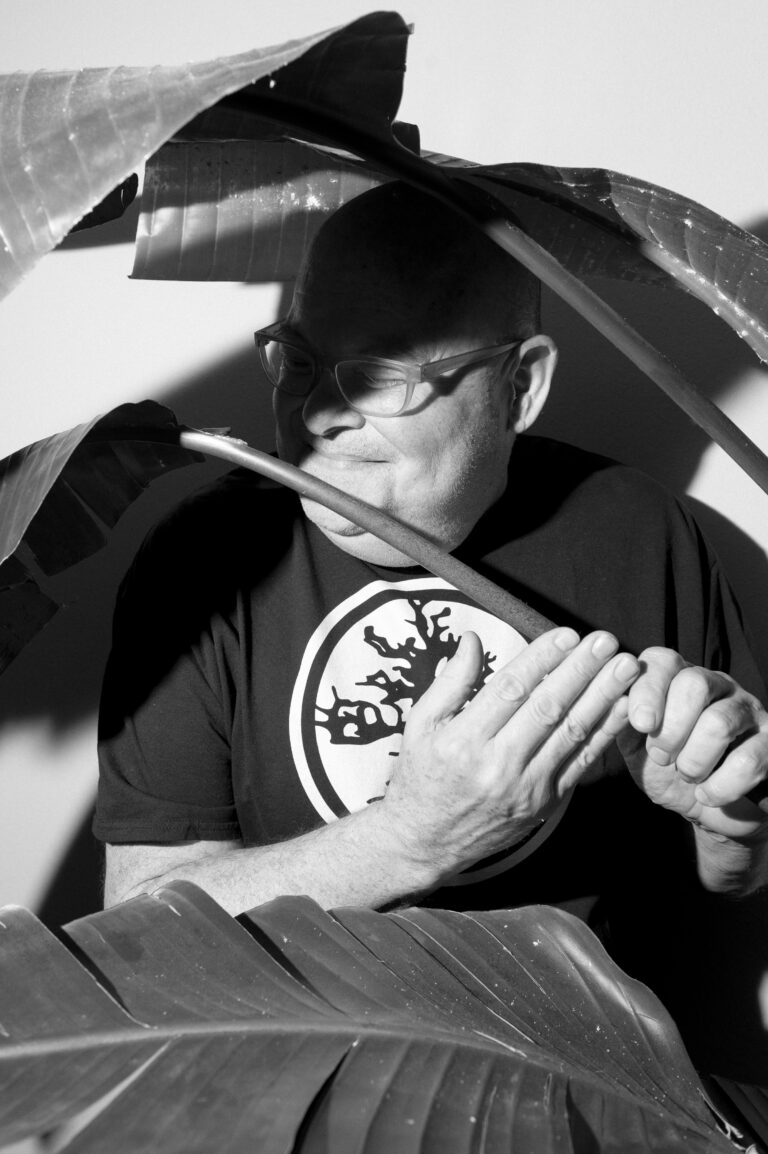
Kirby is a poet and the leading creative behind knife fork book (KFB), a Toronto-based publisher with a focus on poets and community. Their works include Poetry is Queer (2021), she (2024), Softie (2025), and the upcoming Fairy (2026). KFB has had the unique opportunity of representing a variety of writers, with publications like The Size of Paradise (2025 Griffin Poetry Prize Longlist) by Dale Martin Smith, Sadiqa de Meijer’s Fieldwork (2025), and Rainy Day by Norma Cole (2025).
How shall we live? This question sits at the heart of Kirby’s work as a poet and publisher. After moving from Toledo, Ohio, in their twenties and not looking back, they have made Toronto their home ever since. As we celebrate knife fork book’s 10th anniversary, this question of how we shall live becomes prevalent as ever in the living that endures through community and poetry.
White Wall Review’s Januel Noche had the pleasure of meeting Kirby to discuss community, queerness, and KFB’s upcoming anniversary season.
***
JN: You just celebrated 10 years of knife fork book. Congratulations! How are you feeling about the milestone?
K: It’s so exciting. The poets that we have lined up, the work that I’ve read, is just so, so exciting. Out of the gate in the spring, we’ve got James Lindsay’s newest, and Michael Prior, whom we haven’t heard from in forever! Their new chapbook, Shadows Under The Trees, is coming out. They wrote Burning Province; their work is exquisite. We also have this queer “Foreplay” series, which I’m really excited about. There’s a collaboration between Amanda Earl and Matthew Walsh called Slut Flower, which is based on Jean Genet’s work.
Also, Helen Robertson is doing a tri-fold, Lesbia, which is absolutely exquisite, and then my friend Phillip Hare, who had done the cover for Poetry is Queer (2021) with the lovely Rolling Stones tongue on it—we’re doing a visual work of his called Understatements. He works in felt, in fabric, in buttons and stuff like that. He’s created a pair of briefs, and it just changes the colour panels on the briefs, and then the message is on the waistband. There’s one that’ll say “DEFIANT” and one next to it that says “QUEEN.” What’s super exciting is that we’re having a very limited edition, maybe 10 or 12 copies, that are going to have an actual handmade felt slipcover for the wonderful book to slide in. It’s all going to be designed by hand. Honey, it’s stuff like that that just–my juices are flowing! I just go: yes, yes, yes! It’s lots of other things coming up. How could I not?
JN: Knife fork has had to reduce its presence in physical space. What changes have you noticed in the literary culture you’ve cultivated that was prominently based in this physical space?
K: I’ll be the first to admit it: I sorely miss KFB as a physical place. It was quite extraordinary to have a place where people felt like making the pilgrimage to KFB, and it was such a hub and centre, not only for Toronto, but in many ways, for the country. Space, as you know, in Toronto, it’s been problematic because now everything’s got a price tag on it, in ways that were perhaps a little different before. It really cuts into small presses and micro-presses specifically, because for most micro-presses, the only income we’ll see is a good launch.
Of course, all our books have legs, but space has become so prohibitive, not just cost-wise, but also with what’s suitable. We need suitable spaces for poetry, suitable spaces for readings—and what I mean by that is, we don’t always have to be in a hole in the wall, we don’t always have to be in a noisy pub. It confounds me that most readings I go to, it’s not about the reading at all. It’s about the social-ness of it. Which is fine, but I’m actually there to hear the work, and I think that’s something that delineated KFB from a lot of what I’m seeing now. It’s fine if people just want to party and celebrate, but I think the work itself needs to be held.
I come from a theatre background, so there’s a curtain time. We see the performance, and then we celebrate.
JN: That connects to the themes you focus on in your work, about having to refuse the idea of placing yourself in a space where you’re not supposed to be, where you’re not accepted. You focus on this theme of queerness, of being the “other,” and I really admire your language in refusing this idea when you say you were “raised straight in a non-gay world.” What is your connection to this language of refusal?
K: I think that directly speaks to it. It’s interesting, people will come hear me read, most of them parents, they’ll come up to me, and they ask me, “Is anything better for my daughter? Tell me that it’s better.” In some aspects, yes. I guess it depends on where you are and what you’ve created for yourself as your circle of intimates and friends, which is true anywhere, but the recent history-repeating that is happening south of us, there is certainly a lot of that sentiment all over and still for most of the world. Queers are persecuted and killed for not being standard issue.
It’s surprising to me. The recent ban that the administration in the States made deliberately of not recognizing World AIDS Day was such a gut-punch. I’m originally from the States, and I arrived here when I was in my 20s. I came here for schooling, but in truth, Reagan had just been elected. The scoop is, I realized when Reagan was elected that I had no future in that country and that I wanted to live my life in this lifetime, not wait until another lifetime to live my life as Kirby, and part of that was moving here.
Stroke of luck, I met a fella, we fell in love, he sent me his apartment keys. Oh my God, it was high romance—that morning I got the keys, I called my dad. I said, “Dad, can you get me to the train station?” and he goes, “Is it important?” and I said, “Yes,” so I got on the train that day, baby! I got to his place—put on Whitney! We did a little slow dance to “Baby You Give Good Love…baby you give good love.” Wow! That story’s in Fairy (2026).
JN: How did you get into publishing in the first place, and what’s motivated you throughout the 10 years of the press?
K: Hoa Nguyen was my confidant and advisor at that time, and she had just finished judging the bpNichol Chapbook Awards, so she had a bunch of chapbooks, and I had a 40-year collection of poetry, and that’s how we opened KFB. Boom. No money, no front money.
See, some people think “I can’t do it cause I don’t have money.” I’ve lived my life thinking, “What can I do with no money?” I’m not saying I don’t need money, I’m not criticizing those that do it another way. But for me, I’m thinking, I don’t want to be dependent on money to do what I want. I want to create, and I’ll start with what I’ve got. That’s as simple as it gets.
So I got into publishing because we opened up the bookshop, I saw what was moving. We were one of the very few places that carried chapbooks, physical chapbooks, that people could hold and buy. I thought I would be a fool if we didn’t publish chapbooks, and we did. Cause I had an idea of what I wanted—and you’ve seen them, they’re very pretty—and I wanted to make something I myself wanted to hold. That’s what it was.
JN: Do you think that’s possible today? This idea of starting something based on pure creation or idea, and not so much the whole monetary aspect of it?
K: It better be. Because you don’t get grant money your first year. So you’ve gotta find how you’re going to create, even if it’s different than what you might imagine or recreate 5 years from now. You need a starting point. Darling, everybody can work on a blank page. So change the page! Constantly create and change the page! It’s really about the choice and the creative act. That’s the only thing that’s going on.
Of course, I wasn’t stupid. If we sell this many copies, we’ve broken even, and now we have to make a little more than breaking even. So we kept it small, so we would at least be able to break even and not lose money. During the pandemic, we lost money, and that’s why we had to pull back, because we couldn’t handle it. But we continued publishing, and we were doing the Fertile Festival, which we had to postpone this year because I couldn’t find an affordable, suitable space. We’re finding spaces well in advance for our 10th, though, so that’s what’s going on.
JN: I read your column “A Volunteer’s Life” for Send My Love to Anyone with Kathryn Mockler. I admire the humility that you displayed in the article in showcasing the precarity (for lack of a better word) of someone who “[flies] by the seat of their pants.” You talk about your life and not adhering to the conventions of financial stability, that you’ve survived by luck and the support of your loved ones—how do you contemplate the power of community you’ve brought with KFB in fostering collective independence?
K: Mockler is one of the most brilliant people I’ve ever met. I’m Kirby today to a large degree because of the Mockler. She was one of the few people that took an interest in my work. She used to run a journal called The Rusty Toque, which was fabulous. And she had asked me if I had anything to show her, and I’d shown her some stuff of what became This is Where I Get Off (2019), and I thought, “No one would touch this.”
Next thing I hear is Mockler, who goes, “Kirby, I really like this. Do you got any more?” and a little down the road, “Kirby, who’s going to edit your book?” And I said, “I was kind of hoping you would.” And she responds, “I would kill to edit your book.” What a gift.
Those in our intimate circle—we see each other. I say “luck” because it really is. The good fortune that I find myself here today, alive, in Canada, as free as I have ever been in my whole life. I’m still a liberationist, so that means a lot. In terms of community, it’s so different from industry, but I think people confuse them a lot. They always talk about the “poetry community” as some large thing, and it’s not at all.
I’ll never forget when a dear friend of mine—whom I maybe put on a pedestal a little bit—had said to me, “Kirby, I feel so alone. I feel so outside of community.” I’m thinking, I can’t believe I’m hearing this from this person. And I said, “Oh, darling. What’s your fallacy around community?” There is no community. There are people we choose to share closeness with, or work with, and create a relationship, and that becomes our circle. That becomes community.
Another layer to that is…the people that I read and have a genuine interest in becoming a cheerleader for their work—that establishes community. I’m genuinely interested in how others live as I do myself. My constant inquiry is, “How shall we live?” I think what’s happening in Toronto is, unfortunately, that that question is being bulldozed over by this idea of industry and bigness, of success. Being big just for the sake of being big, as opposed to what’s livable. I hope that we move through this.
JN: How does it feel to represent such an amazing range of writers?
K: I’m responding to the work itself, which is so exciting. I wouldn’t be recognizable if I wasn’t being a satellite for those that I love around me. I shine because they shine. It’s the thing that always drove me crazy when I had a “job” job—people would feel threatened by my presence, and I’m going, “Wait, you hired me? I shine because you shine.” I tend to be a big personality, but that’s because I’m given the opportunity to shine. I seek to give the opportunity to others to shine. I tend to be a Teletubby. You know, the sun that goes, “EH OH.” Those things still touch me! There’s an “I see you” element, which is so important, and everybody wants that. I can’t do it for everybody, but I hope there are enough satellite dishes that can do that. That’s the goodness.
JN: Young queer people are facing a very difficult time, especially in the United States, with policymakers seeking to not only invalidate, but eradicate the existence of queer people. Is there any advice you’d like to give to queer people early in their literary careers, who might wish to go into publishing as they face this reality?
K: You’ve read my work. There’s no half-measure to it. There’s no half-measure to praise. There’s no half measure to grief. And when you’re tackling or, let’s say, laying bare, your own experience—there’s no half-measure to that.
At my very first reading, I was 17 years old and in Toledo, Ohio. It was being held in a wine and cheese bar called Tiffany’s, and there was a back patio. It was an open-mic reading for the very first time. I had three poems, and there were two poems where I knew I’d be safe, but the third poem, it would’ve been risky. I read the first two, and then I read the third. I didn’t die, people applauded, and I got off the stage where there was this guy that ran the series, his name was Bob. He looked at me, and he goes, “Come here, you big Fairy,” and he gave me the most beautiful hug. That moment informed the rest of my life. Based upon that moment, a welcoming. Being heard, being seen, being welcomed. Those might seem like small things, but to a queer person, to a woman, to anyone of us who remain oppressed—it’s life itself. It’s whether I can be here or not.
It’s one of the things I say in Fairy: “The thing I’ve done my whole life is be in a room full of people and check to make certain it’s ok for me to be here.” You don’t realize that, because I’m older and practiced and la-la-la, so you don’t realize what you’ve even done to set that up as a condition, or whether it’s useful or not. It may have outlived its use, and now I can maybe enjoy myself a little more, but unfortunately, I’m not repeating myself—history is.
The stuff that I’m writing today—I’m going, “Girl, haven’t you written about this?” Yeah, but guess what? It’s returned. It’s so hard to be here, but I’m gonna live my life this lifetime. It’s what I said to my mom; she said, “You’re not gonna get what you want this lifetime.” And I’m listening to my mom say this going, “Momma! It’s me! Really?” She was just trying to protect me, but it hit me hard that she thought it wasn’t going to happen. I get it, women’s rights still haven’t happened. A few years later, I wrote to my momma when I first arrived in Toronto. I said, “Momma, I want you to know, I’m going to live my life this lifetime. I’m not waiting for the next one.” Here I am. No one’s more surprised than me.
In the beginning of Poetry is Queer (2021) I was able to say “my single success story is I never managed to kill my Fairy,” and now writing Fairy, my only regret is not being gayer.
JN: In Poetry is Queer, you narrativize this unapologetic queer being through your description of urban landscape—how important is it for you to create this running theme through your work, specifically in resistance to the idea of queer people as “other?”
K: I just read this poem by Frank Bidart yesterday. It was World AIDS Day yesterday—basically, he was saying, “These people do the same thing you do in bed.” In Fairy, I write “everybody sucks, everybody fucks,” like, hello? It always surprises me, but you look at history, of course, and only the man is prized, the father wants the son. There’s the passing on of the name, there’s all that fucking bullshit that has to do with nothing except tradition.
It always shocks me. You know that show called “Surrounded” on YouTube? It’s basically Tim Miller, who’s a liberal talking-head person online, and he’s sitting down to confront Gen-Z Christian believers. I watched it cause I kind of have a crush on Tim; he wears that lovely pearl necklace and those beautiful lips. What shocked me was that all of a sudden, I recognized everybody in that room. I grew up in a Christian background myself—I came out in a Bible study! Every one of these young people around the room had that smug believer thing going on. There’s nothing worse than somebody who’s smug and righteous. Nothing worse! It’s the worst look—it’s even worse than my scrimp look.
The absolute seed of that is: I’m not going to allow for my life, or my love, to be treated as anything less than equal. That’s the response I had to my parents when they said, “Do you really think you can have or find what your father and I have?” And I said, “Actually, I’m hoping for a little better.”
I wanted to treat my sexuality as a given, as opposed to an issue. I’m not an issue, I’m living tissue, darlings.