
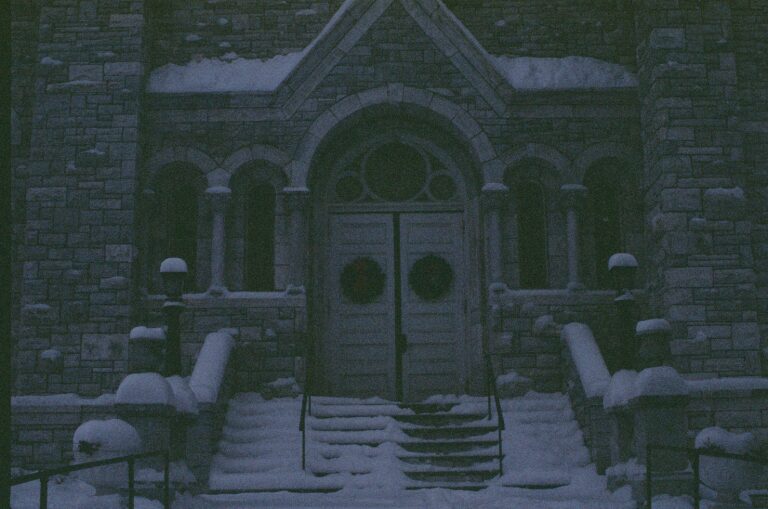
Madonna Chafe sat and shivered in the wooden pew, clad in her least offensive dress and best pair of rubber boots. Her family pressed in on her from both sides, intimidating in their sheer number, and Donna shifted restlessly. Around her yawned the cavernous space of the Basilica of St. John the Baptist. It was Palm Sunday, and her arse had gone to sleep in the middle of the homily.
The still air around her smelled of flowers, myrrh, and wet wool. It was a smell that always put her in mind of funerals. The pew creaked as she shifted uncomfortably.
“Today we hold palm branches in our hands,” Fadder Mike droned, “and remember the cries of ‘Hosanna!’”
“I’ll be the one crying if he doesn’t get on with it,” her brother Brendan whispered from farther down the pew. From her other side, their mudder’s glare landed on them with the heaviness of a hand. Her mouth was puckered in pious indignation.
“Now,” Mrs. Chafe whispered, her tone sending a chill through Donna that had nothing to do with the draft in the Basilica, “I knows you’re not distracting us from Fadder Mike’s moral discourse on purpose.”
“My arse fell asleep,” Donna whispered back.
“Cyril,” Donna’s mudder hissed, elbowing the silent husband slumped on the other side of her from Donna. Cyril Chafe sat up straight and looked around as if yanked from a pleasant dream. “Your daughter says she finds her arse,” Mrs. Chafe said by way of getting his attention. “You better remind her how Sundays are meant for the mortification of the body. A pain in the arse is a pleasure to God.”
Mr. Chafe cleared his throat at Donna significantly, and resistance died in her heart. Donna’s fadder was an unusually quiet man, content to live most of his life in monosyllables. His job as a pipefitter had battered him into looking much older than his fifty-three years, and his drinking kept him mildly baffled by everything.
“It’s true,” Fadder Mike continued, “Jesus was none too impressed with ye, but in you all, he saw a crowd that needed guidance, a people who couldn’t get there without a little help.”
Donna tried to focus her attention back on the squat priest yowling and gesturing from behind the podium on high, so short that the flash of his glasses was barely visible over the top of his Bible.
Sleet-saturated wind battered against the closed front doors and the high rows of stained glass windows. It was the spring of 1968, and outside in the parking lot, invisible under the drifting piles of snow, all the car license plates proclaimed that Newfoundland was “The Happy Province.”
Donna’s eyes wandered over all the happy people slumped in their coats against the cold, heads sagging. One row behind her, Mrs. McCaffrey’s husband, Jim, was snoring. The McCaffreys owned a bakery, and Jim worked overnights, filling the cold dark with the smell of rising yeast and baking bread. Whenever Donna walked past the bakery, the smell reminded her of church, somehow. Something essential and fundamental. She imagined all those loaves of bread and buns and tea biscuits stacked side by side on the shelves, ready and waiting to transubstantiate.
And as she looked around at all the familiar sinners, a few rows ahead and across the aisle, Donna’s eye fell on the thick pink nape of Loyola Doyle—and stayed there. He was a huge man, a few years older than her, his tweed Sunday jacket stretched almost obscenely over his broad shoulders. His shaggy dark hair came to a messy point almost at the top knob of his spine. On either side of this, freckles covered the exposed skin on the back of his neck. He seemed to be resting, all by himself in the pew, chin on chest, arms crossed in front of him. She shifted again, and her mudder half turned, lips already pursed.
“Loyola’s mudder’s missing.” Donna cut her off, tipping her head in the direction of the Doyle pew.
“Is she?” Mrs. Chafe gawked over at Loyola’s back, judging the severity of the situation. “Well,” Donna’s mudder breathed, eyes going wide. “He’s finally gone and done her in.” She blessed herself.
Mr. Chafe raised one of his shoulder blades in disapproval of his wife’s smug tone.
“Loyola’s never gone and killed his mudder.” Donna sighed.
“And why not?” Mrs. Chafe said, pushing Donna back in the pew to get a better look. “Everyone knows he’s a hard ticket.”
“He killed his fadder,” her eldest brother, Cecil, piped up from beside her. Donna frowned down the pew, taking in the sight of all her brudders. Six identical faces in diminishing order. All of them, from Cecil on down through Brendan, Dermot, the twins Garwin and Ron, Wayne, and Alphonse-Davey, had followed their fadder into the pipefitting business. And they all knew Loyola.
“You remember,” Cecil continued, “he used a cigarette to blow up Old Man Doyle’s oxygen tank and sent him head-first through the front window. Ended up all the way to the other side of the street.”
Donna did remember. In a grisly postscript, the neighbourhood kids had started telling how Merle Doyle flew so far that day that Mr. Windsor’s chain link fence across the street had diced his body into stars.
“Emphysema,” Donna’s mudder corrected. “Drowned in his own lungs. Sin. And St. Claire’s Mercy Hospital just a few blocks from his doorstep. I tell you; we’re all doomed.”
Her husband nodded emphatically.
From the pew behind, Mrs. O’Brien gave a warning cough.
“Hypocrite,” murmured Mrs. Chafe into her hankie.
Donna remembered another story about Loyola: that he had stabbed a cab driver right outside the front door of his house, stolen seven dollars from him, and calmly walked inside. The cabbie called the RNC, but when they questioned Mrs. Doyle, she swore up and down that Loyola had been home all day, choking on a cold.
Brendan interrupted her mid-thought. “He’s a drug dealer.”
“Oh, leave him alone,” Donna said. She didn’t exactly understand why she was so keen to defend him all of a sudden. She did know that Loyola lived with his mudder and an older sister named Carmel on Waverly Street, just around the corner from the Chafes’ own home on Dalton. The Doyle house was an over-ripe pink, with trim the same grey as the froth that scums around the dock pilings in Quidi Vidi gut.
“Cyril!” Mrs. Chafe gasped. “Your children are talking blasphemy in church, on Pam Sunday!”
“It’s Palm. Palm Sunday,” Donna corrected.
Mr. Chafe gave a strangled harumph. Mr. Barrie turned around right in front of them and looked down his nose. Mrs. Chafe cracked her knuckles at him, and the disapproving parishioner turned back around.
“All right,” Mrs. Chafe hissed, at her limit. “Shut up, all of ye, unless you all want to meet Jesus in person, this very minute.”
Silence fell over the pew, and Donna looked towards Loyola again, at his bent head and pink neck, the powerful, rounded shoulders, and a shiver went through her. Not fear, or even cold, though the wind still blew against the stained glass and Fadder Mike’s breath showed in front of him in clouds of glory.
“With such humility did Jesus enter Jerusalem, that he rode upon an ass,” Fadder Mike enthused. Brendan snickered, but Donna was not listening. She was moving forward, in thought if not in body, towards that neck. She focused on the large hands tucked under tweed armpits, square-tipped fingers twitching occasionally, and realized what the shiver was. On the way out, she made sure to grab a few extra palm fronds.
***
Donna placed the palms on the kitchen windowsill when she got home from the Basilica, and they lay there still that night as she stood at the counter, scraping Good Luck margarine diligently across twenty-eight slices of toast. The light over the sink threw a seasick glow on the nocturnal chore. The rest of the house was dark and quiet. Even her mudder had gulped her last brandy and egg and disappeared to bed. Donna popped the top off the jam jar, and as the smell of bakeapple filled the room, she realized that with her mudder off to bed and the dark so velvety and full, it must be well past midnight.
A thump behind her made her drop the butter knife into the sink with a clang. She spun to find Brendan leaning against the door jamb. He blinked at her groggily.
“What on earth are you doing up?” she asked, breathing deeply to still her heart. “It’s only a few hours before you need to be up for good.”
Pipefitting was early work, and though not usually done in the snow, this season the company had brought them in for an early April start.
Brendan shrugged and shuffled past her in the tight space, shimmying onto the table and resting his feet on one of the chairs. “Couldn’t sleep.”
“And what do you think mudder would say if she knew you had your arse on the table?”
“What she usually says.” Brendan yawned again.
Donna couldn’t help herself. “When I make bread,” she said, “I don’t want it covered in the stink of you.”
Brendan’s giggles dissolved into a chesty cough, and he shook his head, still smiling. “Might as well put the tea on.”
Donna filled the aluminum kettle and set it on the stove, then retrieved the knife from the bottom of the sink and went back to buttering bread.
“You’re a production line down here,” he said as he looked over her several piles of toast. She pointed as she recited, “Your lunchboxes. Two peanut butter and jam sandwiches each, a Mae West, and a flask of tea with Carnation Milk.”
Brendan muttered something unintelligible.
“What was that?” she asked.
“Nothing. Can we light the stove at least? It’s freezing in here.”
“Not for another few hours. We’re not wasting coal on just the two of us. You could warm yourself with work, b’y. Go ahead and grab a knife. The sandwiches don’t make themselves around here.”
“Well, what else are they going to find for you to do until you get married and get the hell out of here? Twenty-four and still at home.”
“Younger than you, Bren.”
“Yeah, well, it’s different for girls. Might as well be mudder’s age.”
Donna rolled her eyes at him and kept buttering. Brendan lurched off the table and over to the cupboard on the far wall to fetch down two mugs.
The kettle squealed, and she snatched it off the stove before it could wake the rest of the house. The liquid in the cups was stewed black by the time her brother fished out the bags and filled the remaining space to the lip with a thick plop of Carnation Milk.
Donna contemplated the tea, flecks of oil from the milk making rainbows across the surface. She took a sip, then looked back at her brother, drooping in the dim light, pale-skinned, warming his hands around the cup. When he took a sip, he slurped.
“I been thinking about it, you know,” she said.
He roused himself. “About what?”
“Getting married.”
She expected him to laugh. Or spit out his tea. Something. But instead, he just looked at her, loose curly hair flopping over his forehead, nearly covering his eyes.
“Maybe you should.”
She was shocked. “Really?”
“It’ll get you out of here. Cecil can’t put off marrying Betty Healey forever. Once they move in here and start having kids, we’ll be hanging them from the ceiling. You got anyone in mind?”
“I do. And don’t you dare laugh at me, Bren. I’ve had my eye on Loyola.”
He did nearly spit out his tea then. “As in Loyola Doyle? Since when?”
“Since this morning’s homily.”
Brendan just blinked at her.
“He’s got upsides,” Donna said, defensive.
“He’s built like a brick shithouse,” Brendan said flatly. “Dumb as a post, and he smokes like a winter tilt. What in the hell do you want with him?”
Donna set her mug down with some force so she could count her points off on her fingers. “He’s got a job that lasts all year round—”
“Selling drugs—”
“I’m not finished! He’s got a home of his own, with just one stray old mudder and a spinster sister. It’s practically empty! And it’s true he’s got more muscle than brains, but muscle isn’t all that hard to look at, for your information, and I’ve never heard that he beat anyone without a reason. And he sent his mudder to Florida, one year. A full week in a resort, all expenses paid, drinks included!”
Brendan seemed to have forgotten his tea, staring at her in horror. “And what about when he’s in jail? He’s always in and out.”
“One less person in the house.”
“Donna.” Brendan set his tea down beside him with a crack. His voice dropped. “What about the women?”
“Which women?” Donna tipped her chin up. She wasn’t going to make this easy for him.
“All those girls on Long’s Hill.”
“You mean all those streels too stupid to get inside out of the cold? They’d all sell their soul for an extra toque and parka.”
“They sell more than that, Donna. And he takes a cut. You know what I’m saying. Everyone knows. Loyola Doyle isn’t the marrying type.”
“Well, maybe no one ever asked him.”
Brendan threw his hands up.
“All right,” Donna cut him off. “But have you ever considered that I wasn’t born specifically so I could butter three loaves of Wonder Bread for you crowd every night? Maybe I’m willing to put up with a lot for a shot at a man who can give me a thrill now and then.”
Brendan blushed and groaned as if he’d been shot. “All right, can it, will you? I get it.” He dumped the cold remains of his tea out, then set the cup on the counter to be washed. Donna just stared at him, sullenly.
“Jesus’ sake, Donna, don’t look at me like that. I don’t understand why you’re always so damn set on breaking your shins on a stool that isn’t in your way.”
“Clock’s ticking,” she said simply.
He looked at her for a moment, fingers picking imaginary lint from the fronts of his worn pyjama pants. Finally, he shook his head, “Night, Donna,” he said, and went back upstairs.
***
Next afternoon, Donna stood in the snow on Loyola’s doorstep, holding up a fistful of palm fronds like they might light her way home in a storm. When he answered her light knock, she gave him a wan smile. Loyola seemed unsure what to do. Finally, he settled for: “Alright?”
“Donna Chafe,” Donna said. “From around the street. Your mudder knows my mudder, so I brought over some pams.” She winced at her pronunciation, but subterfuge felt necessary at this early stage of her plan.
The fronds waved. Loyola looked cautiously judgmental.
“Because she missed the Mass yesterday,” Donna continued. “Your mudder’s never missed a Pam Sunday, so I figured she might be sick, and I brought her some.” The palms undulated in the icy wind.
“Alright,” Loyola said, and reached out and took them from her, closing the door on her before she could say another word.
It was not the start Donna had hoped for. She rubbed her arms against the cold and looked around, lost for what to do next. She’d just reached up to knock again when the door opened, and Loyola loomed up from the dim interior. Donna raised her eyes slowly to meet those of the man in the doorway. She thought he looked like Sailor White, a wrestler Donna’d seen on afternoon TV with her fadder. Loyola eyed her suspiciously for a moment more and then fetched up a quick sigh and cleared his throat. “Mudder says thank you for the pams. She says I’m to give you some tea.” His voice was deeper than she remembered, a good one for singing, maybe, in one of those choirs the Welsh lads were always chirping about.
He widened the door for her, and Donna, still nervously clutching her coat, ventured into his warm den.
A few minutes later, they sat in Loyola’s smeared yellow kitchen at the small table under the dual portraits of Jesus Christ and Premier Joey Smallwood. Saviours, both.
Donna contemplated the stained vinyl tablecloth. It had pictures of holly all over it, and the indent of so many cup rings that they became part of the pattern. Whenever Donna glanced up at Loyola, she found him round-shouldered, looking glum and resigned at the wall behind her.
When she had first entered, she had turned on the light and stood in the center of the small front room, taking in the family photos on the walls, the creaky phone table and the listing book on the lower shelf. There was a couch against the wall and an armchair near the door, and it was this armchair Donna finally chose to perch on. Loyola stood in the doorway and watched her the whole time, brows knitted in consternation. Once seated, she looked up at him and tried a smile.
“Fadder died in that one,” he said.
Donna stood slowly and crossed to the couch. “Anyone been dead in this one?”
“No. But we keep the tea in the kitchen.” He turned out the light before they left the room. “Mudder doesn’t like to waste on the light bill.”
Now, in the kitchen, after a certain amount of rattling around and Loyola cursing the kettle, Donna blew on her milky tea and cast about for common ground.
“So, is your mudder sick?”
“Upstairs. Choking on a cold.”
“Sin,” Donna commiserated.
Loyola nodded. “She’ll come around soon, though. She’s tough as nails.”
They both nodded at the truth of that. Then, after a moment, as if remembering something from a distant past, Loyola also said, “It was nice of you to think of her and bring the pams.”
“Oh, it was no problem. Did you like the Mass?”
He swallowed what looked like a scalding gulp of tea and shook his curly head. “Nah. Fadder Mike gets on my nerves. Got a face like a smacked arse.”
Donna snorted a laugh. “Only ’cause he does every homily more than three sheets to the wind.”
Loyola nodded. “He’d drink it off dead Nelson, sure.”
They both chuckled a little, Loyola proud of his reference. His face melted back to neutrality after a moment, and he looked around. “He’s welcome to come and try any of that ‘blessed are the poor’ shite in here. Mudder would have him out on his ear.” His hands tightened at this, and Donna’s eyes fell to his fingers, wrapped around one of his mudder’s teacups. They were huge. He could probably hide both of her fists in one of his. For some reason, this image sent a pleasant jolt through her.
“Did you really stab a cabdriver outside your front door?” she asked.
It was out before she knew she was going to say it. The silence in the room turned ominous as Loyola slowly lowered his cup of tea to the table. A dusty cuckoo clock ticked above the fridge. Donna was not ready for what happened next.
Loyola laughed. Not a guffaw exactly, but something genuine, though rusty with disuse. “Who did you say your people were, again?”
Donna allowed herself to laugh with him as she saw some of the tension leave his shoulders. He even leaned forward and put his hands flat on the table. One of them, anyway. The other he seemed to favour by keeping it on its side. She recognized the movement.
“Hand alright?” she asked.
It took him a minute to catch what she was on about. When he did, he waved it off dismissively.
“It’s just scalded making tea. Touched the burner when I put the kettle back.”
She held out her hand. “Let me see.”
“Forget it.”
“Don’t be silly.” She took his hand from where it lay on the table and turned it over so she could see the palm. “Jesus, Loyola, you’ve got a good burn there. Let me fix it for you.”
“I said forget it.”
Donna swallowed at the boom of this voice. Loyola obviously wasn’t used to being questioned. He seemed to regret his quick retort, though, because he stood and crossed to the sink, where he dumped the remainder of his tea and began to rinse out the cup.
Donna stood resolutely from the table and crossed to the small sink. She reached past him, shouldering him aside a bit as she did, and turned the open tap all the way cold. Taking him by the wrist, she plunged his hand under the cold stream of water and held it there until she was sure he wasn’t of a mind to make a dash for it.
She felt him shiver powerfully as relief passed through him.
“Just keep it there,” Donna told him, and he did. She crossed to the tiny fridge and rummaged around. She could feel Loyola watching her as she did, so made sure to bend extra deep when she reached into the back to pull out the tub of Good Luck. His eyes were narrow as she came back to him, peeling off the plastic lid. Then, cradling his paw in one of her much smaller hands, she rubbed a good dollop of the margarine into his palm over the burn with gentle fingers. “Better?” she asked. She felt him shrug, and when she glanced back up at him, he was frowning down at her quizzically. A look that Donna felt might be how Loyola would stare at a wounded bird for a moment, before he left it to its fate. He seemed all at once like he wasn’t really a drug dealer or a pimp, but a man who was tired out and desperate for someone to insist that he sit down for a minute.
Donna was so concentrated on that look that one of her fingers slid too far up his palm and touched the belly of his wrist under his shirt cuff by accident. The touch had an instant effect on him, changing the look she had been so mystified by into one she recognized immediately. She was sad at first to see that touch of confusion, whatever it had been, leave his face. But the hungry look that replaced it was the whole reason she was there, after all. So she stroked him again in the same spot, and Loyola seized her wrist tight with his uninjured hand, and said in a hurry, “Do you wanna stay?”
Donna smiled and said, “Sure, if you’d like.” And then her smile widened and became more genuine.
It made her realize that she couldn’t recall ever seeing Loyola kiss anyone. She’d never even heard of him doing it. He must be able to, though. Especially with the way he was staring at her mouth now, then back at her face, like she was a puzzle put there just to stump him. It stood to reason, she figured, with all those girls of his, he must kiss some of them and hold their wrists in his hand like this, like they were something precious.
“And are you always…” Loyola said, then stopped and looked around his kitchen like the colour of the walls had changed. He took a deep breath of the air that smelled of the damp, and glanced at the still-dripping kitchen faucet, before looking back to her. “Nevermind.”
A moment later, his grip tightened around her wrist, and he crossed back to the table, pulling her after him. He grabbed her coat, tossed it at her, then steered her through the hall and across the living room. He even turned the light on so she wouldn’t unwittingly crash into the mortuary furniture. Once they reached the front door, he roughly jerked up the shoulder of her coat that she was struggling with and ushered her outside into the cold night air, where it had already grown dark.
Donna stood there, shocked and hollow-feeling, and almost didn’t hear him when he said, “Alright getting home?”
“’Course,” she said.
He nodded once, eyes somewhere above her, and then shut the door in her face and locked it and turned out the porch light for good measure. She blinked for a moment at the wooden panel in front of her. Then she sidled a few steps sideways to where she could peer into his living room through the front window. Loyola was standing at the light switch, finger raised to flick it out, but stalled, like a fleshy statue in faded jeans and a pair of vamps his mudder had knit him. He was staring at the palm of his buttered hand, scrutinizing it like some secret letters might appear. But evidently, there were no messages forthcoming for Loyola that evening, because a second later he snapped out the light, and all Donna could see was her own scared face reflected back at her in the dirty glass. She turned and walked slowly round the corner to her house.
A storm was setting in, snowflakes like locusts everywhere at once and blowing sharp and stinging in all directions, adding movement to the tangerine light cast by the streetlights on the snowbanks. The snow was so blizzardlike, so blinding, that if you’d seen her, walking those few steps from one house to the other, you’d never have known if she was crying.