
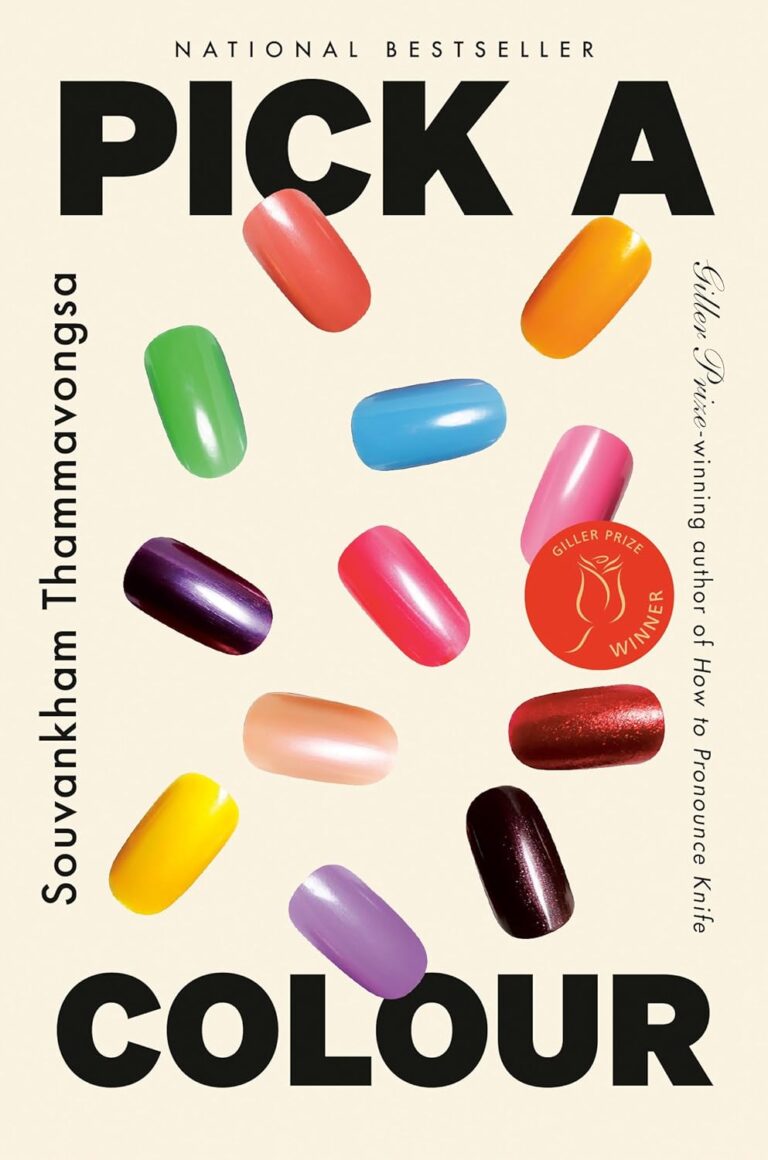
If you’ve ever wondered while getting your nails done, the answer is yes—your manicurist is definitely talking about you. Pick a Colour, the debut novel from Laotian-Canadian writer Souvankan Thammavongsa, exposes the fine lines that separate intimacy from loneliness. The novel explores a day in the life of Ning, a retired boxer turned owner and operator of “Susan’s” nail salon, the name Ning has adopted for her shop and herself. On a hot summer’s day she and her colleagues, Susan, Susan, Susan, and—you guessed it, Susan, traverse the boundaries between life and work, beauty and pain, where the truth, dangling like a hangnail, sticks out between the successive confessions proffered by their clients. As the reader, we only hear these clients through Ning’s narration, never directly. The novel focuses on exploring the conversations often ignored: those of the women who diligently serve.
Often up close but reluctant to be personal, Ning tells us more about herself through what she perceives than she might be comfortable revealing. Ning is tough. Her history as a boxer, and the traumas she’s constantly bobbing and weaving around, have made her a professional at self-protection. Because of this, she knows to keep her clients and employees at an arm’s length in order to carefully paint a pinky toe or take a defensive jab when necessary. And yet, it’s her gift for noticing the beauty and filth amid the mundane that makes Ning a surprisingly intimate character. Her attention is a form of affection. In one scene, Ning watches a pigeon get run over by a streetcar. Her instinct is to retrieve the body from the road, carrying the corpse back to the sidewalk. Fearing the bloody remains may deter potential customers, she places the body in the narrow alley next to her shop—the city’s natural graveyard. Instead of apathy or repulsion, Ning’s actions express empathy and a tender connection that extends to all the life around her. Pick a Colour opens with the line “[E]veryone is ugly,” and in those words Thammavongsa sets up a paradox. In a world built on distraction, systemic hierarchies, and unrealistic beauty standards, recognizing what is deemed unpleasant—a dead pigeon, a blister, or a touch of fungus—is a treasured intimacy too often overlooked.
In their work, the salon women float like butterflies and sting like acetone. Discussing her new novel in an interview with Publishers Weekly, Thammavongsa highlighted a quote from the poet Jan Zwicky: “work can carry you the way love can, but with less sorrow.” Ning’s work gives her purpose, its rhythms shape the hours of her day in the same way picking up the kids from school or dinner with a spouse might, but it’s also a safe outlet to channel expressions of love that she keeps carefully guarded. Despite her best efforts, Ning’s tenderness emerges through the unique, detached intimacy she feels for her clients, for her bold and loyal coworker Mai, and even for Nok—a character whose absence serves as a suspenseful subplot throughout the novel.
To really see Mai, Annie, Noi, and Ning beyond their black salon uniforms and mirrored haircuts—the interchangeable “Susan” facade—one needs to close a superficial distance and dissolve frames of privilege. In the feminized landscape of the nail salon, a microcosm of diasporic experiences is revealed through dry, scraping humour. Social hierarchies are dismantled, translated, and reassembled with each transaction. Furthermore, the relative physical absence of men in the salon, juxtaposed by pervasive discussions about men, highlights the cross-cultural pressure women feel to be heteronormatively coupled. But in stark contrast, Ning considers herself a family of one. I think Thammavongsa’s title—a refrain throughout the novel— subtly speaks to these pressures. What if you don’t want to pick a colour? What if you want to be naturally, your own?
Thammavongsa’s written voice, like that of her narrator Ning, is one of masterful restraint. Consider her handling of one of my favourite aspects of the novel: the motif of Ning’s missing ring finger. Its significance ties a beautiful bow onto the final page of the book (which I will not spoil!). The ring finger is loaded with symbolism and its absence emphasizes how romance and family life have been severed from Ning, though we never find out who, what, or how it has been severed from her. But where others see something missing, an incomplete woman, Ning experiences her own peace and fulfillment. Since her days in the boxing ring are over, this “missing” finger is the new center line of her life. She controls the space it affords her. Moreover, Ning’s missing finger serves as an opening, an opportunity to extend to her the same intimacy, generated through noticing, that she offers to others. As I closed this novel, I felt the pang of universal yearning. We all want to feel seen. We all want to be cared for. As we strive to strike a balance between peace and purpose, we all want to know that someone’s in our corner. In Pick a Colour, Thammavongsa tells us the good news: head to any nail salon, and you’ll find someone there.