
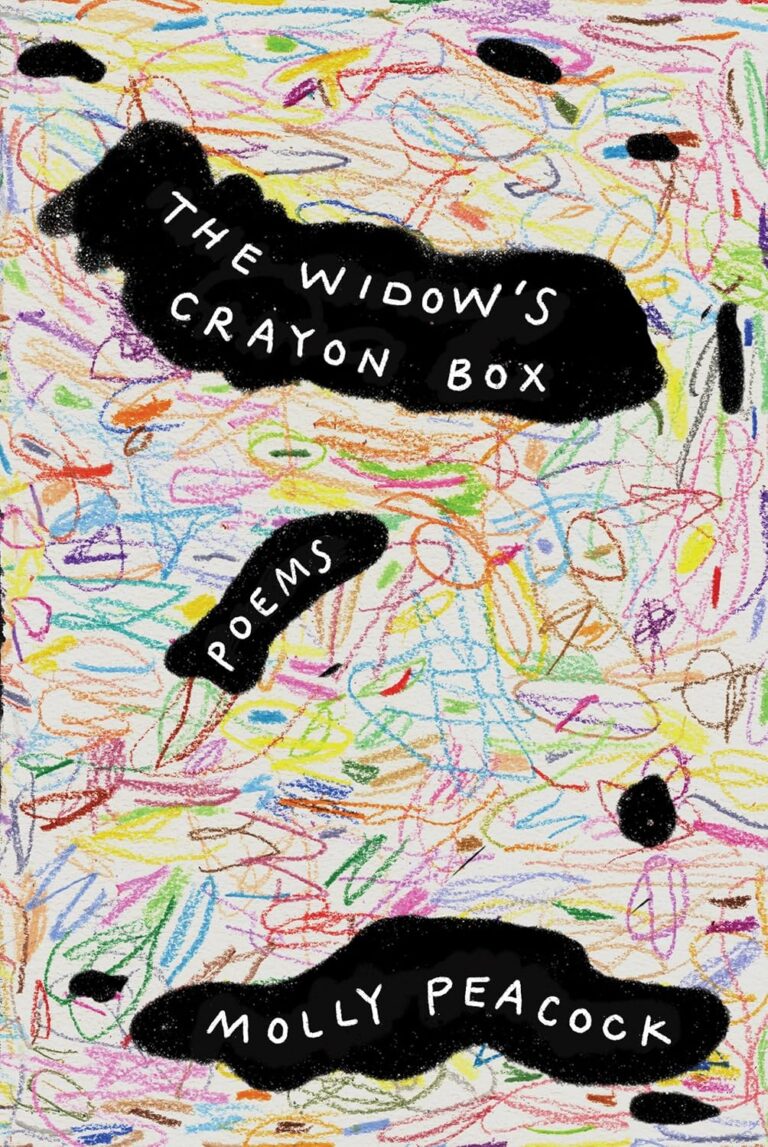
I read this collection in November, the month of mourning, during the season where everything seems to lay its head come afternoon. When greying days paint over the city as trees deliver their miniature deaths into eavestroughs, the smallest flashes of colour become more and more striking. A red scarf, a slit of blue sky, a box of crayons.
Playing fearlessly in flares of colour, Molly Peacock’s poetry collection The Widow’s Crayon Box toys between crayola innocence and the engulfing weight of departure. Writing in memoriam of her husband, Michael Groden, Peacock’s world of grief is not grey but wrought with colours upon colours, whose names dare to be remembered. Bleutiful. Timberwolf. Sepia. Mulberry. As if you’ve raided the paint aisle of its samples and thrown them into the air in an elation of… tears? Must be. Peacock’s Raw Umber and Orchid, Purple Heart and Sunglow littering down around you. This is her cadence of thought: spontaneous imagery ignited with colourful dimensions as a taut throughline for her storytelling.
Folding time across four poetic parts: “After,” “Before,” “When,” and “Afterglow,” Peacock writes her way through sick rooms, breakfast, and sex after seventy. Language is her place for play, letters flying in and out with cheeky punctuation and the subtle shifts of vowels or rhymes. This is also her place for fears and wishes, carving open questions of what we can take with us and what is gathered in pairs for donation. But death’s claim to our bodies is more than imprints and evidence; Peacock’s sacred loneliness glows and rattles through each moment. In her lover’s being, in his absence, and no one after.
Peacock’s tender lines house a deep and moving love for her husband, saturating imagery of the mundane with a much heavier reality. Featured in Poetry Magazine’s Best Canadian Poetry 2025, the speaker in Peacock’s closing poem “Honey Crisp” muses a lone apple as a timekeeper of her husband’s passing, “Hello wizenface, hello apple/ understudy in the fridge/ since March (it’s September).” In her gut wrenching personification, Peacock remains ever sweet and curious, “are you asking why you/ haven’t been eaten by now? …You were earmarked for the date/ he slipped from my arms & we both/ slid to the floor, red angel, are you/ listening?”
It’s funny how at our oldest we become as gentle and organic as housepets, or fruit. In her book’s second part, “Before,” Peacock writes, “When I am so ill, I hope I can be/ as soft as you are. This morning you turned/ and looked back the way the cat,/ climbing into the clothes hamper, stared at me/ when he slowly inched in to recover” (from “Petting My Husband’s Head in My Lap”). Like many of Peacock’s poems, her metaphors hold overlapping meaning. To be an animal is to be mortal–fragile, even. As domestic and dependent as a pair of whiskers turned towards your open palm. This collection is unabashed in its discussions about death through memories, realizations or witnesses, “like a cat shooting through all eight wheels/ of a moving tractor trailer. Now it’s you lighting off/ across the street to begin your tenth life.”
Poetry is a way of writing oneself out. It is the harnessing of language for feelings to live outside of the body, and perhaps the most versatile medium to capture the rhythm and audacious tones of our crowded thoughts. Peacock writes her way through her box of crayons with defiance and mournful admiration, forever preserving the befores and afters of lifelong love. Her writing demands imagination and empathy, reminding me yet again how poetry serves as education for emotions. In this collection, widowhood is not a single note, but a body of water, a double-act, a pan of fried zucchini flowers. Peacock’s perspectives come with more questions of their own, “Is the soul hairless?”, “Have I, /… overstayed?” (from “Question”). Her answers come through unexpected appearances, “Not yet, not yet, my pomme” (From “Honeycrisp”).
I am always captivated by poets who can so gracefully balance a sense of whimsical curiosity while writing about the darker experiences we often struggle to find words to describe. This collection is marked by Peacock’s talented voice and personal bravery, privileging readers to an honest narrative about grief and its colourful halos.