
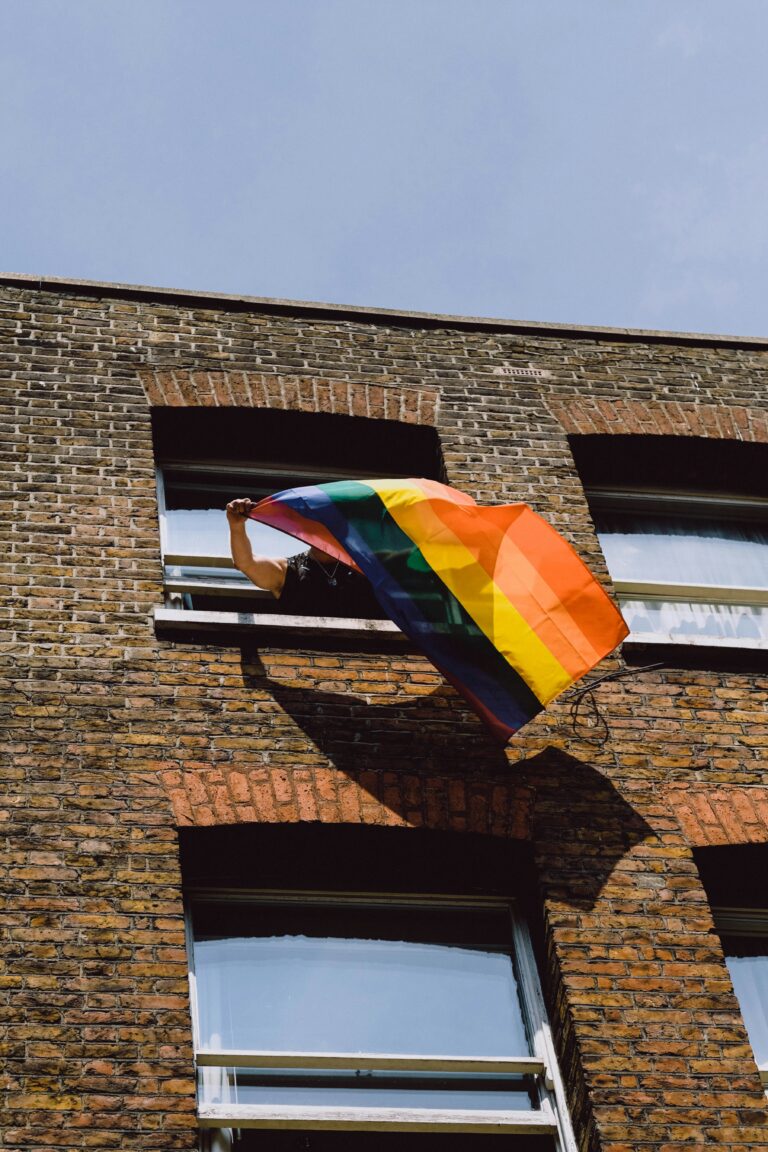
Armed militias were badgering people outside public libraries. I heard the news on a lush June evening, while taking my usual walk. It was Pride Month 2022 and the Proud Boys were targeting Drag Story Hours in Nevada, California and Texas.
I got home and started googling. It wasn’t just the libraries; the events were under attack at other venues as well. A bomb threat at a Virginia bar. A fight outside a pub in Oregon. Drag-clad counter protestors squared off with men toting assault rifles as smoke grenades and rocks rent the air.
It wasn’t as though these aggressions had no context. Thirty-six states had introduced anti-LGBTQ+ bills that year; thirteen states had signed them into law. All kinds of hate crimes were on a sharp incline—even here at home, in New York City. Meanwhile, the U.S. Supreme Court was busy creating new constitutional rights so businesses wouldn’t have to serve scary queer folks.
So no, this latest news should not have astonished me, but I revere public libraries, so it was the assault rifles at the libraries that brought the bad news home to my body—made it bloom with visceral grief at witnessing years of progress give rise to bigoted hate. And as soon as I felt that grief I wanted it gone.
Stupefaction causes something alike to a thermal refraction in my brain. While I understood that I was reading legitimate journalism, the more I fact-checked the more I felt myself dissociate, float up toward the ceiling, distance myself from the truth. Despite all I knew, in my heart I’d been living in a country where we took marriage equality for granted. Where antidiscrimination laws belonged to everyone. Where most people just didn’t give a hoot if their neighbor or brother or colleague was queer. I hadn’t given my heart’s attention to the backlash—not yet. I’d been focused instead on the long view, on what had gotten better, by how much.
In 1971, I’d spent a gray autumn day at a New York City Council hearing. The council had invited public testimony on a proposed bill “to prohibit discrimination against homosexuals in employment and housing.”
At fourteen I had little context for what was at stake, other than the fact that it concerned the two women I’d come with that day, strangers kindly sheltering me in their Brooklyn apartment. What I most remember from those long hours of wide-eyed, open-mouthed watching and listening is my bewilderment. There was a lot of shouting. It lent a chaotic feel to the ornate chamber but it was nothing like the raging of my family. These voices were angry but threatened no bodily harm.
I remember a woman testifying against the proposed bill, reading slowly from some papers she held, carefully enunciating that she didn’t want “ho-mos” teaching her kids. I remember the crowd erupting, someone pounding a gavel, a shouted threat to clear the room. When it quieted, we listened to an instructive digression—I don’t remember from whom—explaining that the term “homo” was considered derogatory.
The testimony dragged on. At one point, as we reconvened from a break, a council member announced that he’d seen a “transvestite” entering the women’s bathroom off the rotunda hall. That’s “the nub of the problem,” he told the room, “transvestitism.” Again, the crowd erupted, this time into furious rhythmic chants of “het-er-o-sex-u-al bastards.” More pounding of the gavel, more explanations of terminology ensued.
It would take fifteen more years for the City of New York to outlaw employment discrimination against queer people, but it took only that one day of watching and listening to awaken my teen self to the crazed injustice of queer hate. And while most of that day is a blur, there is one additional moment I still see and feel and hear clearly, a moment so incongruous that it triggered that cerebral refraction, stupefying me with disbelief.
It was mid-afternoon. The room was overheated. I was tired and hungry. A woman seated in front of me had been fidgeting in her seat, increasing my desire for a break and my longing to get out into the cool autumn air. As I glanced around for a clock she leaned over to her companion and said, “I don’t know what to do. I’m scared to go to the bathroom. What if there’s lesbians in there?”
A year earlier, I’d been living in suburbia experimenting with ways to harm myself. It was the day after Thanksgiving when it occurred to me that I had a choice. I could stay where I was and continue to think about killing myself—or I could leave. One early morning a few weeks later, rather than walk through the woods to my seventh-grade homeroom I walked down the road and stuck out a thumb.
In making that decision I’d been buoyed by a simple—some would say simpleminded—belief that people “out in the world” would be nicer than my family. In the eleven months since making my choice, I’d found this to be the case. Out in the big unknown, dozens of adults had given me rides, taken me into their homes, fed me, inquired after my welfare.
It wasn’t just the two women I was with at this hearing who’d made it their business to help me. It was the guy in the trailer on an Indiana goat farm who’d insisted on showing me self-defense moves. The rural Pennsylvania grandmother who invited me to sleep in her daughter’s room, then made me eat breakfast before I returned to the road. It was the nudist couple on Delancy Street who made sure I felt comfortable and safe. The two truck drivers taking turns sleeping in the cab of their Mack so I could sleep off the flu in their truck-bed as they ferried me safely from Bowling Green to Baton Rouge. It was all the adults who’d gently clue me in when I did or said something stupid—which was very often.
Yes, there was a guy who’d brought me to convulsive shudders, then dumped me in waist-high snow when I refused his demand for sex. But he was one guy—the kind you can always find, even on a good day.
There were others but they were harmless or, at worst, hostile. The Adonis who, shocked by my lack of interest, walked away mumbling, “It’s too cold to get laid anyway.” The yahoos at the hippie-run counseling center who tried to talk me into a threesome, then dissolved in confusion when I claimed to be a lesbian, their bewildered questions and comical looks indicating this was a brand-new idea.
I recently told my daughter that story. Her reaction surprised me. “You told two guys you were a lesbian?” she said, frowning. “Mama, that was so brave.”
It didn’t feel brave though, only necessary, just one of many moments when every bit of instinct kicked in to get me what I needed—to be let alone.
Taking to the road at thirteen, I’d been advantaged by the color of my skin and the standard English of my family of origin, a deeply flawed but powerful signifier of class. I didn’t know this at first; I came to see it slowly as I moved for many months among strangers. From time to time I could sense the way I spoke intimidated people, in other moments I felt it draw approval. I learned to speak most carefully when I was most afraid.
I was also remarkably lucky. In New York I’d met a girl from a background much like mine who’d been abducted and injected with heroin. Melanie had managed to escape her would-be pimp, but I could see what it had cost in her eyes, in the way she shrank from human touch. I’d met girls who’d been raped, heard of others found dead. I understood the great gift of luck in my life on the road and in the streets but it never paled the role of human kindness.
The kindnesses I received from strangers when I was alone and poor and ragged and terrified are an immutable force that shapes me still. It’s why, sitting in New York City Hall in 1971, hearing a woman say she was afraid there’d be lesbians in the bathroom triggered full out-of-body brain-refracting confusion. There I was, protected, housed and fed by two women who, from the looks of their neighborhood and the building where they lived, didn’t have a whole lot of anything except kindness and their love for each other. I’d lived with scary people most of my life. These two made me feel safe.
If kindness is your criteria for judging people, you may not find so much meaning in other characteristics: gender, sexuality, how someone dresses, their profession, nationality, skin shade, religion, accent, political affiliation, financial status—the long and growing list employed to manipulate us to think of someone as other.
The perspective that most people, given the chance, will be kind, has kept fresh my experience of hate when it arises, rendered me raw and disoriented rather than inured, left me stupefied by a disbelief I feel in my gut, in the buzzing of my soul as it struggles to remain in my body, in the grief I allow to unravel my heart. This may sound naïve or Pollyannish, but if so, it’s also been a gift. A bulwark against the temptations of cynicism, a blessing that has saved me from helplessness in the face of the horrors we humans create and inflict with so much enthusiasm, and struggle to confront.
As I grew from a scared and defiant runaway to a fledgling adult I was often enveloped in cognitive dissonance over gender-related hate.
I’d never been a “girly” dresser. Spending my childhood watching three older sisters who seemed to care way too much about makeup, clothing and hair—about their looks and attractiveness—had make me think of these concerns as a trap. I’d left home in a pair of worn dungarees and a denim button-down, clothes I lived and slept in for many months. Still, I needed more clothing. Whenever I was in a place long enough to earn some money, I’d find a thrift shop and go through the racks of men’s mediums and smalls.
In one of those stores I’d found a silky black suit vest patterned with golden brown dogs—pointers—in silhouette. It cost a quarter. I wore it nearly every day for years. Even now, decades since it disintegrated to shreds, it remains my all-time favorite article of clothing.
My wearing men’s clothes prompted insults, most often from men, usually something like, “Gee, you’re an ugly boy,” hurled from a passing car or across a sunny street. But dressing like a man made me feel safer in my body so I swallowed the hurt and moved on.
At eighteen I got my first full-time job, clerical work for Allied Carbon & Ribbon on Duane Street in Manhattan. It was the most mindless work imaginable. All day long I sat at a desk separating carbon copies of invoices into lofty piles. But for the first time in my life I was financially okay, earning $125 every week. It was enough to share a one-bedroom apartment in Jackson Heights, where I slept in the living room. I could buy food, pay for utilities and subway fare, and have some money left over to purchase canvases, paint, craft supplies, an occasional book.
One afternoon during this period I made a special trip to a Florsheim shoe store in midtown Manhattan. I’d had my eyes on a pair of blond wingtips. I hadn’t ever bought anything new so I was excited and proud that I’d saved enough money over many months to purchase these fancy but sturdy men’s shoes.
There were no other customers when I entered the store that day, just two salesmen, young and neatly dressed. I’d worn my silky dog vest and some shiny black trousers for this special occasion. My hair was short and probably messy; I was always hacking away at it with scissors when it got in my face.
The door swung closed behind me with the tinkling of a bell. I walked up to the nearest salesman—a short blond guy in a shirt and tie.
“I’d like a pair of those blond lace-ups,” I told him, “the ones with the double wingtips.” He frowned, seeming not to understand.
“Here, let me show you in the window.” I beckoned, pointing toward the front of the store. Rather than follow me, the guy turned away, stalking off behind a counter where a cash register sat among stacked shoeboxes. He stood there a long moment, staring at me, shaking his head and scowling. I went rigid, felt the blood drain from my face, fought what I knew would be hideous tears.
The second salesman stepped forward, looked at me, looked over at his colleague and said, “You idiot, those are seventy-dollar shoes. I’ll sell them to her.” And he did. It was the mid-1970s. He was working on commission. Seventy dollars was a decent sale.
I left the store in my happy vest with my happy shoes and a deep sense of satisfaction, but also a realization that what I’d just encountered was only the faintest whiff of something that was much worse for a whole lot of people.
This was driven home at a later job in the legal department at Planned Parenthood. Part of my work there involved reading research briefs on people and organizations responsible for murdering abortion providers and bombing, blockading and setting fire to clinics. This was when I noticed something that surprised me: a huge intersection in the Venn diagram of anti-abortion terrorists, white supremacists, neo-Nazis, misogynists, anti-feminists and organizations like the Family Research Council—at the time the country’s loudest homophobic megaphone. In retrospect, of course, none of this should have been surprising. In fact, these very same intersections are, if anything, more robust today.
This was the late ’80s and early ’90s. AIDS was killing tens of thousands of Americans every year, mostly gay men. New York was the epicenter and New Yorkers were terrified. Planned Parenthood was furiously promoting HIV testing, giving away condoms, and working overtime to get the word out about preventing spread of the disease.
At some point during this period, I noticed a change in one of my colleagues. A sharp, kind, funny man in his 40s, Peter worked in the finance department. We’d gotten to know each other co-chairing a committee that negotiated with leadership on behalf of rank-and-file staff. Now Peter—who’d always been meticulous in his speech, in our advocacy with management, in his financial oversight for the organization, in his manners and dress—was coming to the office late most days, usually smelling of alcohol.
I thought I understood. On a recent evening I’d gone downstairs for a snack and found Peter at his desk. The finance staff rarely worked after hours but there he was and when I walked over to say hello he started to cry. As we sat knee to knee in his cubicle, Peter told me everyone he’d ever loved was dead. That he hated himself for being HIV negative. That the loss and guilt engulfing him was too much to bear.
Soon the interventions began. Peter was a beloved colleague and a valued employee. Our VP for Human Resources was an archangel. He made it his mission to get our friend into rehab and make sure Planned Parenthood’s health plan covered the cost. A few months later Peter was sober and back at his desk. A few weeks after that he went back to the bottle. Then he stopped coming to work at all. Then he was found in his apartment, dead from acute alcohol poisoning.
I am ashamed to say I was furious, so incensed I refused to go to the memorial. So, yeah, I thought I understood, but I didn’t. My anger at Peter’s suicide overwhelmed my compassion for my friend, something I have never reconciled and do not expect to. More than thirty years later I still think of him often, his beautiful green-eyed smile, his crushing grief.
Another part of my job was writing grant proposals to fund the dozens of lawsuits we brought all over the country as states passed one law after another restricting access to birth control or abortion, as protestors blockaded our clinics, harassing our patients and staff. A few years after we lost Peter, I was asked to attend a panel discussion of large foundation funders to see what I might learn. At the end of the talk the audience was invited to ask questions.
A handsome young man a few seats to my right raised his hand, then stood. In a soft voice he introduced himself as a grant writer for Gay Men’s Health Crisis, the most effective organization helping New Yorkers with AIDS at that time. GMHC had been born from grassroots desperation at widespread ignorance and neglect; during this period they were helping thousands of sick New Yorkers with their day-to-day needs, while also raising money for research and fighting discrimination against people with HIV.
The organization was raising money through a series of special events but had hit a wall when they’d approached major healthcare funding foundations. What, this young grant writer wanted to know, could GHMC do to improve its chances of attracting foundation support?
The four panelists exchanged nervous looks. There was a long quiet moment. Then one of them, a woman who looked chagrined even as she spoke, rose to answer the question.
“Quite honestly,” she told him gently, “the first suggestion I have is to change the name of your organization.”
The young man blanched. As if from a great distance, I noticed my stomach clench and curl in on itself. The entire room seemed to hold its breath. Then, nothing happened. There was no outcry. We all sat there at a loss for words in the face of the power that is money for a cause.
As time went on several things happened that further challenged my ignorance and drew my attention to anti-LGBTQ+ hate.
In 1998 Matthew Shepard was beaten, tortured and left tied to a split-rail fence in the cold near Laramie, Wyoming. Six days later he died of his injuries.
Shephard’s funeral was picketed by members of the Westboro Baptist Church who held signs proclaiming, “God Hates Fags.” The following year the same church would mount anti-gay protests in defense of Shepard’s killers outside the courthouse as their murder trial took place.
A decade later, Westboro Baptist members would picket the Wichita, Kansas, funeral of murdered obstetrician and abortion provider George Tiller, proclaiming that God had sent the shooter and that the good doctor was burning in hell.
After Shepard’s murder it would take more than ten years to add protections for LGBT people to federal hate crime laws.
1998 was also the year I learned that sodomy was a crime in fourteen states. These statutes were used to take children away from gay and lesbian parents. They were used to prevent LGBTQ+ adults from taking foster children into their homes or becoming adoptive parents. The laws also stymied people whose work required them to obtain a license, including teachers, nurses, hairdressers, social workers, engineers and people in dozens of other professions. Licensing applications, which generally required applicants to swear that they were law abiding, were untenable for LGBTQ+ people in any state with a criminal sodomy law.
I was back in the zone of brain-warping disbelief, astonished to learn that private sex acts among consenting adults could be a crime in my country, one selectively enforced to target queer people just trying to go about their lives.
It also hit me particularly hard because I was a new mother and only recently recovered from months of debilitating illness that had been triggered by my daughter’s birth. That post-partum period had been grueling but it was also a time when my husband Todd and I received unexpected help and care from many people. Among these were our downstairs neighbors, one of whom, a doctor, had examined me when I was screaming in pain, then found me the exact medical care I desperately needed. These neighbors, M– and her partner J–, were raising a daughter of their own. Realizing that, because they were lesbians, living in the wrong state could put them at risk of losing their child enraged me.
Not long after my daughter was born I became a Planned Parenthood speechwriter and moved to another department, but I remained close to the lawyers I’d worked with for so many years; it was from them that I learned about the criminal sodomy laws and about a case unfolding in Texas.
Two men, John Lawrence and Tyron Garner, had been arrested and jailed for having consensual sex in Lawrence’s Houston apartment. LAMBDA Legal—the nation’s premier litigation project promoting LGBTQ+ rights—was developing a strategy; they wanted to use the Texas case to challenge the constitutionality of criminal sodomy laws nationwide. Planned Parenthood and many other organizations would support them in this effort.
Five years later, in 2003, LAMBDA Legal won its case; the U.S. Supreme Court, in Lawrence v. Texas, declared sodomy laws unconstitutional nationwide. This was a tremendous victory, one that removed the threat of criminal prosecution for millions of Americans. It also laid much of the legal groundwork for the court’s 2015 ruling in Obergefell v. Hodges, which made marriage equality the law of the land—the land where my heart had been lingering in June of 2022 when I heard about the attacks on Drag Story Hours.
That was the same month that the Supreme Court overturned Roe v. Wade and with it, a half-century of reproductive rights. As many people have pointed out, after voting to strike down Roe, Justice Clarence Thomas went a step further, writing that the court should also reconsider Lawrence v. Texas and Obergefell v. Hodges along with a third case: Griswold v. Connecticut—the 1965 decision that ended the criminalization of birth control.
Thomas called these three prior rulings “demonstrably erroneous” and wrote that the court has a “duty to correct” them. This was no random musing on his part; it was a blatant invitation to plaintiffs to bring new legal challenges that will allow the Supreme Court to “reconsider” landmark rulings that decriminalized sodomy and birth control and granted same sex couples the right to marry. There is no doubt that the invitation will be taken up. Already, Tennessee has passed a law designed to challenge Obergefell’s establishment of marriage equality. Signed in early 2024, the law allows local officials to refuse to marry same sex couples.
Thomas’ inclusion of Griswold—which decriminalized birth control—on his list of wrongly decided cases is not just alarming, it illuminates one of the weirder refrains of our current political moment: rising public panic over low birth rates, coupled with a shameless shaming of childless women.
I am a mother, but it could easily have gone the other way. I’d never been someone with an overwhelming desire to have kids. If I hadn’t had the great good luck to meet Todd on a bus going to an anti-war demonstration, I’m pretty sure I’d be childless. But when I did eventually give birth to our daughter and, several years after that, we adopted our son, those were choices we had the freedom to think through and make together. For me, the contrast with an unplanned and unwanted pregnancy was stark.
When I was twenty, many years before I ever thought about working for Planned Parenthood, I’d had an abortion at one of their clinics. The moment my partner’s condom had failed I was sure I’d become pregnant because I knew I was ovulating. Home pregnancy tests were not widely available then, but I immediately made a clinic appointment, where my conviction was confirmed.
It was so early in my pregnancy that, after examining me, the doctor told me to wait two weeks before scheduling the abortion. He explained that allowing time for my uterus to enlarge and soften before aspirating the embryo would protect my health and my future fertility. Despite my feverish desire to end the pregnancy as soon as possible, I appreciated his caution—it let me know I was in good hands.
A fortnight later I was accompanied back to the clinic by my partner and my father, who I’d turned to in desperation when I discovered insurance would not pay for the procedure. He’d agreed to pay for my care, but he wanted to see for himself that I was going to a legitimate medical provider and not some potentially deadly back-alley abortionist.
I was scared before the procedure began but the doctor put me at ease. The abortion was noisy—because of the vacuum—and uncomfortable, but painless and quick. A few hours later when we all arrived back at the Queens apartment I shared with my partner, I was floating on a sunny island of relief.
Two years later I left my partner. I’d realized two things. First, he was a committed alcoholic. Second, my relationship with him was making me question my sanity, something I’d fought too hard for to ever willingly relinquish.
All these many years later I am still so grateful that a faulty piece of latex didn’t force me to bring a child into that relationship. Grateful, too, that when I decided condoms were too risky, I had other means of birth control available. Now, if Justice Thomas has his way, other women won’t have that choice. His call to reconsider Griswold six decades after the court made it legal for married couples to use birth control without fear of going to jail is radical bald-faced misogyny dressed up as a difference of opinion in the interpretation of constitutional law.
There’s an obvious nexus between Thomas’ plan to revisit the right to use birth control and the carping over low birth rates on the part of some elected officials and social critics. While this conversation is misogynistic, it is also driven by greed: by a desire to shore up socially irresponsible and environmentally unsustainable growth that requires enough shoppers and workers to prop up the U.S. economy without fixing our broken immigration system—the most obvious, efficient and inclusive way to increase our population—and without having to reform decades of tax and wage policy that’s created obscene, destabilizing economic inequality. The alternative? Demanding that American women have more babies, whether we want to or not.
When Roe v. Wade was reversed it was frustrating; decades of warnings that this would happen fell on deaf ears. But my biggest reaction wasn’t distress at the devastation of abortion rights, awful as that is, it was alarm at a high-profile win that would strengthen and further animate a decades long war on equality and human rights writ large.
In the same way that Justice Thomas’s plan to reconsider Griswold threatens access to birth control, if he succeeds in his quest to have the Supreme Court overturn Lawrence v. Texas, criminal sodomy laws still on the books in at least 12 states will immediately go into effect. This will be much like what happened in Arizona after Roe was overturned. The state’s Comstock law went into effect, leaving Arizona women and healthcare providers at the mercy of a criminal abortion ban enacted in 1901. Overturning Lawrence and allowing these sodomy statutes to come roaring back to life will strip away the very concept of equal rights for LGBTQ+ Americans. It will further empower and energize the same state lawmakers who have introduced more than 500 anti-queer bills in just the past few years, more than 100 of which have been signed into law.
In 2018, twenty years after Matthew Shepard’s murder, his ashes were interred at the Washington National Cathedral. His parents waited all those years to request the interment because they were afraid that the site would be desecrated. When the service finally took place Dennis Shepard, Matthew’s father, said, “Matthew loved the church. He loved the fact that it was a safe place for anyone who wanted to enter. It’s so important that we now have a home for Matt. A home that is safe from haters.”
I can’t help but wonder whether Dennis Shepard would feel as confident in his assessment today.
In 2016, in the aftermath of the Pulse Nightclub murders in Florida, I remember wondering whether that atrocity was a bellwether—a tipping point for a resurgence of violent anti-queer hate. It didn’t seem so. In fact, 2016 was a year when both Louisiana and North Carolina repealed anti-LGBTQ+ laws. Even more instructive was what then-presidential-candidate Donald Trump had to say in response to the massacre. A few excerpts:
“Our nation stands together in solidarity with the members of Orlando’s LGBT community. . . This is a very dark moment in America’s history. . . an assault on the ability of free people to live their lives, love who they want, and express their identity. . .”
Now, these lines were but a small part of a speech in which candidate Trump primarily focused on attacking Democrats, immigrants and Islam. And the harm his subsequent rise to power has done to queer people is profound. Still, it’s noteworthy that in 2016 he felt compelled to perform respect and concern for the LGBTQ+ community, whereas the atmosphere has changed so radically—largely as a result of his presidency and its aftermath—that he was reelected in 2024 after a campaign that spent hundreds of millions of dollars airing ads featuring anti-trans hate, $100 million in Pennsylvania alone.
In a few months my daughter will move to Utah to be closer to her girlfriend. Of course, as her mother, I wish she wouldn’t move so far away. That’s normal. What isn’t normal is wondering whether she’ll be harmed by the half-dozen anti-queer laws the state passed in 2024 alone.
My transgender niece lives in rural Missouri. It’s a place she feels too unsafe to even reveal who she is but for complicated family reasons, feels unable to leave. She rarely ventures outside her home and has no community other than the one she finds online.
Then there’s D–, someone I’ve loved since they were born. A trans-rights activist in a deep red state, their mere visibility increases the threat of violence to them and their transgender wife. Given the ascendancy of trans-hating politics and policies, they’ve had to make contingency plans to escape the country if custody of their child is threatened by the flood of new hate laws.
I didn’t set out to write about the evolution and devolution of LGBTQ+ rights, it was triggered by the reaction of my brain and body to recent and ongoing events, by the happenstance that queer people have done much to shape me and continue to hold a lot of real estate in my heart. By the dreadful reality that people I love—and millions of others I do not know—have been re-endangered with great deliberation in ways I’d thought were finally in the past. As I digest these awful developments, I search for the antidote to this poison.
In 2022, just as Roe was being overturned, just when Drag Story Hours were under attack and thirteen states were passing new LGBTQ+ hate laws, the Marist Institute for Public Opinion was surveying Americans about the importance of the golden rule: the idea that we should treat others as we would like to be treated. More than ninety percent of those surveyed said it played an important role in their lives.
We all know talk is cheap. Still, I believe these survey results.
One morning a few weeks before the 2024 elections I headed to meet my husband at a medical appointment in Manhattan. As I stood waiting to cross Second Avenue, someone spoke behind me in the delicious throaty rasp of Tom Waits. I turned to see a sunburned man squatting on the sidewalk, explaining, between knowing cackles, the workings of the locks that open the gates to heaven.
“Your money ain’t gonna get you in,” he warned sternly. “Won’t open those gates. Won’t get you the keys. All your stuff can’t get you into heaven. Only love. Only kindness gonna get your hands on those keys. Heh, heh. . .”
He went on in this vein. As I pondered his words he met my eyes with a huge, direct gaze. I thought of what cash I had on me but I hesitated. The light changed. I thought of Todd waiting for me at the hospital and started crossing the wide avenue, a call of “stubborn bitch” in my wake.
I spent the next few blocks thinking this over. I was jarred by the name calling but there was something about him calling me stubborn that didn’t seem so very far off. I had cash. I often give it to people. I could’ve waited for the next light to cross the avenue. There was something else in my hesitation. Some tiny bit of unease.
“That guy made me think of those thirty-six people keeping humanity from destruction,” I told my husband as we waited to meet with his doctor. “I just think, yeah, he could definitely be one of the lamed-vav.”
“The thirty-six righteous ones,” Todd nodded. “I don’t think one of those people would call you a bitch,” he smiled gently.
“Maybe not. But I was kind of being stubborn.”
As we headed home I decided to look for the guy, putting some bills in my pocket just in case.
And we did see him, but I didn’t give him the money and this time he didn’t meet my gaze. There he was outside the subway entrance, perched on a low fence, his pants pulled down, explaining to a younger man sprawled on the sidewalk that his greatest skill is connecting people with each other.
“That’s him,” I whispered, nodding.
Todd looked. “Oh yeah,” he snorted under his breath. “One of the thirty-six righteous for sure.”
Somehow, again, I hesitated. We descended the subway steps.
I still think he could be one of them. Because here’s the thing: Jewish folklore holds that the lamed-vav—the thirty-six righteous souls holding the world together—are not just anonymous and unrecognizable, but that they themselves do not know who they are.
I wish I hadn’t let my discomfort dissuade me from a simple act of generosity that day.
When I was a young child I worried that if I took in too much of the world’s enormous grief I would sit down and cry for the rest of my life, rendering myself useless. It’s an image that’s never left me. A guidepost, a warning. But today I know that my fear was misguided, that only detaching from the world’s enormous grief has the power to render me useless in this life.
I think about this when suffering caused by hideous hate and unfettered greed tempts me toward the eviscerating trap of rage. When I am sickened by cynical crusades to divide humanity, I remind myself to stay clearheaded and openhearted. Very often I fail. I keep practicing. Sometimes when I am most terrified and disgusted, risking my heart—letting it break open because that’s what our collective suffering calls for—seems the only right and most radical thing I can do. The thing that allows me to try and be useful, that protects me from the indulgences of surrender and despair.