
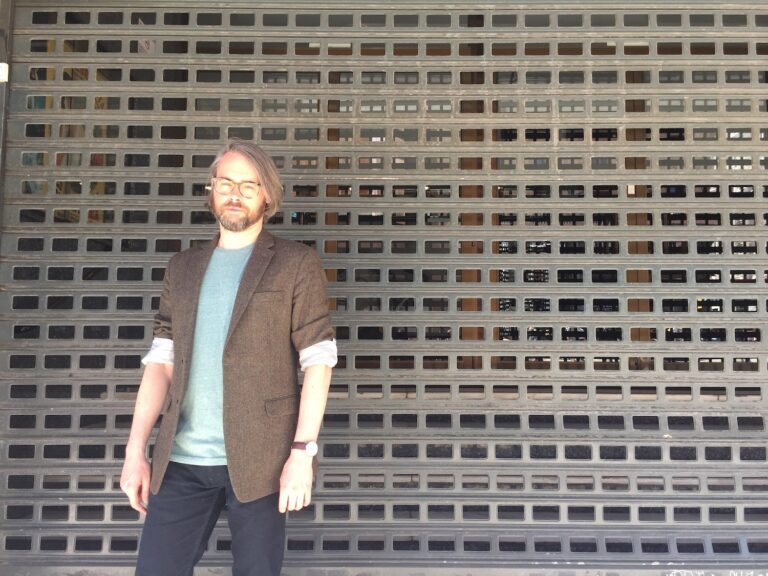
Aaron Tucker is an author and scholar, originating in Vernon B.C. but raised in Lavington B.C., on the lands of the Syilx Okanagan Nation. Currently, he is a guest on the Dish with One Spoon Territory, where he is a lecturer in the English department at Toronto Metropolitan University (TMU), teaching creative and academic writing.
Tucker’s dissertation “The Flexible Face: Unifying the Protocols of Facial Recognition Technologies” was defended March 2023 and studied the cinema of facial recognition technologies and their impacts on citizenship, mobility, and crisis, receiving the Governor General’s Gold Medal. Soldiers, Hunters, Not Cowboys is his second novel, published through Coach House Books in June, 2023. The novel, featuring an apocalyptic depiction of Toronto, explores unhealthy relationships, toxic masculinity, and the 1956 John Wayne movie The Searchers.
Alexander MacIsaac spoke with Aaron Tucker about his creative process, modern masculinity, the Western and disaster genres, and more.
AM: When it comes to writing, what are your main sources of inspiration? And do they differ between your scholarly and creative works?
AT: So when I started my PhD, I was very, very determined to keep my academic and creative writing separate. So, the inspirations are pretty different. And my academic writing was largely fueled by other academic writers. My creative writing, though, has always been fueled by poetry in particular. And then even when I’m writing prose, like this novel, what keeps me nourished is painting. I really like going to galleries, looking at paintings and taking the time in those different spaces to think and reflect. To me, that’s a core part of the writing process. And then when you couple that with reading the particular kind of novels that are experimental or pushing at things, that’s what I find most interesting.
AM: What does your writing process look like for you? What are the steps from idea to product?
AT: So, in a big way, I would say my process begins with a lot of thinking and reading before I even start writing. So, for example, I’m thinking about starting a new novel. So I’m in my iPhone making little notes as they come up. I’m structuring things. I’m thinking through things. I’m reading other books. In this case, this is kind of a science fiction book. So I’m just reading a lot of science fiction. And eventually, as I did with Soldiers, Hunters, Not Cowboys, I will transition into the actual writing for that novel. I watched a lot of movies as well, in particular Westerns, and I was kind of thinking about them as I wrote on a more granular scale. What a writing day looks like for me? Usually I try and read for like a half hour, an hour. Then, I’ll reread what I wrote the day before. I really like to write every day. That’s kind of when I’m at my best is when I’m writing consistently. So, I’ll spend about a half hour rereading what I wrote the previous day. And on a good day, I usually write for hour and a half, maybe 2 hours, and then I spend the last half an hour making notes for the next day and trying to set myself up so that when I sit down the next day, I’m not starting from nothing.
AM: Can you tell me a little bit about Soldiers, Hunters, Not Cowboys?
AT: So, the novel is split into two parts. The first part is entirely dialogue inspired by Manuel Puig’s Kiss of the Spider Woman. There are two main characters. They’re ex lovers, and they’re talking through the movie The Searchers which stars John Wayne, directed by John Ford. Very famous, well respected movie. And they sort of use it as a way to talk about their relationship, but then also kind of the contemporary moment of aggrieved masculinity. And as they’re talking in the evening, it sort of escalates. And it gets to a tipping point, and he ends up leaving. The second half of the book takes place two days later. There’s been some unnamed catastrophic event in downtown Toronto, and The Searchers, from the first half of the novel, kind of maps itself onto the second half of the book, while the man convinces himself he has to rescue the woman and make his way across the city in the midst of this. And we’re not quite sure if he’s hallucinating or if the violence is actually happening, and how much of the movie is leeching into his life and how much of it is he imagining.
AM: So, this novel was pitched to me as “Cat Person” meets Station Eleven, and that was what originally drew me to the novel. Was this comparison something you came up with or was this created by the publisher?
AT: It was a bit of both. So, typically when you sit down with a book, the publisher will give you a questionnaire to get a sense of what you think the novel is about and then what they think will get readers interest. I didn’t come up with the “Cat Person” comparison, but I’m happy that somebody did. It’s a short story that I’ve taught, actually, in TMU classes. It’s a story that I find really pointed in the way that it talks about a specific type of young man and how they treat women. And so I think I’m very flattered, actually, to even have those two things put side by side, because that’s sort of what in particular the first half of the book is striving for. And then the second half of the book is a little bit more Station Eleven. It’s not quite as big in scope. It doesn’t have all the characters that Station Eleven does, but it does have that sort of, like, pulsion and post apocalyptic feel. And they both have Toronto as well. Station Eleven isn’t set in Toronto, but a large part of it does take place in Toronto.
AM: What inspired the structure of the novel, in the sense that it has two very distinct sections? Was this something that erupted as you were writing, or was this something you knew from the beginning you wanted to explore?
AT: Oh, it definitely wasn’t something from the beginning. I actually wrote the second half of the book first. And at that point I was really interested this book called The Bronx is Burning and it’s also a documentary and it’s about late seventy s New York and this collision of a blackout and the serial killer Son of Sam. And I was thinking about the Spike Lee movie Son of Sam, and so I kind of thought the book was going to be this serial killer kind of thing. Again, taking up this idea like Taxi Driver of this form of masculinity. And then as, frankly, the Trump administration went on and we had Ford and all these different kind of political powers rising up and the changes in some of the discourse, I started to think more and more about it. Being kind of grounded in this specific guy that is more normal than not and having him be the main character rather than this kind of sensational serial killer. And so I was kind of thinking about that and reflecting about living in Toronto. And I didn’t quite finish. I ended up going to Banff to do a residency there, and that’s where I actually wrote the first half.
I had talked with my editor, Alana Wilcox, about the book and she suggested I go out there and I Manuel Puig’s Kiss of the Spider Woman was in my head when I went out there. If you don’t know the book, there’s two prisoners, they’re in a jail cell and one is describing the plot of movies to the other as a way of kind of passing the time. But they also eventually enter into this romantic relationship and then pairing that with The Searchers, this movie that I remain fascinated by, in part because the movie is tremendous and the achievement of it is really interesting. But then it has this double edge of John Wayne and his openly racist, white supremacist beliefs. And how do those two things kind of coexist in one document in particular in 2023? So I was writing through this and eventually again, the pandemic happened and I ended up writing probably the last ten pages of the book in the first two weeks of the pandemic. And so the airborne event in the pandemic of COVID basically took on this new meaning for me as I was doing a similar thing. I was walking around with my mask on, observing, taking photos, and then eventually wrote the last ten pages in this kind of intense burst.
AM: So, this novel focuses a great deal on John Wayne and his movie The Searchers. Do you think there is a place for these classic masculine figures in the modern cultural zeitgeist or do you think they have a damaging effect on masculinity?
AT: It depends on what critical tools you approach it with. The Searchers is a beautiful, incredible movie. Like, there are moments of it that are absolutely stunning, just in terms of raw achievement. And the fact of the matter is John Wayne’s by far the best actor in it. He’s the most compelling figure in what is an excellent movie. I keep referring to it in other documents, but the Sight and Sound Poll came out last year, which is a mix of film critics and filmmakers, and they rated it the 15th best movie of all time. It’s still this incredibly respected film. So I think it necessarily has to live in the contemporary. But like anything, including things from the contemporary moment, I do think we need to approach things critically, ask about their production, ask about their circulation. How does something like this, in particular films that are participating in creating visual cultures and visual languages, how do those things resonate and echo? To me that’s the conversation the book is having, tracing these circulations and networks. Rather than saying let’s never show this again, instead, let’s show how it works, let’s show how it resonates and we can be critical of it, or in other things, we might revisit something and be like, oh, actually, this circulates in a really interesting way. I think if you’re approaching it uncritically, yes, John Wayne is a deeply damaging figure. There’s a part in Soldiers, Hunters, Not Cowboys, that references this Breitbart review of the film. Breitbart is this far right website and they name The Searchers the number one film of all time, and they reframe John Wayne as this martyr figure. And so part of what the book is interested in is how do we get from John Wayne, who Scorsese calls his Ethan Edwards character poet of hatred, to martyr and builder of America? And that trajectory is sort of like what I think the book is interested in and grappling with it rather than dismissing it.
AM: Within the novel, the narrator is unable to comprehend ideas around toxic masculinity. Do you think he is representing a certain form of masculinity in the current moment, in the sense that he is unable to recognize within himself his own toxicity?
AT: Absolutely. And in many ways, this book is autobiographical. I do involve memories and instances from my own childhood growing up in British Columbia. But part of this book has also been thinking about my own masculinity and how I approach women and my relationships with women. And not to say I solved them, but at least it was a way of looking at my own behavior. And I think that’s sort of what the main character of the book is unable to do. There isn’t quite this reflexivity or self interrogation that I think is something that I really value and I have tried to work on in myself. But, I mean, parts of this book are me not necessarily confessing, but getting pretty close to it and then grappling with what that looks like. And then again, using these different cultural filters as a way of framing a narrative rather than it being a memoir. We can fictionalize parts of it and we can use autobiographical parts of it, and then we can have this film to bounce off of. But yes, I thought about the men I grew up around. I thought about the man that I’ve been.
AM: What brought you to combine the tropes of Western and disaster narratives?
AT: This myth of the frontier, which is central not just to America, but to Canada as well, this Western expansion, manifest destiny, has always been something that was ingrained in me when I was growing up in British Columbia. So I’ve always been interested in those narratives. And as I get older and I read more and I learn more, almost always, the expansion of the frontier is catastrophic for any number of populations. Including settlers to some extent, but mostly indigenous peoples. If we’re talking about Texas, we’re also talking about Mexican, Spanish, the various indigenous nations that are in Texas. If we’re talking about BC, inevitably, we’re talking about residential schools, and cultural genocide. And so for me, the Western is tethered almost directly as a genre to forms of catastrophe.
AM: Do you have any new writing projects in the works you can talk about?
AT: I’m working on a kind of nonfiction project that’s memoir crossed with some of my graduate work, actually looking at artificial intelligence, and in particular, this moment of generative AI, things like ChatGPT. And again, going back to this idea of the frontier, like, how does my idea of the frontier and what I was taught as a child overlap or correspond to what people are pitching as the frontier of AI? Right now we’re on this edge of some brave new world of generative AI, and I’m interested where those two things overlap.
AM: What advice do you have for any aspiring writers out there?
AT: In terms of just writing? I would say very little of writing is writing. Most of it is reading, most of it is editing. Very little of it is sitting down and actually physically writing. Investing in your editing tools will be far more useful in the long run than focusing on writing.